


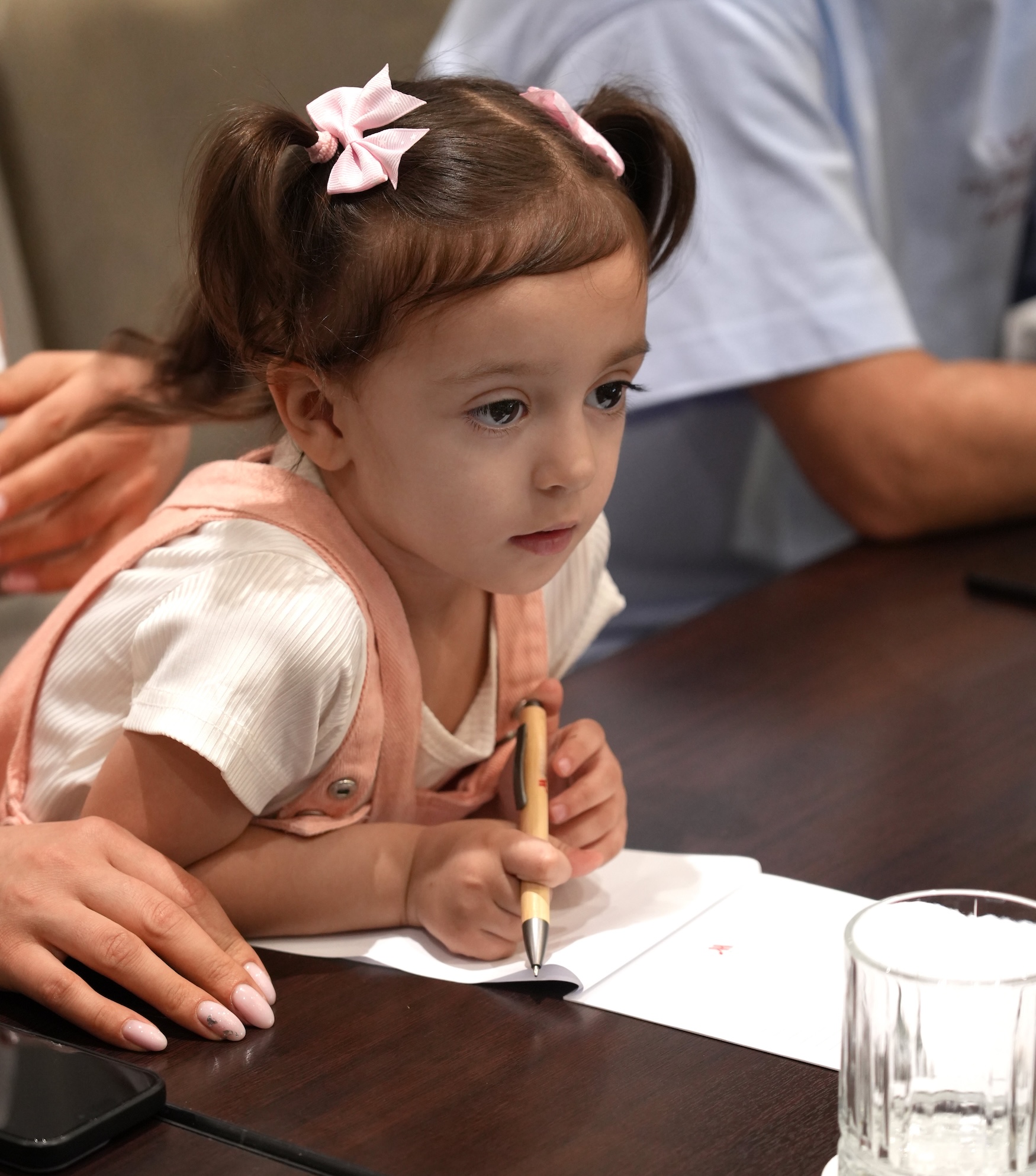
I am rushing through the winding corridors of my hotel in downtown Yerevan, the capital of Armenia, when I spot a toddler hopping past holding her mother’s hand. Her youthful energy makes me smile, even before I realize we are searching for the same room — and that I am about to hear her story.
I later learn that this little girl’s name is Sophie and that her life is a miracle, in more ways than one. That’s because she was born the day that her homeland, Nagorno-Karabakh (also called Artsakh by Armenians), came under attack in 2023. As the sound of shells and drones surrounded the local maternity hospital, doctors raced to perform cesarean sections on pregnant women like Sophie’s mother. They didn’t have time for a normal delivery.
“At 4:25 sharp, my daughter was born and, with her cry, all the (outside) noises became useless,” Sophie’s mother, Vehanush Hovsepyan, says through a translator. “I realized I became a mother … what mattered (is that) I had a healthy baby that was there.”
Vehanush is speaking to a group of us visiting Armenia in mid-September with the nonprofit advocacy group Save Armenia. As part of our trip, we are hearing the stories of Christian refugees forced to flee the mountainous region of Nagorno-Karabakh in 2023.
We have already learned about Nagorno-Karabakh, and how an estimated 120,000 ethnic Armenians were displaced from the region, now under the control of Azerbaijan. They left after enduring a nine-month blockade that led to starvation and a lack of basic necessities and medical supplies. They left after Azerbaijan launched a military offensive on Sept. 19, 2023, Sophie’s birthday.
Sophie’s mother, Vehanush, and one of the doctors at the maternity hospital where Sophie was born, Dr. Eduard Kagramanyan, tell us about that day.
Vehanush, a journalist born and raised in Nagorno-Karabakh, says that the nine months of her pregnancy with Sophie coincided with the nine months of the blockade. She holds Sophie in her lap while telling us that she and other expectant women walked to their medical appointments, because they had no gasoline. They could prepare for their babies’ births only so much, because the shops were empty. Vehanush also worried that, when the time came to give birth, doctors would no longer have adequate medical supplies.
The morning of Sophie’s birthday, Vehanush went to the maternity hospital to give birth. The day seemed like a normal one until, all of a sudden, chaos erupted from the corridor. Everyone began talking all at once. Fifteen minutes later, Vehanush heard the shelling begin. Those at the hospital were personally impacted: Doctors and staff worried for their husbands on the front lines and their children in school.
“Despite that, all of them stayed there and started consoling (the pregnant women), saying that, ‘Don’t worry, we’ll take you downstairs to the cellar, and that’s where you will be giving birth,'” Vehanush says.
Doctors like Dr. Eduard helped women into the basement and even carried some of them on stretchers. But that’s not where Vehanush ended up giving birth.
As Vehanush speaks, Sophie, with her dark eyes full of wonder and hair dotted with two pink bows, begins to grow restless. Dr. Eduard is sitting next to her and smiles. He draws little pictures to cheer her up as her mother speaks. My group sees firsthand that his care for her didn’t end on her birthday.
Vehanush tells us she still thanks God every day for doctors like Dr. Eduard. She returns to her story. Before giving birth to Sophie, she had to go back upstairs where doctors could perform a cesarean section. They had learned that the hospital could become a target, and the doctors wanted to deliver Sophie as quickly as possible. The surgery took 20 minutes.
Sophie is here because others risked their lives for her.
Dr. Eduard, a gynecologist, describes Sept. 19 as a 24-hour nonstop attack. He had already survived previous wars and knew of their destruction. Still, during the 2023 attack, doctors prepared to stay at the maternity hospital even if it meant being killed.
“All of our staff, the top doctors in the administration, decided that we’re not going to move out,” Dr. Eduard says through a translator. “That we’re going to stay and receive patients and complete our duties, even if we have to face the Azerbaijanis in front of our maternity hospital … we’re doctors, we’re there to save life.”
Since my trip to Armenia, I’ve thought of Dr. Eduard’s selflessness, Vehanush’s bravery, and Sophie’s vibrant energy. I’ve thought of their gratitude and faith through it all. I’ve thought of the value they place on human life, including the lives of babies like Sophie.
And, when I look at their stories in the context of Armenia, the first nation to adopt Christianity as its official religion, their courage strikes me with a familiar beauty. Their lives embody a Christlike love that we’re each called to live out in our own, unique way. Many of us will never have to worry about our lives because of war or face starvation. But each of us can do something to sacrifice for the sake of new life, joy and hope.
Katie Yoder writes for OSV News from Maryland.
