


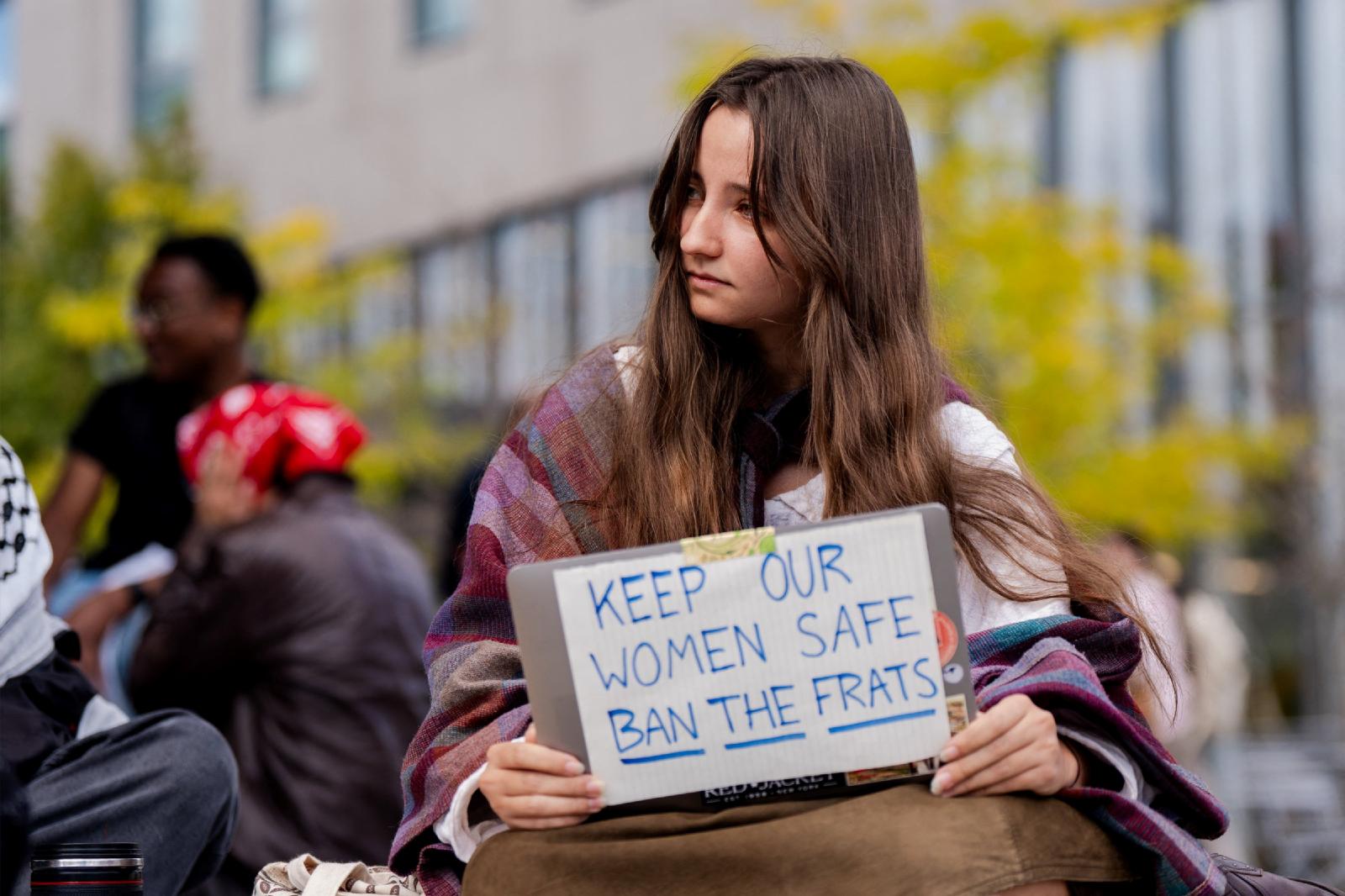
(OSV News) — As Cornell University grapples with a high-profile sexual assault case, Catholic leaders on campus said they are responding with “prayer, pastoral care, and renewed commitment to the formation of Catholic students,” along with an 11-page pastoral letter to guide the faithful on campus.
That response comes as the university has come under scrutiny following a Sept. 16 civil lawsuit filed by a former undergraduate student alleging she was gang raped at a campus fraternity house in 2024.
Since the filing, concerns over previous handling of the case by university and local officials have led to campus protests, along with the appointment of New York State Attorney General Letitia James to investigate the matter as a special prosecutor.
“We are mindful that these issues are not solely matters of public debate. For some students, the recent news has brought back painful memories, including their own experiences of sexual violence, accusations, and sins,” said Deacon Matthew J. Hall, associate director of the Cornell Catholic Community, in an Oct. 7 press release.
Deacon Hall, who serves campus Catholics along with chaplains Father Daniel T. McMullin and Father David Cataline, added, “We are accompanying these students steadfastly.”
The “Jane Doe” plaintiff of the civil lawsuit names seven men as defendants, alleging they took advantage of her intoxicated state to further inebriate her with alcohol, ketamine and marijuana while sexually assaulting and raping her for several hours.
In addition, the suit — which demands a jury trial — accuses Cornell University, Chi Phi Fraternity, the Delta Delta Delta Sorority and a local bar with “negligent, willful, or intentional failure” to protect the young woman from the alleged attack.
‘Salt, leaven and light’
Amid campus outcry, and with members of the faculty senate set to consider a no-confidence resolution against the university administration, the Cornell Catholic Community is encouraging its members to serve as witnesses to their faith.
“We do not want our Catholic students to retreat from difficult conversations,” said Deacon Hall. “We want our students to have the intellectual and spiritual resources to enter those conversations charitably and courageously. We need to be able to affirm what is true, recognize human dignity, and help one another pursue what is genuinely good.”
Included with his Oct. 7 press release was “Salt, Leaven, and Light: Our Christian Responsibility in the Public Square,” an 11-page pastoral letter offering what the deacon described in an accompanying note as “some reflections on what we believe, how Catholic moral theology helps us think well, and what our baptismal vocation requires of us as members of Cornell University.”
The pastoral letter acknowledged that “we are living through a moment in which questions about sex, marriage, consent, and human dignity are being debated publicly and passionately,” but stressed that “Catholics have something important to contribute to these conversations.”
The letter, written by Deacon Hall, surveyed Catholic teaching on marriage and human sexuality, noting that both are ordered to reflect the surpassing love of God.
Such “sublime truths,” in turn, provide “a very practical framework for thinking about sexual ethics,” he said.
“Sexual acts are not morally significant merely because two (or more) people do or do not consent to them,” wrote Deacon Hall. “Consent matters enormously: violating someone’s freedom or autonomy is a grave offense. But consent answers only one question. It does not tell us what the act itself is or whether the thing chosen (or forced) is worthy of human beings in the first place.”
Freedom, authority, autonomy
The letter also explored the Catholic understanding of freedom, authority and autonomy, all of which are divinely intended to uphold human dignity, he said.
“Human freedom is ultimately freedom for something: for truth, for goodness, for wholeness, for human flourishing, and ultimately for the Love by whom and for whom we were created,” wrote Deacon Hall, pointing to Colossians 1:16.
The legitimate exercise of authority helps “preserve the conditions in which human beings and communities can flourish,” he said.
He explained that true autonomy — distinct from licentiousness, lawlessness and even anarchy — allows a person to do “what justice and charity requires, even in the absence of a positive law, because the moral law — what is intrinsically good and true — has been so deeply internalized that he or she freely does what a just law would have required.”
He added, “In this light, we can see how profoundly ‘autonomy,’ especially ‘bodily autonomy,’ is fundamentally misunderstood in many contemporary conversations.”
Yet Catholics are, by their baptismal calling, sent to engage through faith with those very conversations, which often already include “fragments of good moral intuition” to which “Catholic theology can give a clearer articulation,” he said.
“The Lord Jesus tells us that we are salt of the earth, leaven in the dough, and light for the world,” he said, referencing Jesus Christ’s words to his followers from Matthew 5:13-16 and 13:33.
As Catholics, he said, “we are called to help our neighbors see more clearly what they may already see in shadow: that human beings are endowed with an infinite dignity; that sex is sacred; that our choices have real moral meaning; that some things are objectively good and some objectively evil; and that freedom is not simply the power to choose whatever we want, but the capacity to choose what is truly good.”
9 concrete suggestions
Deacon Hall offered “nine concrete suggestions” for “seasoning, leavening, enlightening Cornell.”
Those include praying before speaking; studying the Catholic faith and its moral theology, with special attention to its vocabulary; affirming what is true in another’s thought, even when disagreements remain; avoiding relativism and shunning fundamentalism.
In addition, he said, “be a friend who tells the truth” and “use your influence to make something better.”
Deacon Hall also urged Catholics at Cornell to “make room for the good to grow” by doing things that build community — sharing meals, inviting others to Mass, engaging in conversation.
And, he said, “Enter the public square.”
“When an issue involving human dignity, sexuality, freedom, justice, or the common good arises on campus, do not hold back or hope that someone else will speak,” he said. “Your task is to bear witness to what is True and Good. Your words may bear good fruits in ways you will never learn about.”
Gina Christian is a multimedia reporter for OSV News. Follow her on X @GinaJesseReina.
