


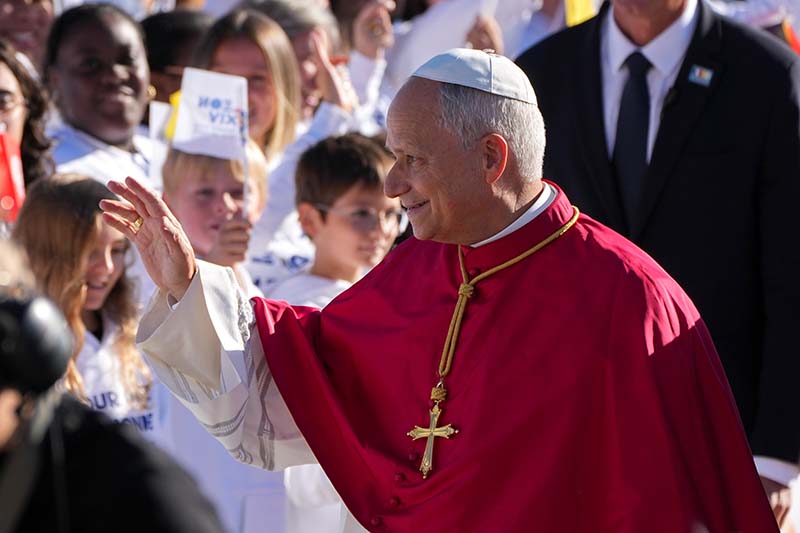
PARIS (OSV News) — Pope Leo XIV arrived in Paris Sept. 25 beginning his four-day trip to France by urging French leaders not to forget their duty to protect every human life in a forceful speech at the Élysée Palace condemning “assisted dying,” abortion and surrogacy.
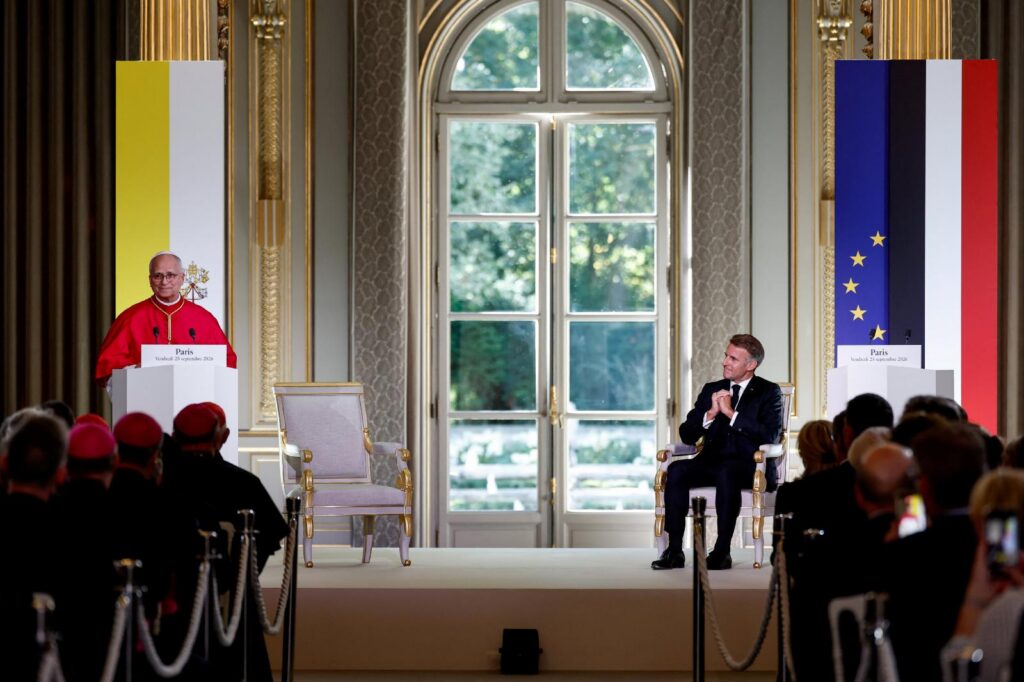
In a speech at the official residence of President Emmanuel Macron, the pope told France’s civil authorities that “the protection of the right to life constitutes the indispensable foundation of every other human right.”
He expressed concern about “trends in society that risk turning science and technology into profit-driven ventures promoting genetic manipulation, surrogacy, the trade in human organs or the possibility of arranging one’s own death.”
Calling the lawmakers to a conversion and minds and hearts, the pope underlined the need to “to welcome life unconditionally, to support frailty with loving care, to accompany every stage of life with respect and mutual trust, and to defend with courage and compassion those unable to make their voices heard and those who feel ignored or overlooked.”
“Let us not forget that mutual respect and the protection of every human life is a duty incumbent upon each and every one of us,” Pope Leo said, recalling that the “Universal Declaration of Human Rights” was first proclaimed in Paris.
First public address of papal trip to France
The speech at the 18th-century palace was the pope’s first public address of his Sept. 25 to 28 apostolic journey to France, an official state visit that will bring him from the French capital to the Marian shrine of Lourdes in the south and the northeastern city of Metz near the German border.
The motto for the papal visit is “That the world may have life” (John 6:51), a theme that resonates with the faithful in the country after a vote by French lawmakers in July to legalize “assisted dying,” including euthanasia and assisted suicide in certain cases, a move that French bishops called a “radical choice.” The French Parliament also made abortion a constitutional right in 2024.
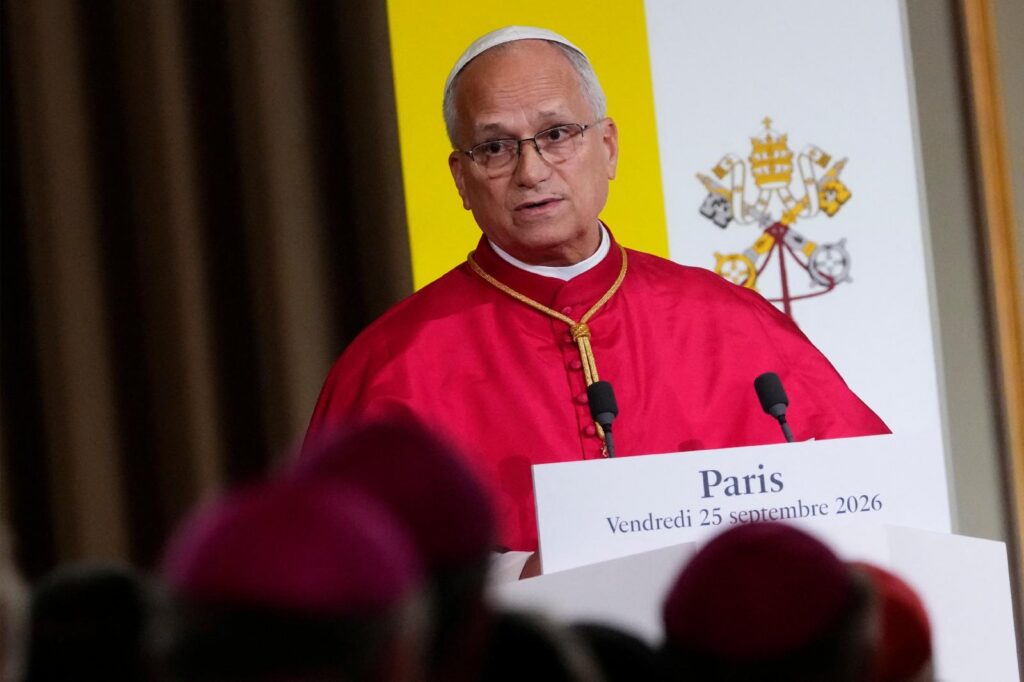
“Nowadays there is a temptation to expect science to eliminate or alleviate every form of suffering. This often brings the risk of self-delusion,” Pope Leo said.
“For when science and technology are not guided by a deeper wisdom, they can offer immediate solutions that apparently address people’s wishes and their pain, but can seriously divert them from the greater good to which they aspire.”
The pope pointed to the witness of the charitable works of St. Vincent de Paul in 17th-century Paris and the many Catholic institutions that continue that legacy today.
‘Constant concern for welfare of the poor, underprivileged’
“Through the remarkable efforts of men and women who remained faithful to their humanity and to the values of the Gospel, the Catholic Church in France has demonstrated constant concern for the welfare of the poor and underprivileged, and has sought to be the living face of God’s own mercy and compassion,” he said.
“In our own day, those many Catholic institutions where caregivers accompany our brothers and sisters in their sufferings,” he added. “These examples of care and concern serve as a true lesson in humanity; they show the grandeur of compassion and are a powerful reminder of the unique and irreplaceable worth of every human being.”
Pope Leo highlighted the centrality of the Catholic faith in French culture for many centuries as “a land with deep Christian roots” from the second-century St. Irenaeus of Lyon and the baptism of Clovis, the King of the Franks, in 496, whose conversion led France to be known as the “Eldest Daughter of the Church.”
While France is a traditionally Catholic country, today the government maintains a strict form of secularism in public life called “laïcité” that separates church and state.
‘A genuine thirst in the heart of modern man’ for God
Statistics vary in the last years, but on average more than half of the French population today identifies as “nonreligious.” In light of this secularization, Bishop Pierre-Antoine Bozo, spokesman for the French bishops’ conference, has said that “there is a genuine thirst in the heart of modern man” in France, pointing to the record number of French adults and teenagers choosing to be baptized this year as evidence that “spiritual curiosity is awakening in the country.”
Pope Leo said that France is a country that is frequently in his prayers, recalling his personal family origins in Normandy and Béarn.
The papal plane, a chartered ITA airways jet, touched down in the Paris Orly Airport minutes before 10 a.m. During the roughly two-hour flight from Rome, Pope Leo spoke with journalists about how the trip to France “has a number of very important topics.”
Asked by OSV News about the Sept. 24 beatification of Archbishop Fulton Sheen, the pope said he was “very happy to have been able to approve that,” and that at his family home “we watched him as a family … spending some time together … with the truths, with the teachings that he shared in such an enthusiastic, lively way.”
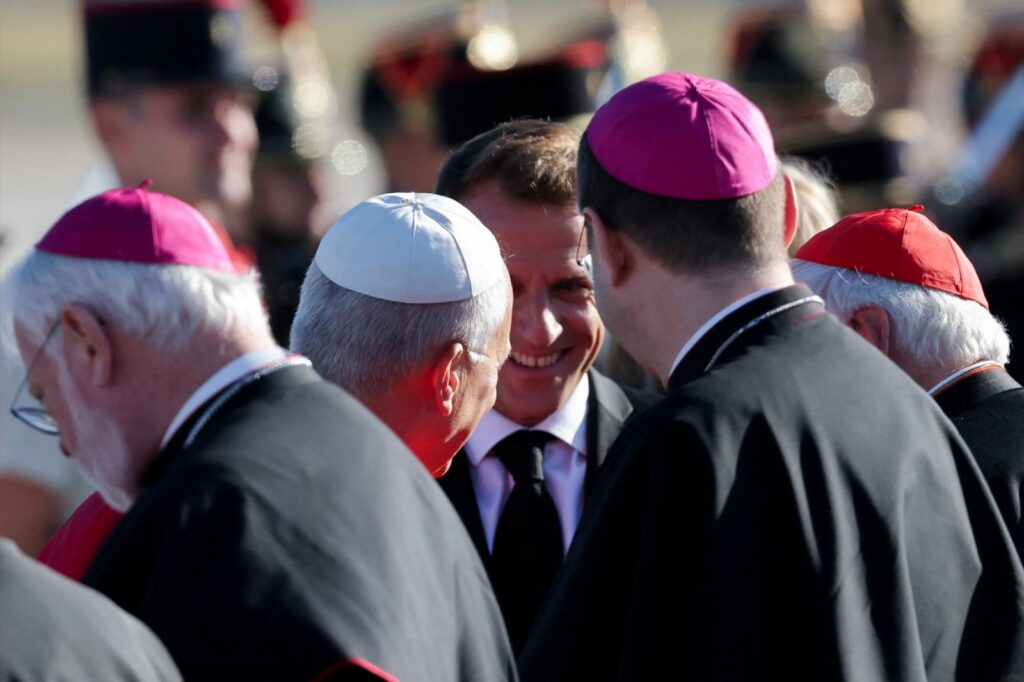
President Macron personally welcomed Pope Leo to France at the foot of the stairs at the airport runway at the start of the pope’s whirlwind first day in the French capital. The pope’s first stop was the Élysée Palace, where he met privately with the French president before addressing French civil authorities and diplomatic corps.
Early afternoon visit to UNESCO headquarters
In the early afternoon, Pope Leo will visit the UNESCO headquarters, near the Eiffel Tower, to speak about the protection of young people in the age of new technologies and artificial intelligence.
The pope will then travel through downtown Paris in the popemobile to Place Saint-Michel, across from the Île de la Cité, where Notre Dame Cathedral is located.
“The bells of all the churches will ring to welcome him,” Archbishop Laurent Ulrich of Paris said ahead of the trip.
At Notre Dame, the pope will celebrate vespers with 2,000 bishops, priests, religious, seminarians and consecrated persons. It will be the first papal visit since the devastating fire in April 2019 and the years-long restoration that followed before the reopening of the 800-year-old cathedral in December 2024.
In the evening, the pope will travel to the iconic venue for the 2024 Paris Olympic Games — Stade de France in Saint-Denis — where he will take part in a prayer vigil bringing together an expected 80,000 young people.
Close to 600,000 people expected at open-air Mass Sept. 26
On Sept. 26, Pope Leo will celebrate an open-air Mass in Paris for which nearly 600,000 people have registered at the Place de la Concorde and the Avenue des Champs-Élysées. In another witness to the dignity of every human life, the papal Mass will have altar servers with Down syndrome in a country with a 68% abortion rate in cases of a prenatal diagnoses of Down syndrome.
The pope will also visit a Catholic social center Maison Bakhita, dedicated to the assistance of refugees in the city’s Montmartre neighborhood, and meet with catechumens and neophytes at the archdiocese’s major university as part of the Synodal Assembly of Île-de-France, which is taking place in the archdiocese to better welcome the influx of young people and adults who ask for baptism.
The pope will then fly to the south of France on the evening of Sept. 26 for the second leg of his trip to spend time with pilgrims, the sick, and abuse victims at one of the most visited Catholic sites in the world, the Marian shrine of Lourdes, known for its healing waters where the Virgin Mary appeared to St. Bernadette in 1858.
Pope Leo’s apostolic journey to France will end on Sept. 28 in the city of Metz, close to the German border, part of a region that was annexed by the German Empire between 1871 and 1918 and caught up in the conflicts between France and Germany during the two World Wars. The city is closely associated with Venerable Robert Schuman, a statesman known for his Franco-German reconciliation efforts after World War II who is considered one of the founding fathers of European integration.
“In the face of rumors of war and the varied crises troubling our world, France is called to remain a tireless champion of peace and multilateralism, particularly within our beloved Europe,” Pope Leo said in the Élysée Palace.
“May your liberty grow in constant concern for the common good. May your fraternity embrace the entire human family. And may the equality to which you aspire always be built upon the foundations of justice and charity — not by erasing the differences between people, but by allowing them to flourish harmoniously for the benefit of society as a whole.”
Courtney Mares is Vatican editor for OSV News. Follow her on X @catholicourtney.
