


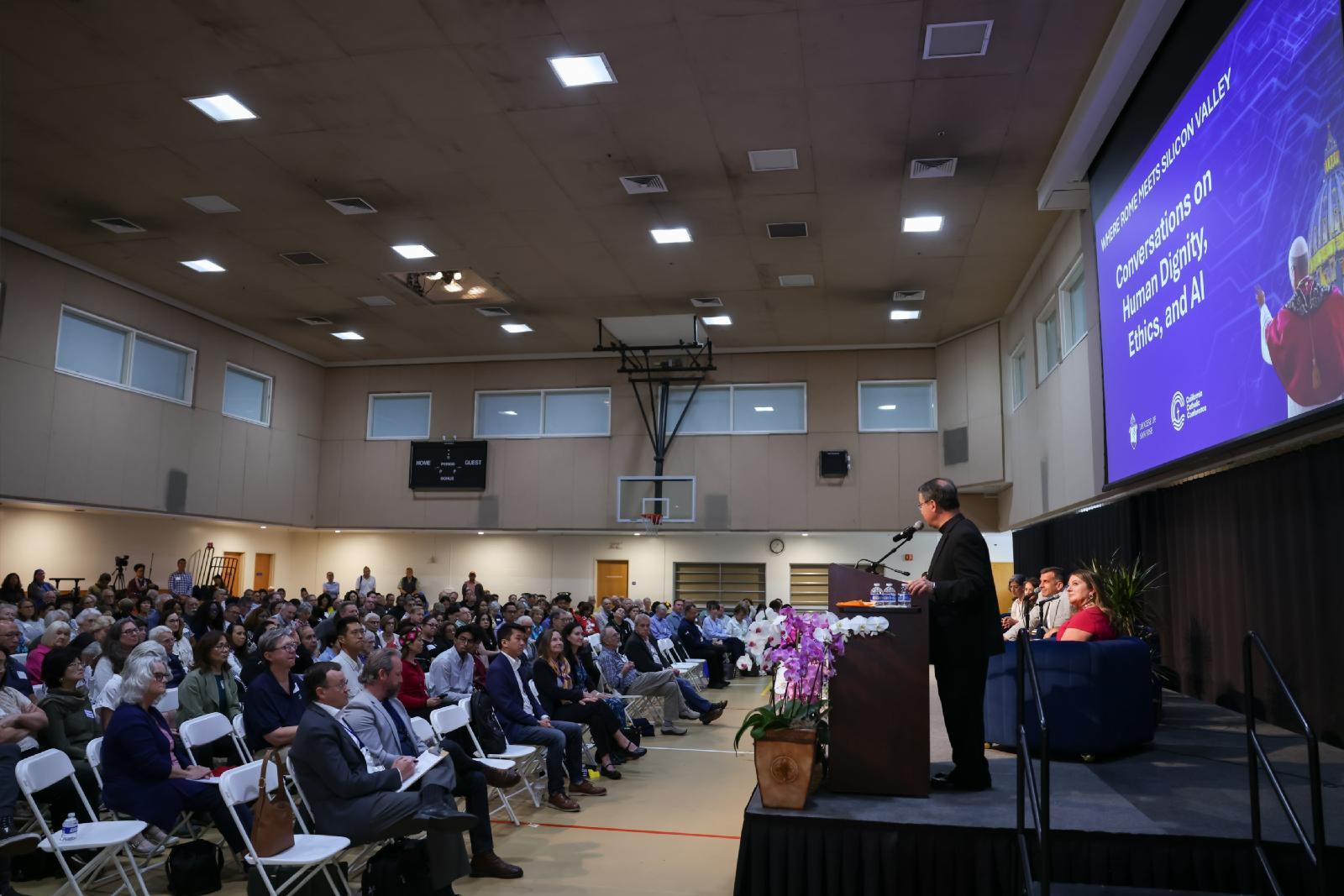
What does the bishop of Silicon Valley have to say about Pope Leo XIV’s encyclical “Magnifica Humanitas” on artificial intelligence? Bishop Oscar Cantú of San Jose, California, recently spoke with OSV News’ Charles Camosy about the insights the encyclical offers to his flock.
Charles Camosy: I imagine you were waiting for the Holy Father’s new encyclical with a particular level of anticipation! Any sort of broad reactions now that it has been released and you’ve had some time to sit with it?
Bishop Oscar Cantú: As the pastor of a local church, I had been interested in the AI debate from a distance, though I was not able to invest much time or energy in learning what the issues are with AI. “Magnifica Humanitas” gave me, and indeed all of us, the impetus to dive deeply into the issue, especially since the Holy Father had presented the issues not only from a Christian perspective, but indeed from a broadly human perspective.
I was aware that dialogues were taking place between technologists and the Church. I had not really had the opportunity to participate in those dialogues until now. I did feel, however, a pastoral responsibility to convene people — particularly in the wake of “Magnifica Humanitas” — as the Church in Silicon Valley. I knew others would be looking to us to take the lead.
When I was in Rome last fall, I asked a trusted friend who’s been involved in the AI dialogues what the posture of the Church in Silicon Valley ought to be. He responded that the Church has the power to convene. We are experts in humanity, and thus we bring a most important perspective: that of the good of humanity, the true meaning of humanity. We can learn from the technologists about the machines they are creating. But it is important that we frame the conversation in human dignity — the dignity of every human person!
St. John Paul taught us many years ago that faith and reason are like two wings on which we rise to contemplate the truth. My hope is that we keep both wings working together and that human dignity remains at the very center of all innovation.
Camosy: Your diocese and the California Conference of Catholic Bishops recently co-hosted an event focused on the encyclical. What sort of takeaways do you have from that day?
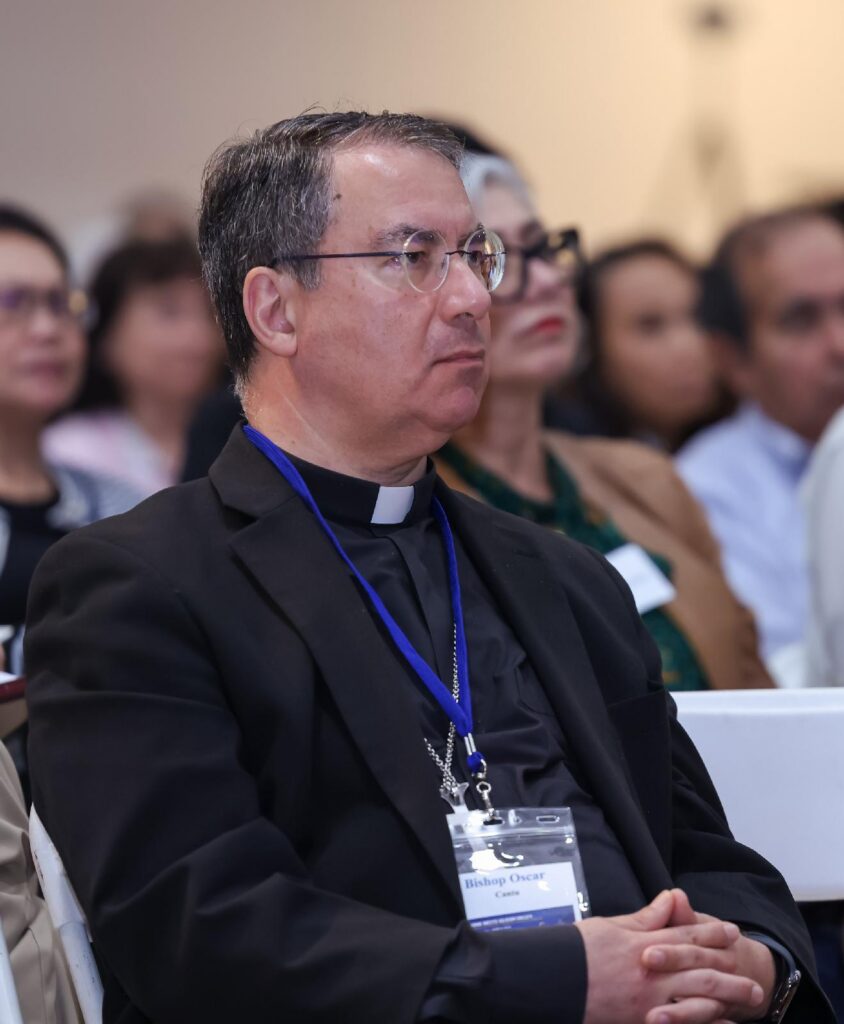
Bishop Cantú: While I have now been in San Jose for some eight years, I really don’t have strong connections to the tech world. I’ve been busy building up the local ecclesial community in various facets. So, I needed to rely on others with deep connections to key persons in the tech/AI world. I was delighted to meet them and begin some working relationships with them. My contribution has been that of a pastor with a theological background. I have no background in tech, certainly not in AI. So, I’ve been fascinated by listening to them, learning from their experiences, their excitement, their concerns.
Also invited to the conference were several medical professionals. They were very optimistic about the prospects of AI in helping to diagnose patients and providing breakthroughs in their field. That, to me, is a glimpse of the good the encyclical holds out — technology placed at the service of the suffering, and of the healing work medical professionals offer suffering humanity.
Some of the practical elements of putting the conference together were fun, exciting and, of course, stressful. We put it together essentially in about two-and-a-half weeks. There were five of us on the committee, meeting nearly every other day. There was a strong bond formed among us in working together so closely and intently. Getting 350 people in attendance at the public segment of the conference truly spoke to the power of the moment, the pressure built up anticipation of the encyclical and the desire to hear the Vatican’s contribution to the AI debate.
We had in attendance curious tech people, sitting in the crowd, listening and observing; Church personnel completely new to the AI debate, seeking to learn what the issues are; those in the medical field, wanting to understand some of the downsides to AI and its rapid development; and AI developers grateful for the voice of the Church urging caution in the development and usage of AI, noting many of its possible unintended consequences.
The private dialogues among the various field professionals after the public portion was equally rich. As we agreed to Chatham House Rules, there was a relaxed honesty with each other in an environment of trust, listening and thinking together. They were truly inspiring moments. Additionally, after a very long day of thinking together, we were able to relax and break bread, connecting with each other on a more personal — and indeed, human — level.
Camosy: Perhaps based in part on your experience with that event, what advice can you offer other Catholic groups who want to invite others into dialogue about the encyclical?
Bishop Cantú: I subsequently spoke with a few fellow bishops at our biannual USCCB assembly about our conference and gave them a few tips. Many of them were interested in hosting a similar event. I advised them to find one or two persons with networks in the tech/AI field and someone with a network in the theological field. You convene them and give them a platform to speak to each other, dialogue and maybe have others listen in.
That was part of the grace of the moment — the dialogue and learning from the interactions. The Church’s particular gift here is not that we have all the answers, but that we can bring people to the same table, help them ask the right questions together and hold human dignity at the center.
Camosy: Many Catholics may be interested in “Magnifica Humanitas” but at the same time feel intimidated by a long document. Any advice for them in terms of breaking into it?
Bishop Cantú: I would say it’s like eating an elephant: one bite at a time. Yes, it is a long, somewhat intimidating document. For some, it might make sense to form a discussion group and take one section at a time, perhaps on a weekly basis. If one is not familiar with the history of Catholic social teaching, that section is certainly important. For others, it may be easier to start with the questions Pope Leo himself poses early on — “Where are we going? Toward what goal do we wish to orient ourselves?” — and with the choice he sets before us between building Babel and rebuilding Jerusalem. Those pages frame everything else. But most important are the cautions Pope Leo issues regarding the many unintended consequences of AI, especially when developed quickly and without guardrails.
I particularly appreciated Pope Leo’s encouragement to take the perspective of the lowly and how technology such as AI affects them — the poor, the marginalized, those without much voice or agency. As I said at our own conference, we are called to view history through the eyes of the little ones — the widow, the orphan, the stranger, the wounded child. This moment is no different.
Finally, I take from the encyclical Pope Leo’s encouragement to dialogue with each other across various fields and that each of us exercise our agency — that we raise our voices, and as one panelist urged us, to vote with our clicks, on behalf of human dignity. In the end, as the Holy Father writes, we are all called to be weavers of hope in the tapestry of humanity.
Charles Camosy teaches moral theology and bioethics at The Catholic University of America in Washington.
