


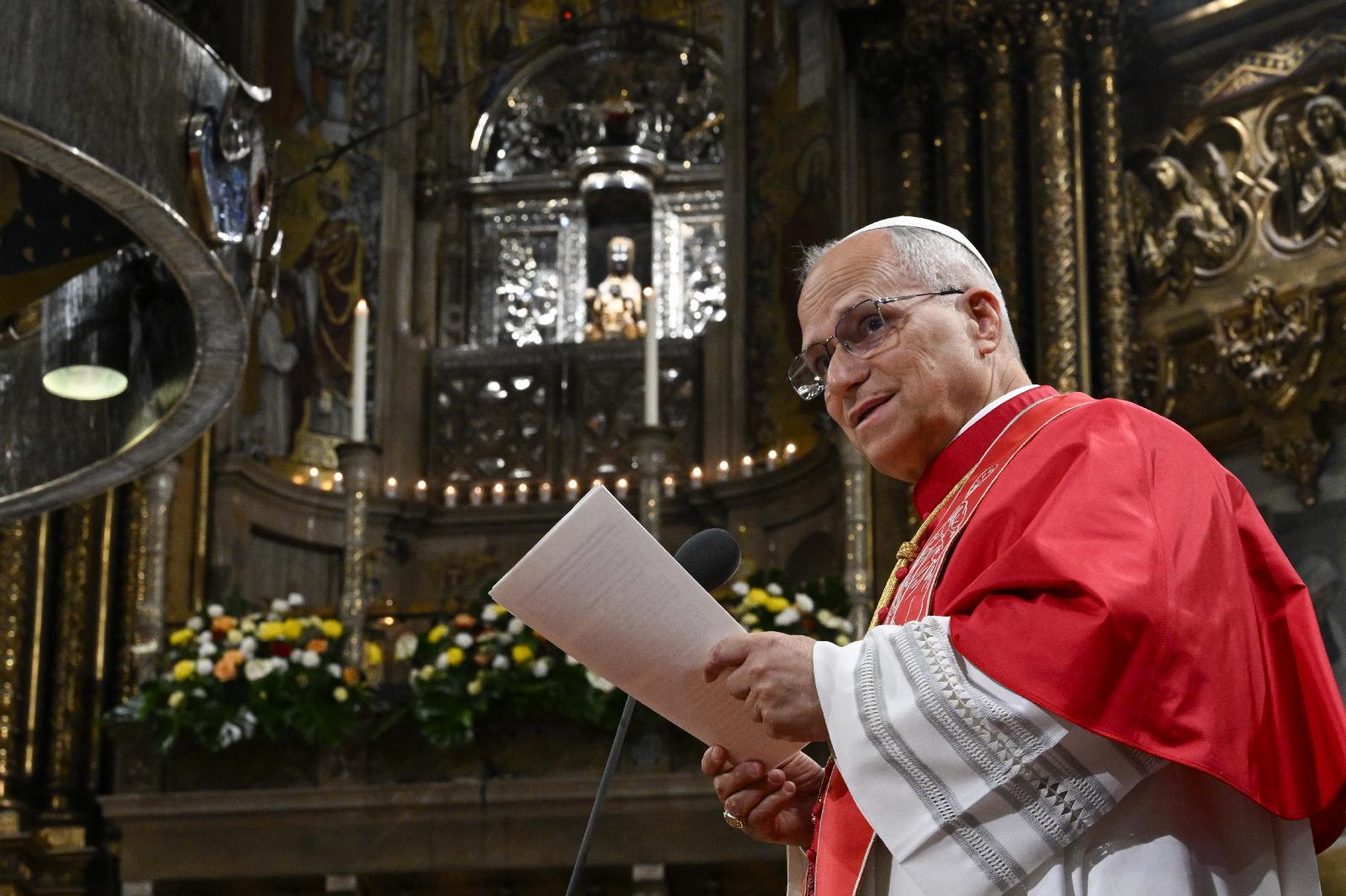
When Pope Leo XIV arrived in Spain on June 6, many expected a successful papal trip. Few expected what unfolded over the following week.
The images were difficult to ignore: packed streets in Madrid, Barcelona and the Canary Islands; at least 600,000 young people gathered for an evening vigil in Plaza de Lima; an estimated 1.5 million faithful filling the Plaza de Cibeles for Mass and the Corpus Christi procession; and a seven-minute standing ovation in Spain’s Congress — the first time a pope had ever addressed a joint session of the Spanish Parliament.
The numbers alone do not explain the significance. Papal trips have always drawn crowds in Catholic countries. What made Spain different was that the enthusiasm surrounding Pope Leo seemed to reveal something about both the pope and the moment. If his earlier visit to Africa introduced Catholics to a missionary pope, Spain demonstrated something more: that people are increasingly listening to Pope Leo not simply because he occupies the Chair of Peter, but because they find his voice compelling.
The trip was intended as a conversation with Spain. It quickly became a conversation with Europe.
The dignity of every person
Throughout the six-day journey, Pope Leo returned repeatedly to a single theme: the God-given dignity of every human person. Whether speaking about unborn children, the elderly, migrants, trafficking victims, believers facing restrictions on religious freedom or individuals carrying personal wounds, he presented human dignity not as a political slogan but as a truth rooted in humanity’s creation by God.
Speaking before lawmakers — in what many considered the defining speech of the visit — Pope Leo drew on Spain’s own intellectual tradition, recalling how Cervantes proclaimed that freedom is “one of the most precious gifts that heaven has bestowed upon men” and invoking the School of Salamanca’s five-centuries-old insistence on the irreducible worth of every human being.
He then made the contemporary argument: “Every truly just society is built upon the recognition of the inviolable dignity of the human person. Such dignity precedes any concession by the State and cannot be subordinated to shifting social consensus or the whims of the majority at any given moment. It belongs to every human being by the very fact of their existence.”
From that principle flowed his reflections on some of the most contested issues facing contemporary Europe.
Life and its defense
Addressing bioethics, Pope Leo offered one of the strongest defenses of the unborn, the elderly and the sick of his pontificate to date. “If life ceases to be recognized as a fundamental value, what future can our societies have?” he asked parliament. “Can a community that casts into the shadows the unborn child, the elderly, the sick, those who suffer in silence, or those who depend entirely on the care of others be called fully just?” He insisted that “every human life must be recognized and safeguarded from conception to its natural end” — not as a partisan position but as “a goal of civilization.”
At the gates of Europe
The same framework shaped his increasingly urgent appeals on behalf of migrants as the journey moved south and west, from the halls of parliament to the docks of the Canary Islands.
At the Port of Arguineguín in Gran Canaria — one of Europe’s principal migration gateways — Pope Leo did not reach for diplomatic language. He named what he saw.
“Even today, monsters lurk in these seas: mafias that profit from despair, traffickers who enslave women and children, and those whose indifference allows the poor to be swallowed up by exploitation or forgetfulness.”
Addressing a trafficking survivor named Blessing, who had shared her testimony in absentia for safety reasons, he said: “If others have put a price on your body, know that God has never ceased to recognize your inestimable worth … Your life belongs to God, who has given you a dignity that cannot be taken from you.”
Then, turning to Europe, the pontiff said: “Europe cannot claim to uphold human dignity while growing accustomed to the Mediterranean and the Atlantic becoming unmarked graves.” And the line that became perhaps the most quoted of the entire journey: “Human dignity has no passport and does not lose its value when crossing a border.”
The following morning in Tenerife, visiting the “Las Raíces” migrant reception center on the final day of the trip, Pope Leo’s tone shifted to something quieter. “We are all, in some way, migrants,” he told those gathered — “all of us pilgrims on the way toward our heavenly homeland. Let us help each other make this journey a more human experience for everyone.”
Faith, stone and the cross over Barcelona
The trip will not be remembered only for its speeches.
On June 10, Pope Leo celebrated Mass in Barcelona’s Sagrada Família and blessed the basilica’s newly completed Tower of Jesus Christ — making it, at last, the tallest church in the world, on the centenary of Antoni Gaudí’s death.
Moving from the architectural to the moral, he told the congregation that the cross now shining over Barcelona was a call to charity, then delivered what may have been the most direct statement of his pontificate: “We cannot believe in Jesus and promote war. We cannot believe in Jesus and kill the innocent. We cannot believe in Jesus and abandon those who suffer, those who weep, those who flee from misery.”
It was a rare moment — formal address and pastoral fire in one. And it illustrated something consistent across the entire week: While comfortably engaging heads of state and legislators, Pope Leo appears equally determined to keep the individual person at the center of every discussion.
A pope for this moment
The enthusiasm of the crowds was striking not only because Spain is one of Europe’s most secularized nations, but because it suggested Pope Leo’s message is resonating beyond the Church’s most committed faithful.
Spain has welcomed popes before — St. John Paul II visited five times, Benedict XVI three times. Yet Pope Leo’s parliamentary address, a first in both form and moral scope, received a prolonged standing ovation.
It was not a speech that softened its edges for secular ears. The pontiff spoke plainly about the confessional seal, religious freedom and rearmament — telling legislators that “weapons may impose a temporary silence, but they can never build a genuine and lasting peace” — alongside the dignity of every life from conception to natural death.
The timing mattered too. Only days before departing, Pope Leo had presented “Magnifica Humanitas,” his encyclical on artificial intelligence and human dignity, arguing that technological development must remain at the service of the human person.
Unveiled to a room that included Silicon Valley figures alongside clergy, it signaled a pope willing to engage the defining questions of the twenty-first century. Spain, seen in that light, was the encyclical made flesh — the same argument carried into a continent wrestling with secularization, migration, polarization and the search for common purpose.
What Spain revealed
Pope Leo came to a nation wrestling with many of the tensions confronting the broader West. His argument remained consistent throughout: Human dignity is not bestowed by the state, earned through productivity or determined by usefulness. It is given by God.
That message was the heart of the trip. The surprise was the response — from the masses, from secular institutions, and from civil authorities including left-wing Prime Minister Pedro Sánchez, known for his anticlerical stance.
Pope Leo XIV came to Spain hoping to speak to Europe. He left having demonstrated something larger: The world in awe and ready to listen.
Ines San Martin writes for OSV News from Madrid. She is the editor of Mission Magazine, a publication of the Pontifical Mission Societies USA.
