


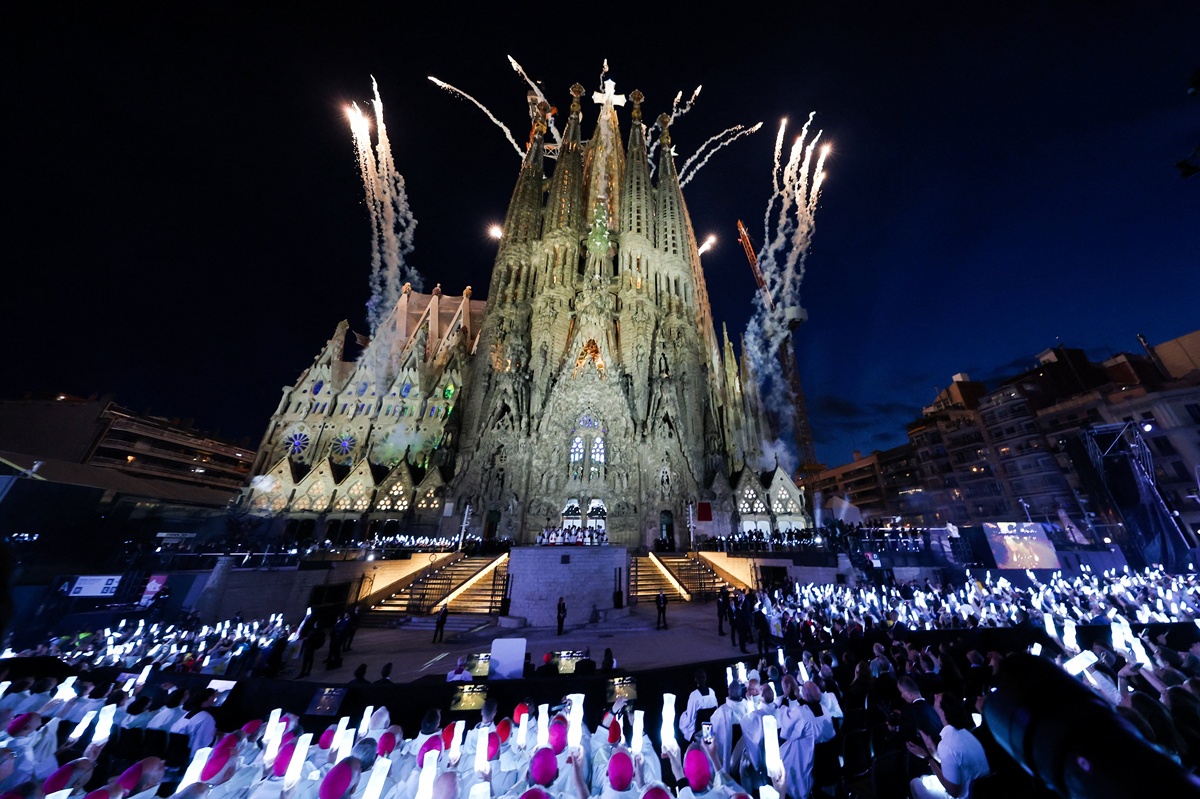
BARCELONA, Spain (OSV News) — Pope Leo XIV blessed the newly completed Tower of Jesus Christ at Barcelona’s Sagrada Familia basilica June 10, inaugurating the crowning spire that makes the iconic church the tallest Catholic church the world and urging people to lift their gaze to Christ “who alone reveals to us the truth about God and the truth about ourselves.”
Pope Leo offered Mass inside the basilica and formally inaugurated the Tower of Jesus Christ, which stands at more than 564 feet, before a crowd of thousands gathered inside and around the Sagrada Familia.
“By looking at Christ, we can see the world with renewed eyes: the tower of the cross then becomes a banner of charity, for God loves us in this way, transforming an instrument of death into a sign of hope,” the pope said.
100th anniversary of Gaudí’s death
Spain’s King Felipe VI welcomed the pope upon his arrival at the basilica. Before Mass, Pope Leo descended to the basilica’s crypt to pray at the tomb of Antoni Gaudí, the visionary Catalan architect who devoted 43 years of his life to the design and construction of the basilica before his death in 1926 at age 73.
The papal Mass fell on the 100th anniversary of Gaudí’s death. Known as “God’s architect,” Gaudí’s cause for canonization advanced last year when Pope Francis declared him venerable in April 2025.
Pope Leo paid tribute to the visionary builder in his homily, reflecting on Gaudí’s intent to narrate the mysteries of Christ’s life through stone and light.
Power of beauty to evangelize
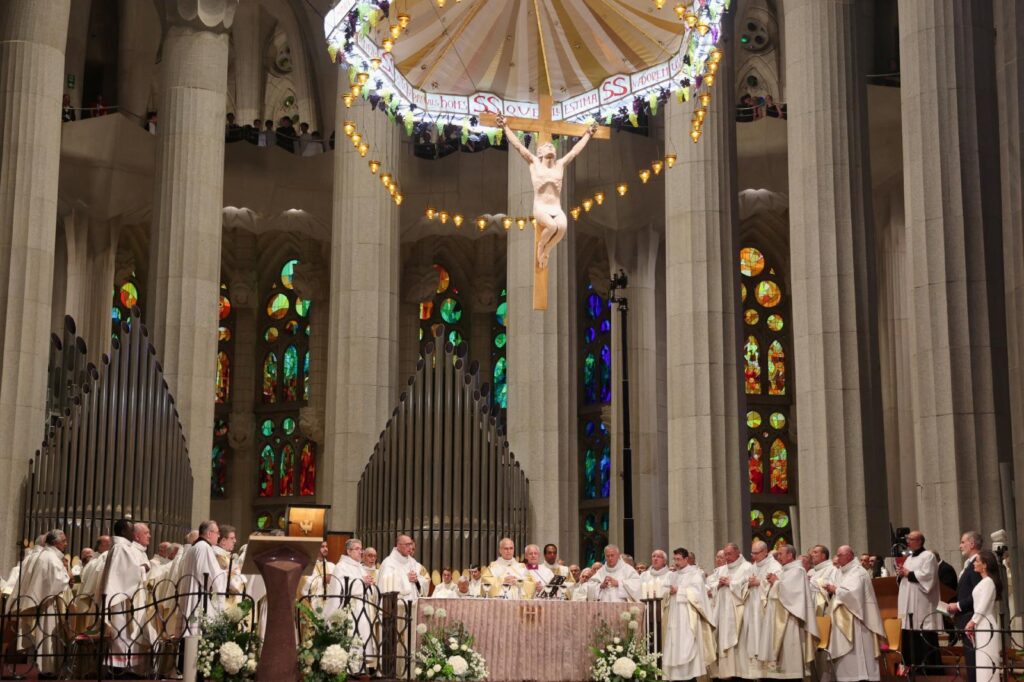
Light streamed through the basilica’s colorful stained glass windows as the pope spoke, casting dancing colors on the soaring columns. Trumpets sounded as a choir of 500 people sang hymns from the high galleries on either side of the basilica, as multiple children’s choirs harmonized around the apse.
Pope Leo pointed to the Sagrada Familia as a testament to the power of art and beauty to draw people closer to God.
“In her wisdom, the Church thus renews the ‘Biblia pauperum’ of the ancient cathedrals, which are in themselves rich messages of evangelization,” he said, invoking the medieval tradition of visual depictions of the Scripture designed to communicate the faith to those who could not read.
“In this age in which image is so prevalent, it becomes even more evident how art and beauty are privileged channels of evangelization,” he said.
The Sagrada Familia’s three facades — dedicated to the Nativity, the Passion and the Glory of Christ — embody this vision architecturally. Gaudí designed them so that sunlight illuminates each portal at the moment most consonant with its theological meaning: dawn light for the Nativity, the setting sun for the Passion and full midday light for the Glory facade.
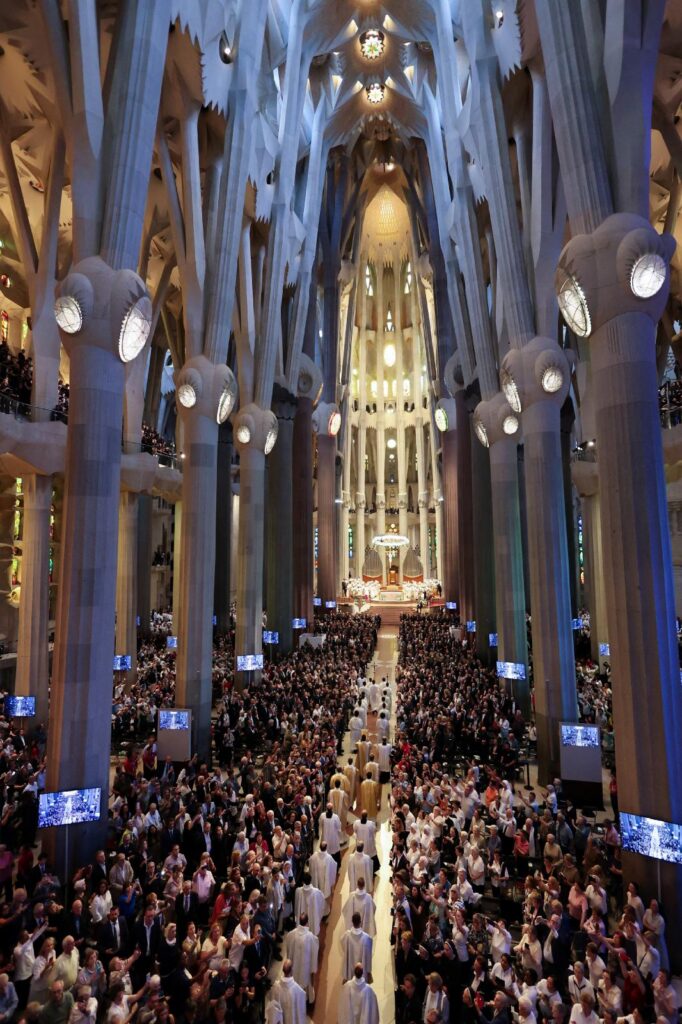
Gaudí’s design drew inspiration from both Christian doctrines and the observation of nature. The basilica is filled with organic forms inspired by natural elements. Its central nave columns evoke a forest of trees.
Tower of Jesus Christ
The Tower of Jesus Christ is now the tallest structure in Barcelona, and it makes the Sagrada Familia the tallest church in the world.
Gaudí designed the tower to stand precisely half a meter below the summit of the nearby Montjuïc hill, believing the work of human hands should not surpass the work of God. At its crown stands a four-armed cross of glass and white enameled ceramic, roughly 17 meters tall and 13 meters wide, bearing the inscription: “Tu solus Sanctus, Tu solus Dominus, Tu solus Altissimus” — “You alone are Holy, You alone are Lord, You alone are Most High.”
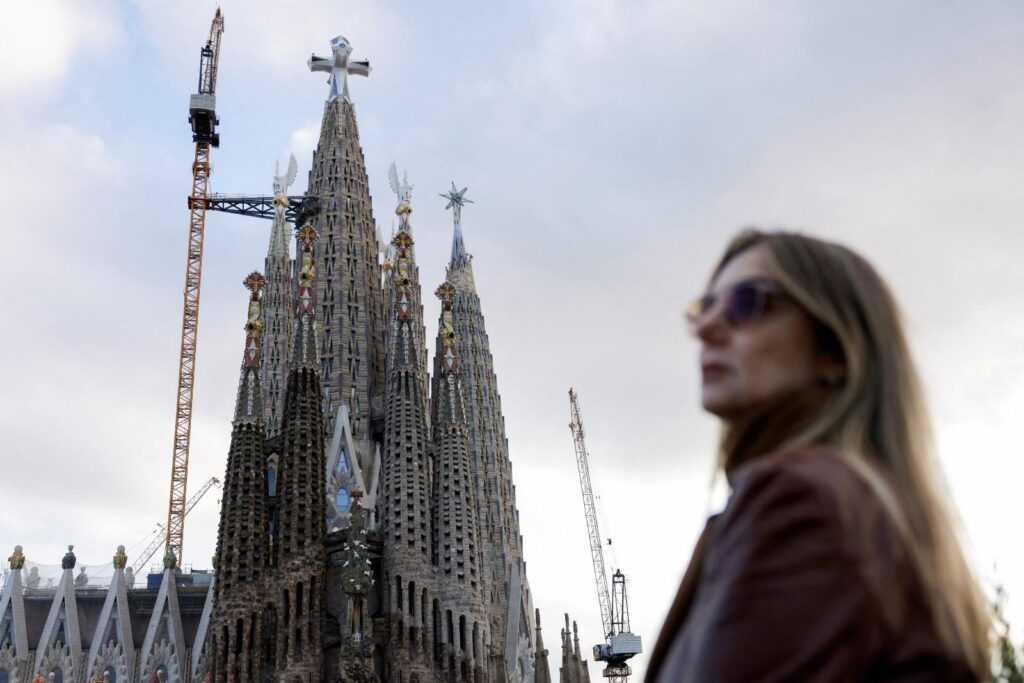
“In Jesus’ cross, our faith reaches its summit,” the pope said. “This cross shines by day, reflecting the sunlight, and shines by night, illuminating the city like a lighthouse overlooking the Mediterranean. Yes, the light of Christ shines in the darkness, even though the darkness has not received it.”
Strong words on war, abortion, salvation
An estimated 9,000 people attended the papal Mass inside the basilica, while an estimated 120,000 people worshipped from outside. In his homily in the Sagrada Familia, Pope Leo issued a forceful appeal against abortion, war and the exclusion of migrants.
“Dear brothers and sisters, we cannot believe in Jesus and promote war. We cannot believe in Jesus and kill the innocent even before birth. We cannot believe in Jesus and abandon those who suffer, those who weep, those who flee from misery,” the pope said.
The pope reflected on the day’s Gospel reading from John, in which Jesus tells the Pharisees, “you will die in your sins unless you believe that I am he” (Jn 8:24).
“These are strong words,” Pope Leo said. “They are an invitation to salvation — that is, a call to freedom extended by Christ, who desires for us the ultimate, eternal good.”
“As God made man, he becomes for us Emmanuel, the source of grace and forgiveness, of salvation and new life,” he said. “That is why, if we do not believe in Jesus Christ, we remain in sin, and not only do we die, but we bring about the death of our neighbor.”
Basilica a century in the making
Pope Leo paid tribute to Gaudí and to all who have labored on the basilica across generations.
“Together with Gaudí, as we commemorate the centenary of his death, we remember and give thanks to all the supporters and benefactors, the artists and the workers who cooperated in the construction of an architectural masterpiece, which is also an eloquent catechesis made of stones, colors and light.”
The foundation stone of the Sagrada Familia was laid in 1882. The project was initially entrusted to architect Francisco de Paula del Villar before passing to Gaudí in 1883, who transformed it into one of the most ambitious building projects in modern history, comprising three facades, five naves and 18 towers. The portion built by Gaudí was declared a UNESCO World Heritage Site in 2005.
Unfinished masterpiece
Despite the completion of its crowning tower, the basilica remains unfinished; work is still ongoing on the baptistery, the sacristy, the Chapel of the Assumption, the cloisters and the Glory Facade. It is projected that the basilica will not be completed until 2036.
Pope Leo embraced that incompleteness as a spiritual metaphor. “Much more than a monument, the Basilica of the Sagrada Familia remains a work in progress today, reminding us that the Christian life is always a journey, because it is a project that God is carrying out,” he said.
“The fact that it is incomplete is not a flaw, for it bears witness to a desire; it does not signify a shortcoming, but rather expresses a promise that we wish to honor with consistency,” he added. “Our gratitude thus becomes a commitment as we cooperate in God’s plan — that is, in the edification to which he himself calls us.”
“Since we are the temple of the Holy Spirit, this work consists in our very lives, which God conceives as a masterpiece that we are to create together.”
Fireworks celebrate the tallest church in the world
After Mass, the pope presided over the formal blessing of the Tower of Jesus Christ. The inauguration ceremony concluded with a dazzling interactive light show and a live musical performance by the Escolanía de Montserrat, the oldest boys choir in the world, followed by fireworks from the basilica’s towering spires. A drone show in the sky illuminated the face of Gaudí, as well the architect’s words, “First you need love, then technique.”
“As we lift our gaze toward him, the crucified and risen One, let us commit ourselves to lifting up those who lie in the dust,” the pope said. “And let us show in this way that the Sagrada Familia is the tallest church in the world, not so as to stand out in worldly rankings, but rather to guide the steps of the people of God who make their pilgrimage in Spain, with the cross illuminating their path, like a lamp burning brightly as we await the return of the Bridegroom.”
Courtney Mares is Vatican editor for OSV News. Follow her on X @catholicourtney.
