


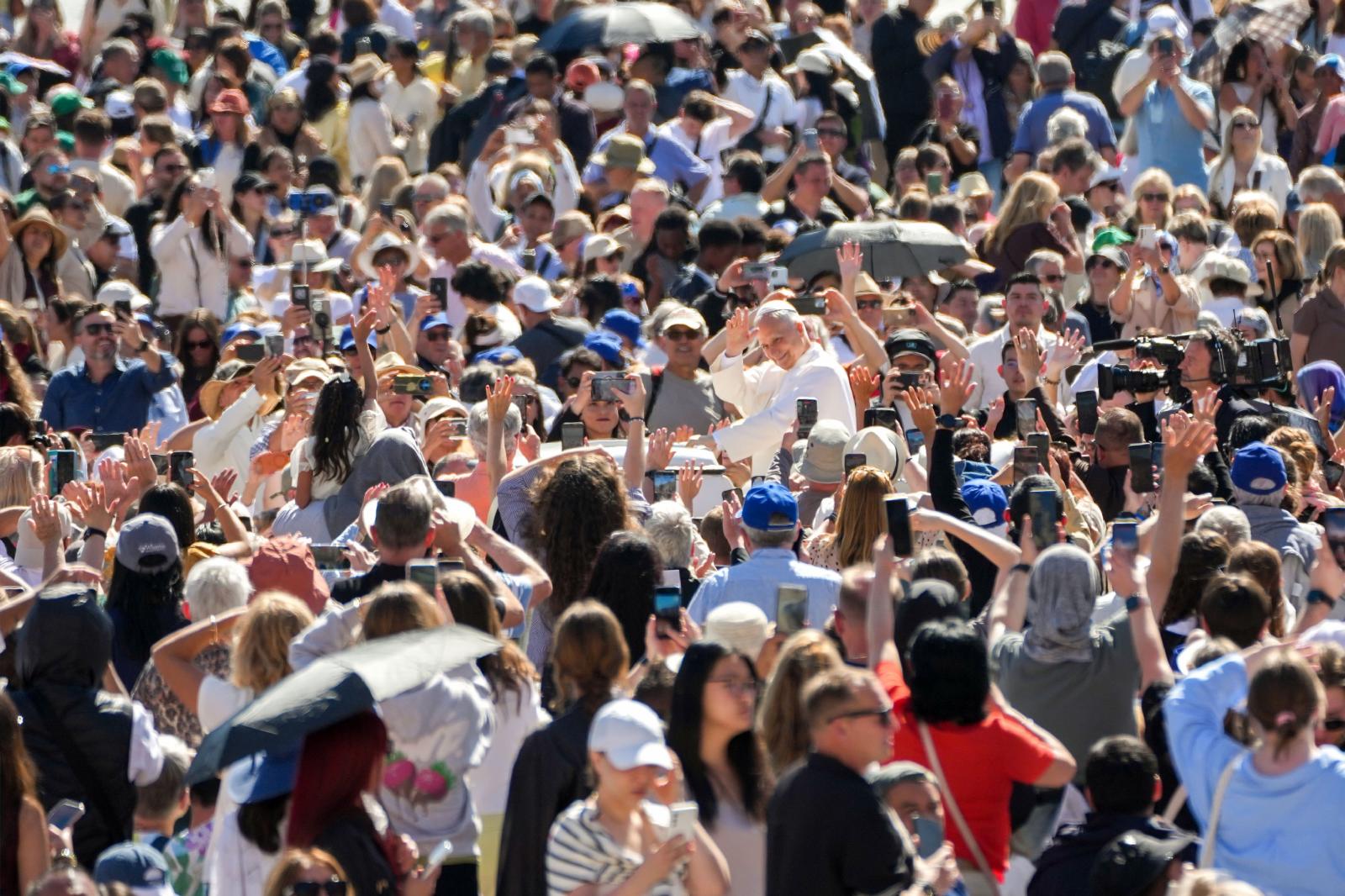
(OSV News) — Catholic bishops are welcoming Pope Leo XIV‘s first encyclical, dedicated to safeguarding human dignity by invoking Catholic social teaching as a framework for anchoring artificial intelligence.
The document is a “powerful reminder that no technology can replace a child of God, and all technology should be placed at the service of helping humanity thrive,” said Archbishop Paul S. Coakley of Oklahoma City, president of the U.S. Conference of Catholic Bishops.
The archbishop shared his thoughts in a May 25 statement issued minutes after the official release of the pope’s highly anticipated encyclical on AI “Magnifica Humanitas: On Safeguarding the Human Person in the Time of Artificial Intelligence.”
Clarity amid confusion
Pope Leo joined senior Vatican officials, theologians and Christopher Olah, one of the founders of the AI research and safety firm Anthropic, for a press conference at the Vatican at which the encyclical was publicly presented.
“Magnifica Humanitas” invokes the wisdom of the Church’s social teaching — which articulates the means of building a just society and living out holiness in modern life — as a framework for shaping AI amid rapid technological advances, a fractured global order and accelerating threats to human dignity.
“The Holy Father’s teaching on safeguarding human dignity in the age of artificial intelligence speaks to a critical need and brings clarity to a confusing landscape,” said Archbishop Nelson J. Pérez of Philadelphia said in a May 25 statement posted to CatholicPhilly.com, the digital news outlet of that archdiocese.
“Pope Leo emphasizes with crystal clarity that the sanctity of human life must remain paramount as artificial intelligence systems continue to develop and become more closely integrated into nearly every aspect of our lives,” said Archbishop Pérez.
AI’s benefits to healthcare, education and evangelization are accompanied by the technology’s “significant moral and ethical pitfalls that must be navigated and reflected upon,” he said. He encouraged “all people to read it with care and reflect on its vital message.”
Bishop Michael F. Burbidge of Arlington, Virginia, also exhorted the faithful to read the document, which is available online at the Vatican website.
In his May 25 statement, posted to Arlington Diocese’s website, Bishop Burbidge said he was “grateful” for Pope Leo’s attention to “issues of profound concern to the human person, most especially our innate desire for God and everlasting happiness.”
He said the encyclical is “especially welcome in this time of tremendous social and technological change, especially concerning artificial intelligence and the right use of such tools.”
Help at a historic time
Bishop Michael T. Martin of Charlotte, North Carolina, said Pope Leo’s text was “so helpful at this historic time in our world.”
In a May 25 statement emailed to OSV News, Bishop Martin, a Conventual Franciscan, observed that like the Industrial Revolution — which Pope Leo XIII addressed in his 1891 encyclical “Rerum Novarum” — AI is “revolutionizing the world as we know it.”
The Church “then and now stands ready to offer safeguards that value human dignity above all else,” said Bishop Martin.
He clarified that Pope Leo’s new encyclical “isn’t the Catholic Church lamenting progress,” but it is “our pontiff calling humanity to live into its best expression for the common good while never disregarding the importance of the person.”
In a May 25 post in Spanish on the X social media platform, Mexico’s Catholic bishops said the encyclical “offers a profound and enlightening perspective on our times, demonstrating that emerging technologies can become allies of human dignity when oriented toward the common good.”
“The text combines lucidity with hope: it analyzes real risks, but, above all, points to concrete paths for safeguarding the human element in the age of Artificial Intelligence (AI),” said the Mexican bishops. “Its strength lies in its capacity to integrate doctrine, discernment, and social responsibility.”
“It is too early to say how the AI revolution will pan out,” Ukrainian Catholic Metropolitan Archbishop Borys A. Gudziak of Philadelphia told OSV News, “but the optimism and embrace for human discovery that Pope Leo combines with deep anthropological, cultural, social, moral and spiritual reflection is something that is welcomed — because it is deeply needed.”
Gina Christian is a multimedia reporter for OSV News. Follow her on X @GinaJesseReina.
