


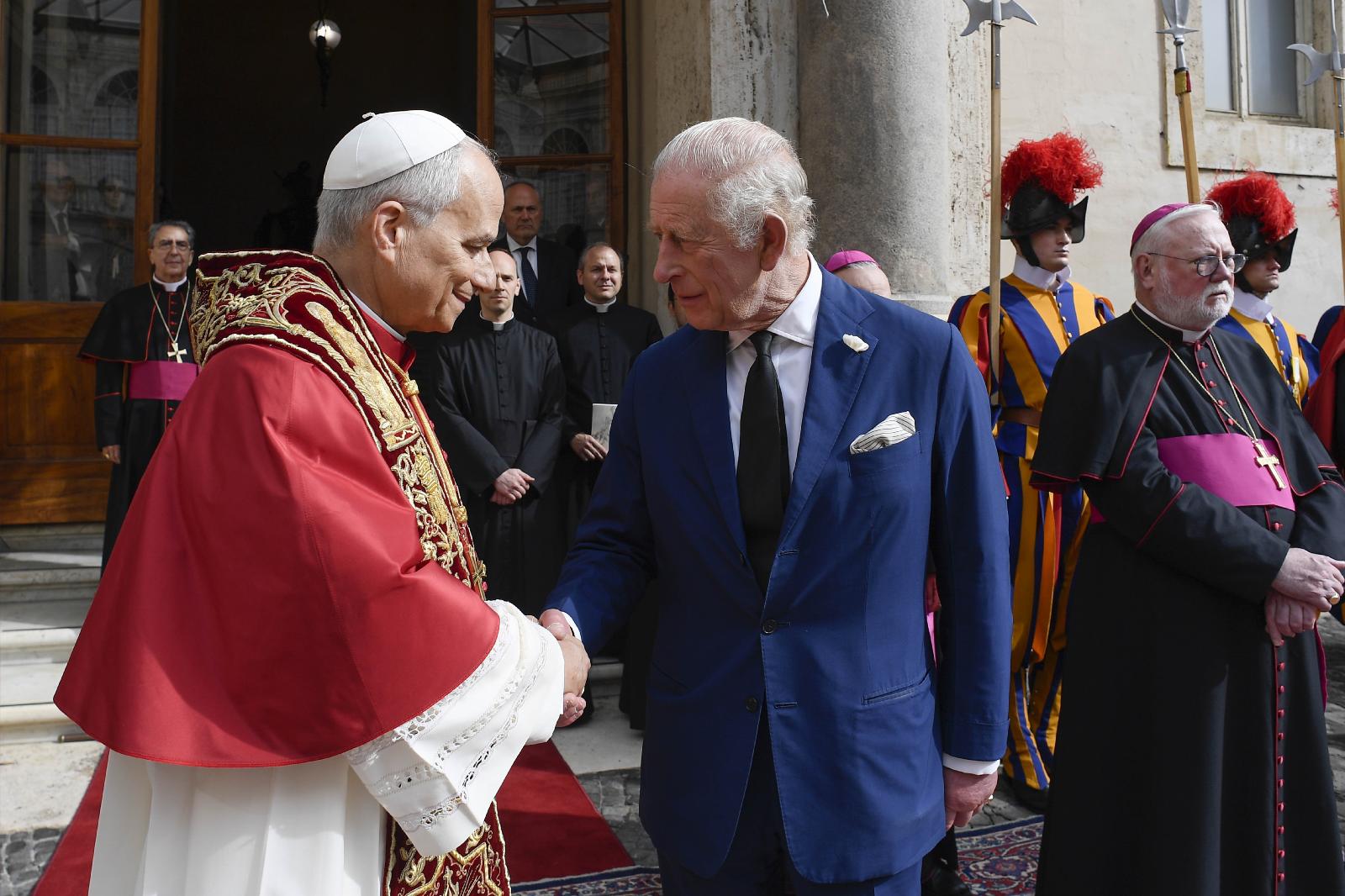
(OSV News) — When King Charles III awarded Pope Leo XIV a special title at the British royal family’s ornate chapel near London, the unprecedented honor caused some surprise.
To date, the British monarch remains head, or “supreme governor,” of the Anglican Church of England and must uphold constitutional links between the state and official denomination.
Yet some commentators think the late October gesture expresses something deeper — a significant realignment of attitudes after centuries of political and religious discord.
“Connections between the royal family and Vatican are still quite new,” Timothy Guile, chairman of the English Catholic History Association, explained to OSV News.
“They’re developing as more Anglicans look to Rome for spiritual guidance, knowing their own church lacks any teaching authority. The king’s personal involvement is playing well with Catholic audiences.”
Honor welcomed as ‘sign of spiritual fellowship’
The announcement that the U.S.-born pontiff was being made a “papal confrater” of Windsor Castle’s St. George’s Chapel came on the anniversary of King Charles’s historic October 2025 state visit to the Vatican, during which he himself was named a “royal confrater” of Rome’s papal basilica of St. Paul’s Outside the Walls.
The honor for Pope Leo was welcomed by Windsor’s Anglican canons as “a visible sign of spiritual fellowship” and praised by Archbishop Richard Moth of Westminster, president of the English and Welsh Catholic bishops’ conference, as reflecting “strong historical ties between the papacy and kingdom of England, dating back centuries before the Reformation.”
Yet it was only the latest in a series of recent exchanges that have broken new ground in a historically troubled relationship.
“Interesting things are going on, and most Catholics seem to have welcomed them,” said Catherine Pepinster, former editor of The Tablet, a London-based Catholic weekly.
“Our country has better relations now with Rome, while the king is taking his religious role very seriously. He’s made overtures to the wider Catholic community and clearly wishes us all to draw closer.”
Suffering of Catholics from the British monarchs throughout history
Catholics suffered harsh repression following the 16th-century Reformation, when King Henry VIII and Queen Elizabeth I were excommunicated for defying papal authority and death sentences imposed on Catholic priests caught saying Mass.
Restrictions were eased after the 1829 Catholic Relief Act, which allowed Catholics to attend universities, enter professions and hold public offices for the first time.
However, some curbs continued into the 20th century, including a 1701 Act of Settlement barring royal family members from marrying Catholics, which was only lifted in 2013.
Conciliatory moves have intensified since Charles III became king in September 2022.
His May 2023 coronation was presided over by Anglican leaders but attended by England’s Cardinal Vincent Nichols and top Vatican representatives, while also featuring a processional cross donated by Pope Francis.
In December 2024, the king attended a special Advent service in London’s main Jesuit church, while the following April, he and Queen Camilla discreetly met Pope Francis in Rome in what turned out to be his final weeks.
However, when Pope Leo received Archbishop Sarah Mullally of Canterbury, the Anglican Church of England’s first female head, in Rome in April, he warned “new problems” had appeared in Catholic-Anglican relations, “rendering the pathway to full communion more difficult to discern.”
Guile, the Catholic historian, thinks this reflects a paradox now at work.
Anglican holy orders were declared “absolutely null and utterly void” by the American pope’s namesake, Pope Leo XIII, in “Apostolicae Curae,” an 1896 apostolic letter which still remains in force.
And with Archbishop Mullally set to continue the Church of England’s liberal path, which has taken it from ordaining women priests to blessing same-sex unions, the prospects of Catholic-Anglican reunification seem more remote than ever.
New opportunities for practical cooperation
Yet with doctrinal and ethical differences now firmly set, opportunities for practical cooperation may actually be improving.
“Links between the English crown and papacy, very strong in medieval times, were broken by centuries of hatred and distrust,” Guile told OSV News.
“Yet today, those historic enmities and divisions are no longer being felt. It seems we can maintain friendly ties by gently glossing over the past.”
There may be limits on how far the relationship can go.
At his May 2023 Westminster Abbey coronation, King Charles had to pledge to protect the Anglican Church of England’s established rights.
Guile thinks gestures could be made toward Catholics without upsetting the U.K.’s antiquated constitutional rules — such as by regretting the arbitrary mass Reformation-era seizure of Church lands and properties, and perhaps by scrapping the requirement that all kings and queens must be Protestants.
Charles ‘is more open-minded’ about religion than his late mother
“King Charles is more open-minded towards religion than his late mother, Elizabeth II, and this suits the current mood when most people think faith affiliations no longer matter,” the Catholic historian told OSV News.
“To say a monarch can only adhere to one religion is an absurd anachronism, a discriminatory relic of a bygone age. So is the idea that the Church of England should have a monarch as its supreme leader.”
Pepinster, former editor of The Tablet, thinks changes of this order are unlikely.
But she agrees King Charles is likely to continue his warm engagement with Catholics, and hopes Pope Leo will one day visit the U.K. and sit in the ceremonial chair being prepared for him in Windsor’s St. George’s Chapel.
“Successive British governments, whatever their political stance, have realized it’s worth engaging closely with the Vatican, given its clout on the global stage,” the Catholic writer told OSV News.
“In future, we’re likelier to have problems with monarchs who are atheists than would-be Catholics. In the meantime, people on all sides now seem to be finding ways of reconciling diversities and building closer ties.”
Jonathan Luxmoore writes for OSV News from Oxford, England.
