


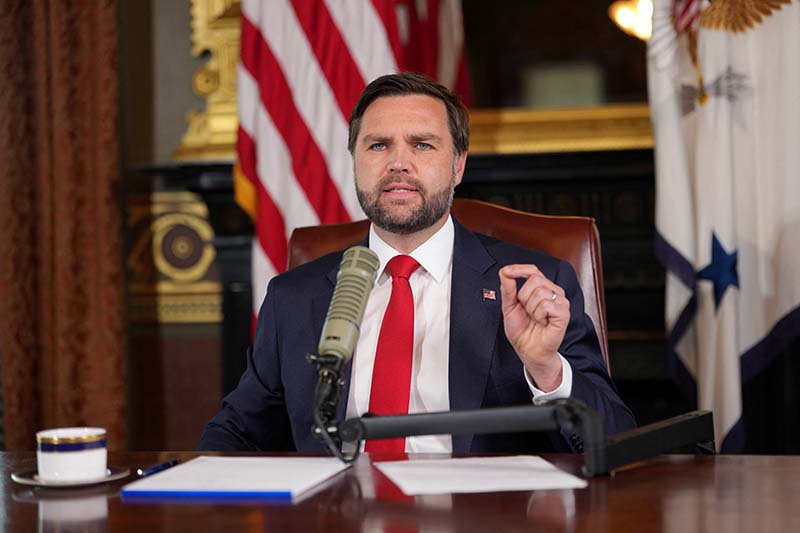
WASHINGTON (OSV News) — Officials in the Trump administration said they would seek to target what Vice President JD Vance called “left-wing extremism” following the fatal shooting of conservative activist Charlie Kirk.
As he hosted the late Kirk’s podcast on Sept. 15 Vance argued that “left-wing extremism” was “part of the reason” Kirk was killed Sept. 10 during an event at Utah Valley University in Orem, Utah.
“Of course, we have to make sure that the killer is brought to justice,” Vance said. “And importantly, we have to talk about this incredibly destructive movement of left-wing extremism that has grown up over the last few years and, I believe, is part of the reason why Charlie was killed by an assassin’s bullet.”
The shooting prompted calls for prayer from Catholic leaders, among other faith traditions.
Controversial political rhetoric
After his death, Kirk received praise from his allies in conservative politics for his willingness to debate and his advocacy for their cause. However, in discussions about his legacy, his critics also pointed to his controversial political rhetoric on subjects including race, persons experiencing same-sex attraction or gender dysphoria, and immigrants.
Kirk also faced criticism from devout Christians who either found his comments incompatible with the demands of the Gospel or argued he was advancing serious errors in Christian doctrine to support his political vision.
Attorney General Pam Bondi argued in a Sept. 16 social media post that “hate speech that crosses the line into threats of violence is NOT protected by the First Amendment.”
The Foundation for Individual Rights and Expression, or FIRE, states on its website that “the Supreme Court of the United States has repeatedly rejected government attempts to prohibit or punish hate speech.”
‘That era is over’
But Bondi argued, “It’s a crime. For far too long, we’ve watched the radical left normalize threats, call for assassinations, and cheer on political violence. That era is over.”
Other recent instances of political violence include assassination attempts against Trump, but also the murders of Minnesota House of Representatives Speaker Emerita Melissa Hortman and her husband, Mark Hortman, and the firebombing of the Pennsylvania governor’s mansion, which is being investigated as the attempted murder of Democratic Gov. Josh Shapiro.
A Sept. 12 analysis by The Economist found nine out of 10 Americans are opposed to political violence, with little difference between those on the left and the right. But it noted that those numbers also showed “potentially millions willing to condone violence — and some proportion of them willing to commit it.”
Actual political violence remains rare
The Economist’s survey of available databases showed criminal cases of politically motivated violence involving the right overall outnumbered those on the left, but an uptick of violence on the left has taken place in recent years. It noted researchers’ observations that actual political violence remains rare — nowhere near the levels of the tumultuous 1960s — but a recent trend shows those engaged in violence are increasingly seeking attention rather than to further a cause.
Kenneth Craycraft, a professor of moral theology at Mount St. Mary’s Seminary and School of Theology in Cincinnati and author of “Citizens Yet Strangers: Living Authentically Catholic in a Divided America,” told OSV News he is concerned “that our ‘American experience of ordered liberty’ has failed.”
The political and philosophical concept of “ordered liberty” generally refers to an attempt to balance individual rights with public good.
‘Rejecting the notion of common good’
“We cannot elevate unfettered individualist liberty to the highest political good and then expect people not to be violent when they feel their liberty is being infringed,” Craycraft argued. “By rejecting the notion of common good, we have set ourselves on a trajectory of political violence.”
“Put another way, our political theory tells us that we are enemies of one another, all possessing absolute conflicting rights claims,” he said. “We have constructed a fictional social contract by which we mutually promise to constrain our liberty. But there is no natural limiting principle to that fictional contract. When we don’t like its implications, we ignore it.”
In response to a question about Bondi’s claims, John White, a professor of politics at The Catholic University of America in Washington, told OSV News, “The question is whether there will be selective prosecutions or whether prosecutions will also include threats made to Democratic officials as well.”
“It’s a question of watching what they do, not what they say,” he said.
Patel at Senate Judiciary Committee hearing
At a hearing of the Senate Judiciary Committee Sept. 16, FBI Director Kash Patel appeared to strike a slightly different tone than Bondi, who oversees the Department of Justice.
Despite some contentious exchanges with some Democratic senators criticizing Patel’s leadership of the FBI, Patel had a cordial exchange with Sen. Amy Klobuchar, D-Minn., after she offered her condolences about the death of Kirk, with whom Patel said he was friends.
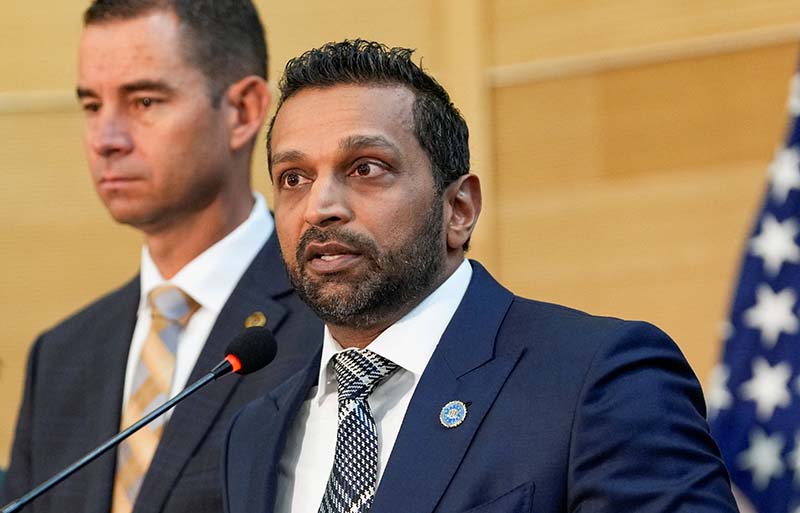
Patel said that “Minnesota has suffered untold tragedy in these last few months,” also acknowledging the murders of the Hortmans.
When Klobuchar asked Patel about various policy proposals aimed at reducing gun violence, he replied, “Whatever creativity we can use to eliminate even just one shooting, one horrific death, I am in favor of engaging with Congress — fully — to do. I don’t have the answers. I don’t know what will eliminate it in its entirety, but I’m willing to engage and explore new ways with you, Senator.”
Ideologies on either side of aisle
Klobachar cited a series of examples of recent political violence, including by perpetrators who espoused ideologies on either side of the aisle, and asked Patel to “convey that to the president and that we actually work on things that are solutions.”
“Absolutely, Senator,” he said.
Other topics that arose at the Patel hearing included the administration’s handling of documents surrounding the Jeffrey Epstein case.
Sen. Josh Hawley, R-Mo., also asked Patel about “anti-religious, anti-Christian violence.”
During that exchange, Patel said the bureau is publicly investigating “60 anti-Catholic hate crime incidents.”
Kate Scanlon is a national reporter for OSV News covering Washington. Follow her on X @kgscanlon.
