


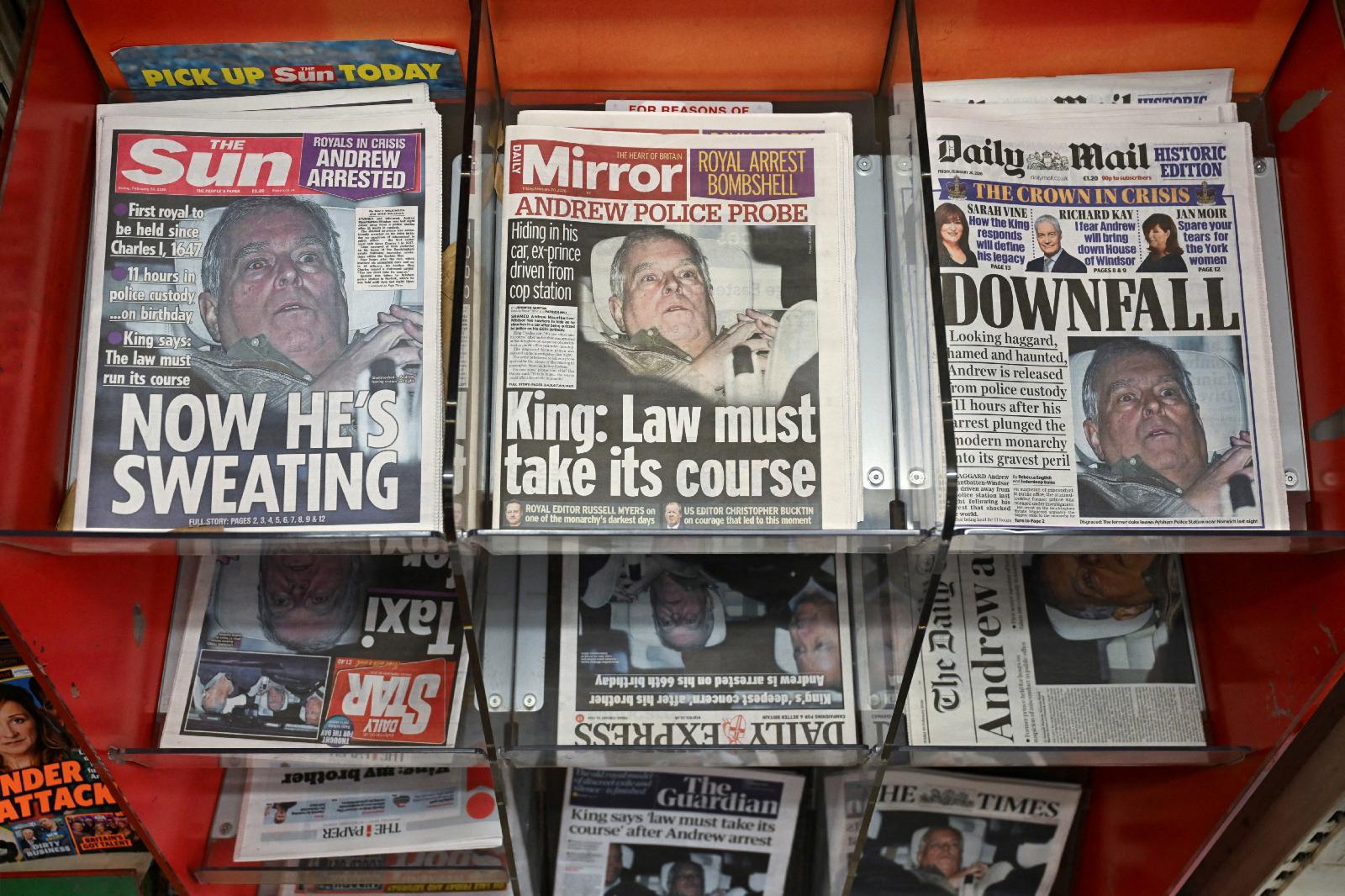
(OSV News) — News of the arrest of Andrew Mountbatten Windsor, followed by Feb. 24 arrest of Peter Mandelson, former British ambassador to the United States — made headlines around the world, given its unprecedented nature.
The former prince’s Feb. 19 arrest on misconduct allegations related to his time serving as the U.K.’s trade envoy was the latest in the fallout due to the recent release of files of convicted sex offender and financier Jeffrey Epstein.
For years, Mountbatten Windsor has faced allegations of sexual misconduct by victims trafficked by Epstein, one of whom committed suicide in 2025.
The arrest was the latest reckoning of those associated with Epstein after the U.S. Department of Justice was forced by Congress to release a 3-million-page tranche of documents.

Epstein’s disdain for the Catholic Church
Despite Epstein having a photo in his office of himself and co-conspirator Ghislaine Maxwell greeting St. John Paul II at what appeared to be a public audience, the files revealed Epstein’s disdain for anything or anyone associated with the Catholic Church.
Among the many revelations were that Steve Bannon, a former White House chief strategist during President Donald Trump’s first term, and Epstein discussed strategies to undermine the late Pope Francis.
According to a Religion News Service report published Feb. 11, Bannon and Epstein would often speak negatively about the Vatican under the late pope and expressed hopes of taking him down.
Both men spoke of their involvement in a documentary that was never made based on the controversial book “In the Closet of the Vatican.”
The book, written by French journalist Frédéric Martel, accused the Vatican of hypocrisy, claiming that the majority of prelates working within its walls lived active homosexual lifestyles.
“Will take down Francis,” Bannon wrote to Epstein. “The Clintons, Xi, Francis, EU — come on brother.”
“The weaponization of information is a classic resource for a dirty war in the public sphere,” said Father Jordi Pujol, associate professor of media ethics and law at the School of Church Communications at Rome’s Pontifical University of the Holy Cross.
“It’s a nasty turn of a ‘shame culture,’ which in social media has also gained volume and pervasiveness,” he said.
Body of Christ betrayed
During a 2014 news conference aboard the papal flight to Rome after his visit to the Holy Land, the late Pope Francis said the abuse of children by members of the clergy was “truly a horrible crime” that betrayed “the body of the Lord.”
“It is like saying a black mass. You are supposed to lead them to holiness and you create a lifelong problem for them,” the pope said.
Fast forward to 2026, and the sacrilegious nature of Epstein’s abuse seemingly fits the late pontiff’s description. One of the most disturbing revelations from the documents involved a message Epstein sent to an unnamed person regarding a young victim who had expressed her reliance on her faith to cope with her situation.
“(Redacted) said that she felt gods presence next to her when she was in bed.. she knows that jesus watches over her and he helped save her life. Whoops,” Epstein wrote in an unedited email published by the Justice Department.
Father Hans Zollner on the stories from Epstein Island: “It was very harrowing”
Asked for a comment on the Epstein files and patterns of abuse used by influential people in his circles, Father Hans Zollner, Jesuit expert and director of Institute of Anthropology at the Pontifical Gregorian University in Rome, said that while “we must be cautious about presenting the Church as an authority in this area, because we are not through this process ourselves,” he admitted that when he read about the stories of abuse on Epstein Island “it was very harrowing.”
“These were girls who were trafficked, who suffered the most despicable horrors at the hands of people who had promised them luxury, influence, and wealth. They were probably also longing for real love and understanding — and what they found was hell.”
Asked about the lack of any kind of respect for the dignity of another person — like in the case of a victim who hoped her faith would protect her — Father Zollner said that some perpetrators “are not only highly narcissistic but are also sociopaths” — people who, “by definition, lack conscience,” Father Zollner said. “They don’t feel any remorse and they don’t feel any guilt. They take pleasure in seeing people suffer. That doesn’t mean that they are without emotions or the capacity to read another person.”
“When someone like this finds that a person clings to faith, clings to other values which (an abuser) despises, then you take pleasure in shoveling that in the face of people and hurting them more,” Father Zollner said. “It’s difficult to understand, but there are people like that. Yes.”
Psychological aspects of sexual abuse and fear of speaking out
Asked about the fact that many people turned a blind eye on what happened in Epstein circles, Father Zollner, who researched psychological aspects of sexual abuse for over two decades, said that “belonging to influential groups can create a segregated world — a bubble — in which people feel entitled and detached from ordinary responsibility.”
This, he said, “does not depend on intelligence, success or upbringing. It can occur anywhere that belonging to a certain elite creates a sense of being untouchable.”
Within such circles, Father Zollner said, there is often a tacit understanding: “Don’t expose me, and I won’t expose you.”
“Even people with different convictions may protect each other because they know how much harm the other could cause in return. In this environment, moral criteria fall away and boundaries are easily overstepped,” the IADC director said.
High-profile cases remind Catholics of the pain of abuse cases within the Church
For many Catholics, hearing about the “evil” actions of people in positions of authority and influence, which include world leaders, tech giants, philosophers and royalty, feels very similar to the pain felt when hearing about abuses committed by members of the clergy.
While it is difficult for many, both within and outside the Church, to find the truth without falling into despair, Father Pujol told OSV News that, amid the scandals, “hope is the key at stake here.”
“In the Church, we are trying to walk our own path of conversion and healing from this terrible wound” of abuse, he said. “There’s no other way but forward. This path is humbling and hard but full of hope, because it’s not cosmetic; it departs from truth and justice.”
Father Zollner, for his part, urged more prayer for victims of abuse — an appeal that relates back in the mystery of Christ’s suffering and one that his institute took initiative on this Lent by offering Lenten reflections that invite to pray for survivors of sexual abuse.
Calls for transparency and prayer for survivors
Both experts, however, admit that while the Catholic Church has spent decades trying to learn from painful lessons about how to handle abuse and cover-ups, it still has a long way to go in fostering accountability and transparency before it can serve as an example for the secular world.
“I hesitate in presenting the Church as an example, because I see how some people in the Church have not got it yet,” Father Pujol said. “Some of the damage done will require a very long journey of accompanying” those who have suffered “the consequences of the hurt” and pain it has caused.
“However,” he added, “transparency has revealed itself as a good disinfectant.”
Father Zollner highlighted that, in the Church, “we have learned from listening to victims and survivors and from accompanying their healing and reconciliation processes,” but at the same time “we cannot now claim expertise or offer simple solutions. Any contribution must be a result of sincerity and ongoing commitment to a journey that is far from over.”
Junno Arocho Esteves is an international correspondent for OSV News. Follow him on X @jae_journalist. Paulina Guzik is international editor for OSV News. Follow her on X @Guzik_Paulina
