


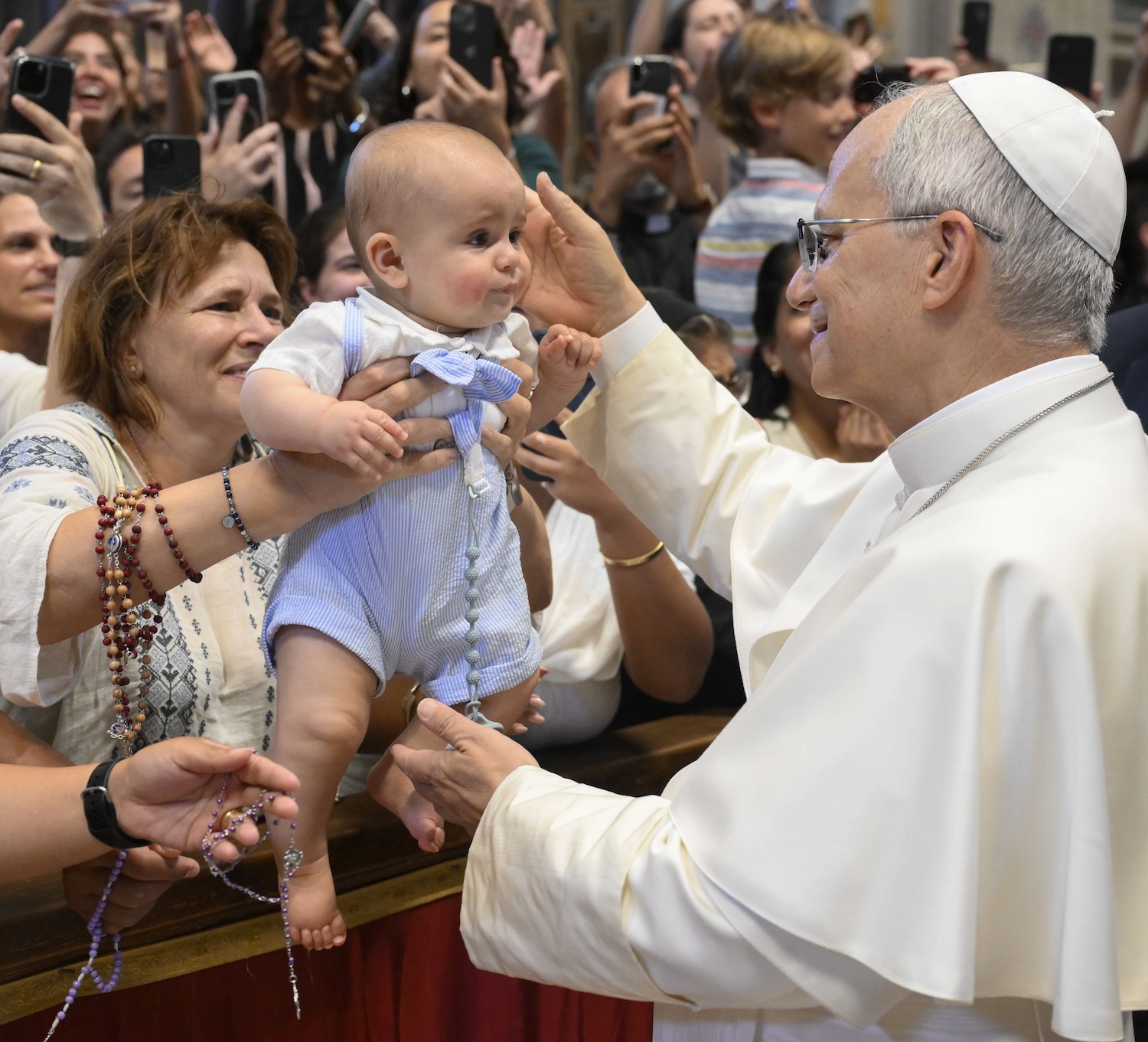
I took a close look at my dear friend’s newborn. As she snuggled into my arms, I memorized her face: her chubby cheeks, her full head of hair, those pink lips and dainty nose. I was just starting to get to know her. And yet, as her bright eyes met mine, I knew that she was perfect. She was perfect just by being her.
I thought of this moment from last weekend, and about what perfection means, while reading stories about surrogates — women carrying and delivering babies on behalf of other people — who have refused to seek abortion against the wishes of the baby’s biological parents. Most recently, in a case national pro-life leaders are calling attention to, a surrogate from Alaska refused to end the life of the baby in her womb after he was diagnosed with a serious congenital heart condition.
A look at the industry
I was curious about how the surrogacy industry approaches abortion, so I started researching various surrogacy agencies. With surrogacy, I noticed that abortion seems to happen when the baby — or the situation — isn’t what society might consider “normal” or “perfect.”
Most commonly, “selective termination” or “reduction” happens when a surrogate becomes pregnant with multiple babies or when the babies are diagnosed with genetic or medical abnormalities, according to a surrogacy agency in Fairfield, Connecticut.
Another major surrogacy agency based in Los Angeles agrees that abortion is most often considered for medical reasons. The agency says it has seen abortions performed for reasons including reducing the number of babies in a pregnancy, severe intrauterine growth restrictions, diagnoses of Down syndrome or other genetic conditions, and diagnoses of congenital defects.
Other times, someone’s reason for an abortion might have nothing to do with the baby involved. A surrogacy agency in Des Moines, Iowa, adds that couples seeking a surrogate may want an abortion due their own divorce, break up, terminal diagnosis or death.
The Church’s recognition of the child
The Church anticipates this commodification of the human person and condemns surrogacy as a whole in recognition of something greater: the dignity of the child and woman involved.
“By transforming gestation into a negotiable service, this violates the dignity both of the child, who is reduced to a ‘product,’ and of the mother, exploiting her body and the generative process, and distorting the original relational calling of the family,” Pope Leo XIV said of surrogacy earlier this year.
His words echoed Pope Francis, who said during a 2024 address, “I deem deplorable the practice of so-called surrogate motherhood, which represents a grave violation of the dignity of the woman and the child, based on the exploitation of situations of the mother’s material needs. A child is always a gift and never the basis of a commercial contract.”
Other Church documents, from the 1987 Vatican instruction on respect for human life, “Donum Vitae,” to the 2024 Vatican declaration on human dignity, “Dignitas Infinita,” denounce surrogacy while emphasizing that life is a gift.
The Catechism of the Catholic Church, which quotes “Donum Vitae,” declares that “a child is not something owed to one, but is a gift.”
“A child may not be considered a piece of property, an idea to which an alleged ‘right to a child’ would lead,” it reads later. “In this area, only the child possesses genuine rights: the right ‘to be the fruit of the specific act of the conjugal love of his parents,’ and ‘the right to be respected as a person from the moment of his conception.'”
An expression of ‘unfailing love’
Perhaps we can see how surrogate women might think they are helping other women grow their families. We can see the good desire of couples to have children. We can — and should — love children born through surrogacy as persons of inherent dignity and worth. But that doesn’t mean we can’t question the human cost. That doesn’t mean we can’t condemn the practice of surrogacy and its relationship with abortion, where people can decide how and when to begin and end the life of an innocent, vulnerable person. Where they can determine someone’s worth based on perfection, as the world defines it.
As Pope Leo wrote in his new encyclical, “Magnifica Humanitas,” and repeated during his general audience Sept. 9: “Human dignity does not depend on a person’s abilities, wealth or position in life, nor on the right or wrong choices made; instead, it is a gift that precedes and transcends each person, endowed by God as an expression of his unfailing love.”
Our life, our dignity, our humanity has never been about being without flaws. It is about each of us being loved and loving in return.
Katie Yoder writes for OSV News from Maryland.
