


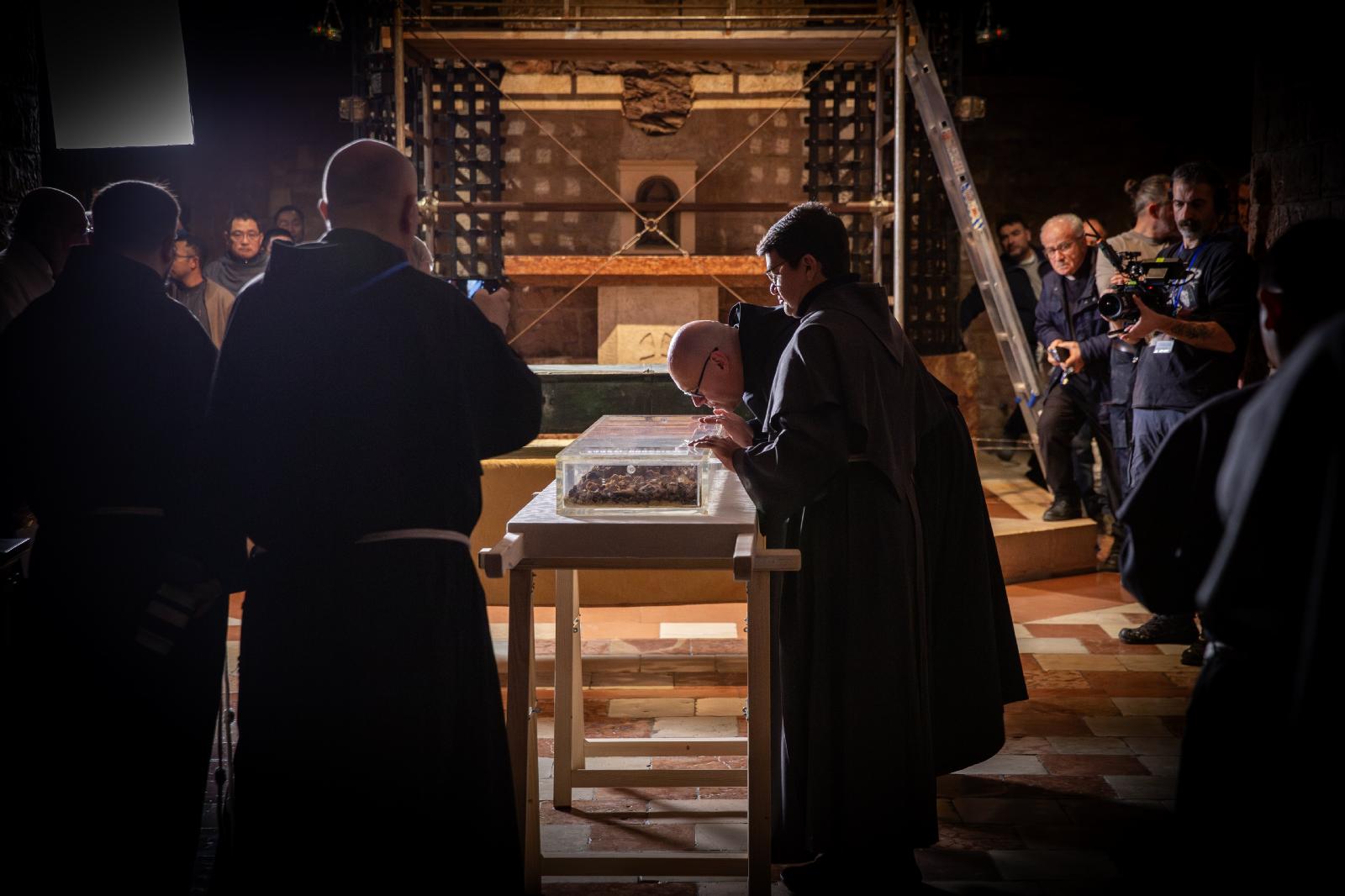
ASSISI, Italy (OSV News) — For the first time in eight centuries, the mortal remains of St. Francis of Assisi are being exposed for an extended period of public veneration, drawing hundreds of thousands of pilgrims from around the world to pray before “the Little Poor Man of Assisi.”
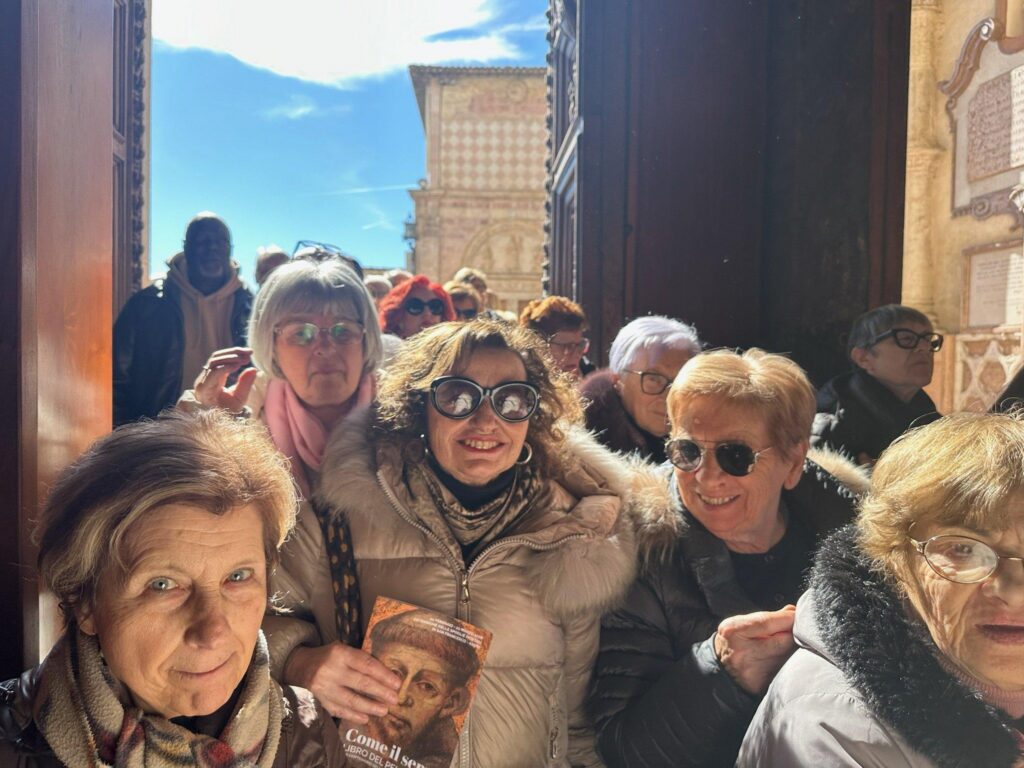
The bones of the beloved saint were unveiled for public display Feb. 22 in the Lower Church of the Basilica of St. Francis of Assisi. Pilgrims waited in line outside of the Assisi basilica, taking in the panoramic views of the Umbrian countryside from the medieval hilltop town, for their chance to pray before the relics.
The veneration runs through March 22 as part of the Catholic Church’s yearlong celebration of the 800th anniversary of St. Francis’ death in 1226.
Among the first to venerate relics
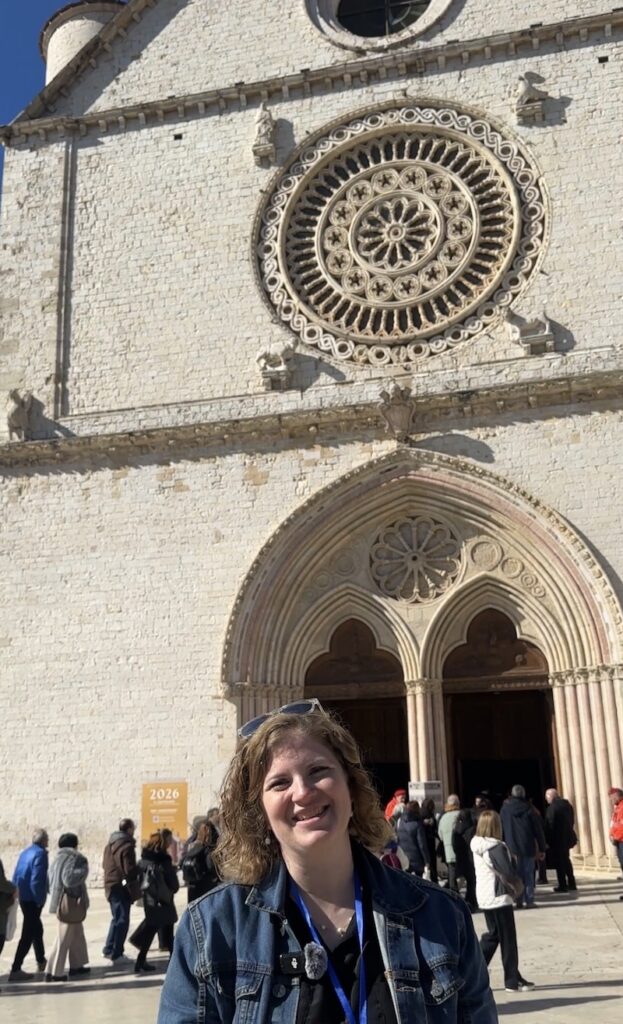
Heather Martin, an American mother who has lived in Assisi for five years with her family, was among the first pilgrims to venerate the relics.
“St. Francis is by far the most important saint in my life. He’s shown up for me in so many ways and so many dark moments,” she told OSV News.
“This experience to be able to go and physically see his physical form has been utterly life-changing.”
Martin recalled a conversation she had with one of the Franciscan friars about the experience. “He felt like he was finally meeting a long-lost relative for the first time,” she said. “And I can’t agree with that more.”
Fabrizio Ballanti traveled from Ancona, Italy, as part of a care home run by the Focolare movement.
‘Came together to live this experience’
“We are a community for people with HIV and AIDS, and we all came together to live this experience,” Ballanti said.
Standing before the relics of St. Francis, he said, “I felt the presence of the Lord very strongly,” calling it “a truly powerful experience.”
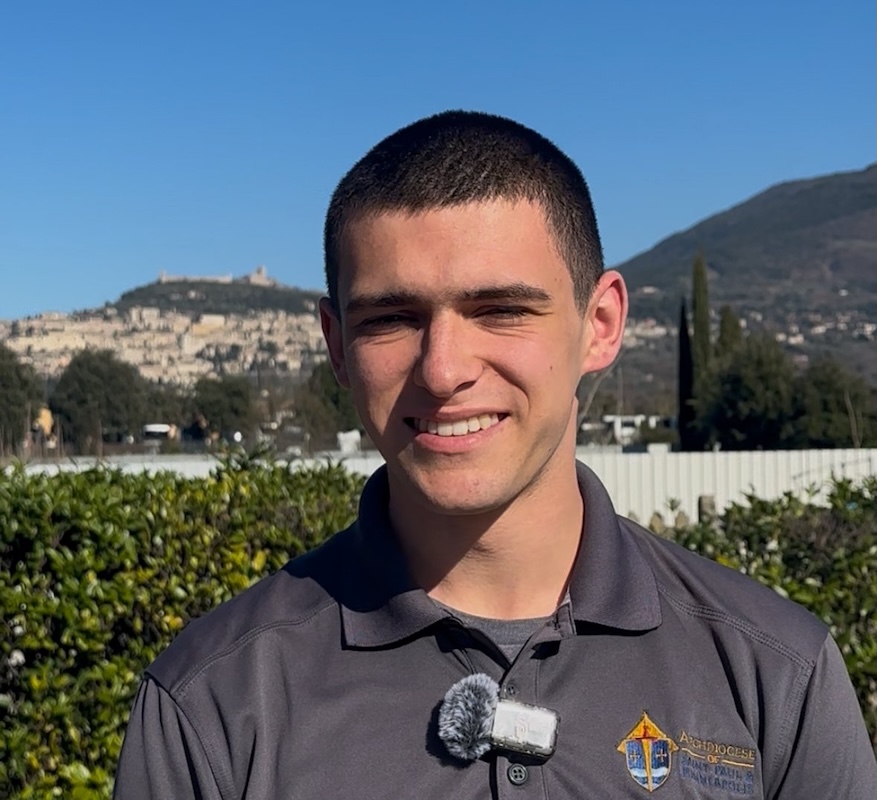
For 21-year-old seminarian Gregory Maloney from the Archdiocese of St. Paul and Minneapolis, the moment was an opportunity to ask St. Francis for the gift of a deeper conversion “to grow in the virtue of poverty.”
He said that the long wait in line to view the relics gave him an opportunity to reflect on the life of St. Francis in prayer. “Here is the man who wanted to live poverty as Christ really said it in the Gospel,” Maloney said. “He wanted to give up his whole life, to give up all the things of the world to focus on the pearl of great price … the treasure of heaven.”
“And so that was a great encouragement for me then to say, ‘OK, what are the areas in my life I need to give to the Lord? I need to focus more on the things of heaven,” the seminarian added.
Opening of the sarcophagus
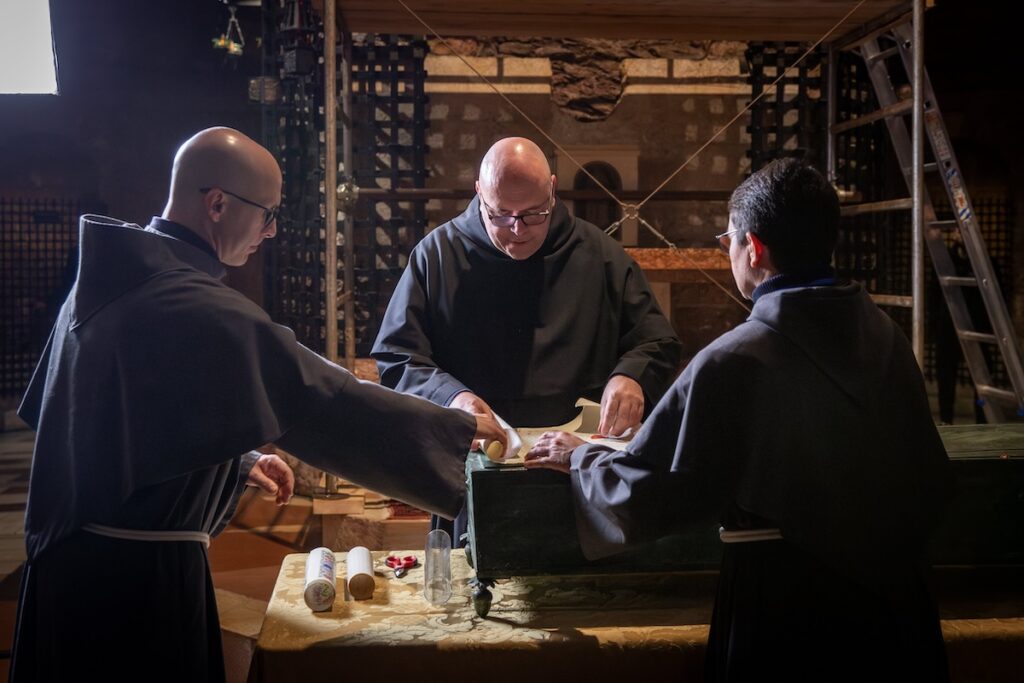
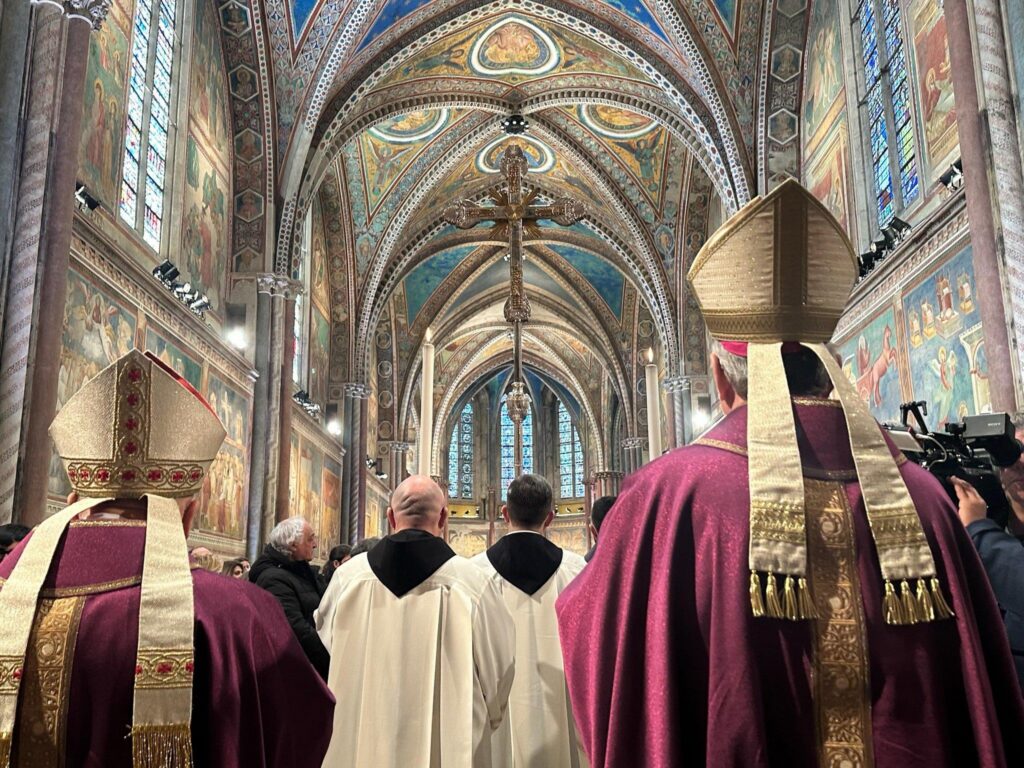
Franciscan friars opened the sarcophagus to exhume St. Francis’ remains Feb. 21, placing his bones on a specially prepared table in the crypt before carrying them in procession through the Lower Church while praying the Litany of the Saints.
Franciscans from across the world participated in a solemn vespers with the exposed relics beneath the basilica’s frescoed ceiling on the evening before the relics opened to the public.
Friar Ignacio Ceja Jimenez, a Franciscan friar from Mexico, called it a historic moment of fraternity for all branches of the Franciscan family “because we all recognize ourselves as children of St. Francis, heirs to his charism.”
“Seeing and praying before the body of St. Francis also means that we must commit ourselves to living what he lived,” he said.
Gospel’s transformative power
“St. Francis reminds us that the Gospel can not only transform human beings, hearts, but that the Gospel can also transform the structures of our world and help us build a fraternal, peaceful world.”
Cardinal Ángel Fernández Artime, the pontifical delegate for the Papal Basilicas of Assisi, presided over both the vespers and the inaugural Mass Feb. 22.
The cardinal recalled St. Francis’ final hours on Oct. 3, 1226, in his homily for the Feb. 21 vespers.
“When St. Francis felt his death approaching, he asked a friar to read the Gospel to him. Not just any passage, but chapter 13 of John: ‘Before the feast of the Passover, Jesus, knowing that his hour had come … having loved his own who were in the world, he loved them to the end,'” Cardinal Artime said.
“His life had been this: a constant listening to the Word, a burning desire to conform himself to the poor and crucified Christ. Service and self-sacrificing love are the heart of Francis’s spirituality.”
Advice for those unable to get to Assisi
Brother Jimmy Zammit of Toronto, now based in Rome as general definitor for the Franciscan order, shared his advice for Catholics unable to make the trip to Assisi who want to live out the special Jubilee Year of St. Francis in a particular way.
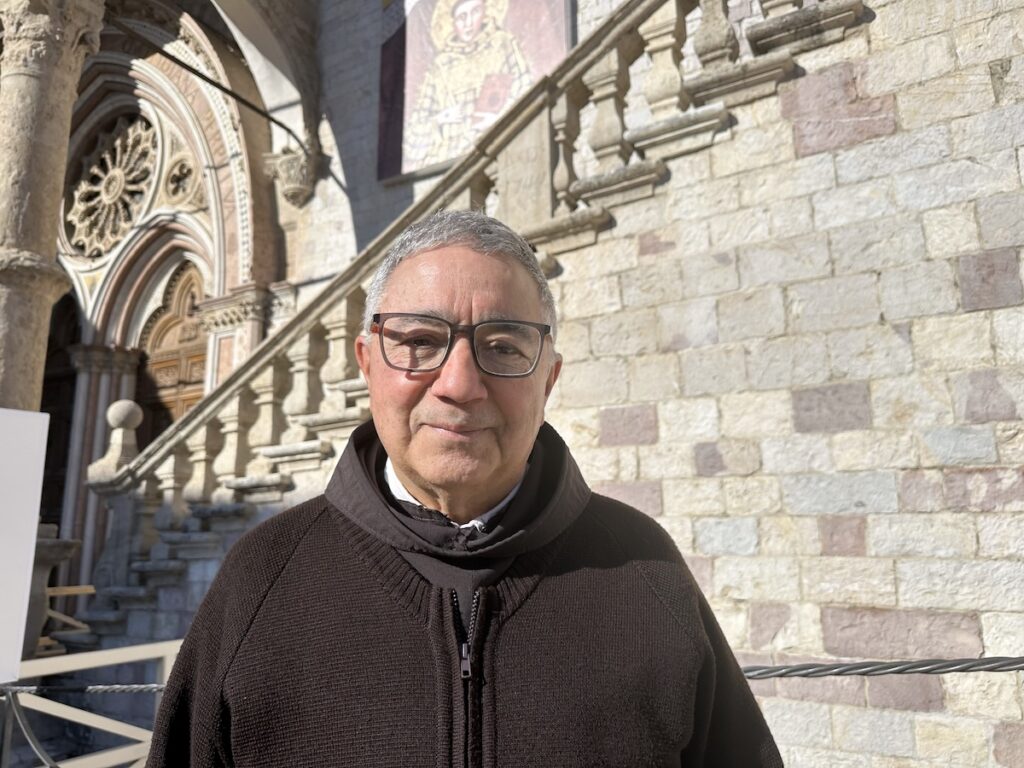
“If our heart becomes more Franciscan, we become makers of peace,” Brother Zammit said. “We seek out to help those who are less fortunate than we are to help the poor, but also to help those who are suffering because they’re feeling isolated and maybe even shunned in some way.”
Approximately 370,000 people from five continents have registered to venerate the relics, with Italians making up 80% of registrants. International registrations include 5,000 from the United States, 3,100 from Croatia, 2,000 from Slovakia and 1,500 each from Brazil and France. Some 400 volunteers from dozens of countries are giving of their time to make the monthlong historic event possible.
Free to viewing relics but registration needed
Entry to view St. Francis’ relics is free, but it requires advance registration at saintfrancisliveson.org. The exposition will close with Mass on March 22 in the Upper Church, to be presided over by Cardinal Matteo Maria Zuppi, archbishop of Bologna and president of the Italian Episcopal Conference.
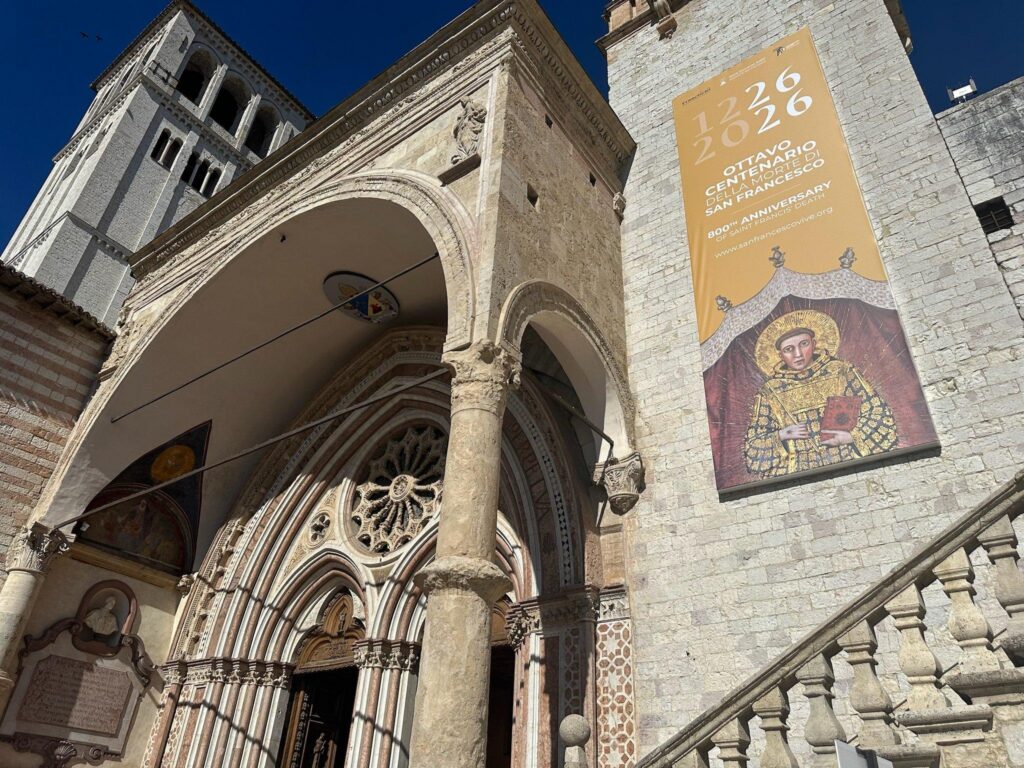
“We are experiencing an event of extraordinary grace: For an entire month, in this holy land where St. Francis of Assisi lived and was buried, the exposition of his body is offered for the veneration of the faithful, on the eighth centenary of his death,” Cardinal Artime said.
“This body, fragile and poor, reminds us that the Gospel is also lived with the body, with real choices, with daily gestures. Francis did not love an idea of Christ: He loved Christ, poor and crucified, to the point of bearing his marks in his flesh.”
Courtney Mares is Vatican editor for OSV News. Follow her on X @catholicourtney.
