

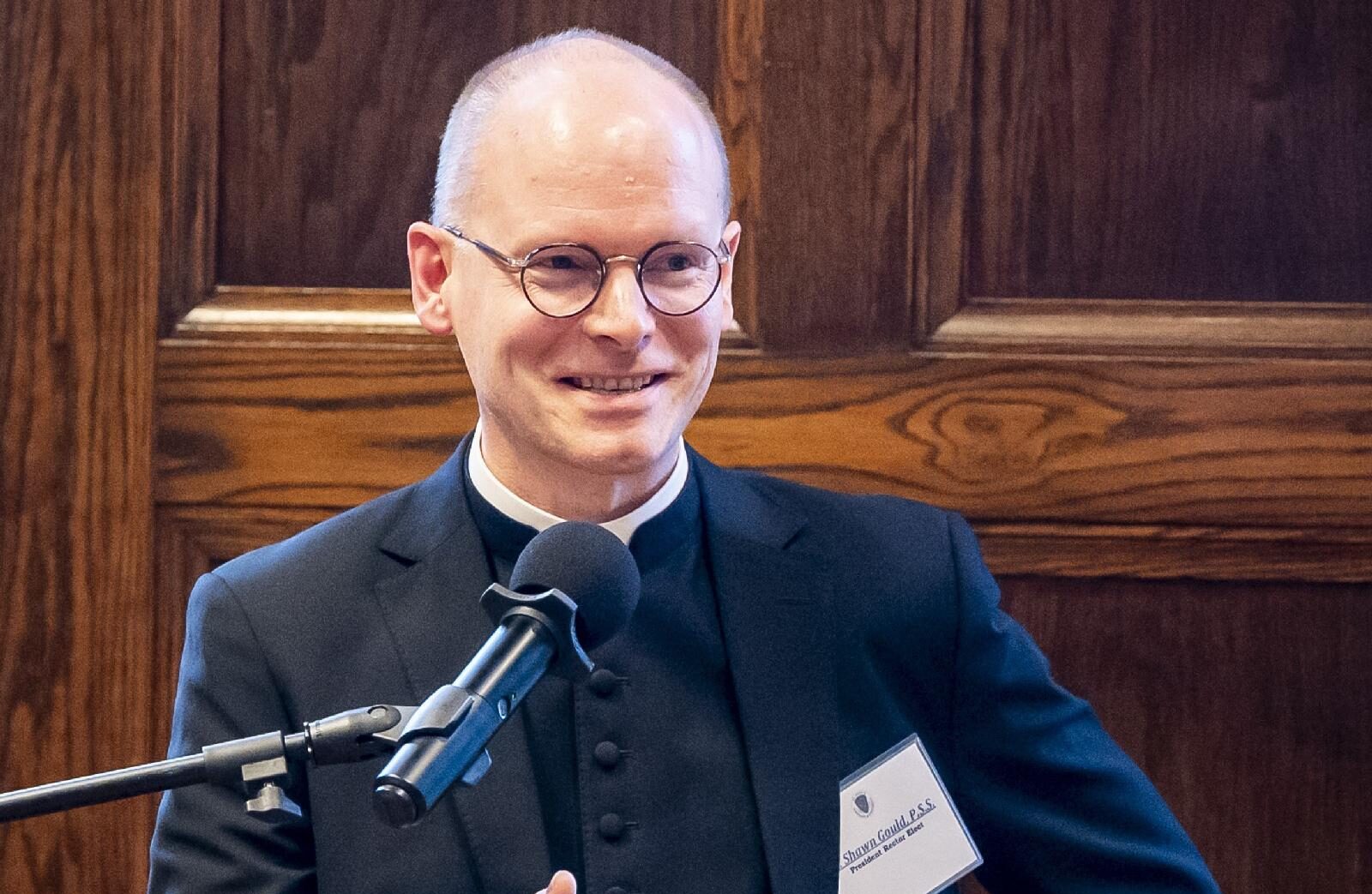
BALTIMORE (OSV News) — On Sept. 2, Sulpician Father Shawn Gould will be formally installed as the new president and rector of the nation’s first Roman Catholic seminary, St. Mary’s Seminary and University in Baltimore, which was established in 1791 by the Society of St. Sulpice.
Father Gould succeeds fellow Sulpician Father Phillip J. Brown, who retired June 30 after a decade at the seminary’s helm.
Ahead of his installation, OSV News sat down with Father Gould — whose appointment was announced in January and took effect July 1 — to explore his remarkable vocation journey.
This interview has been edited for length and clarity.
OSV News: Were you raised a Catholic?
Father Gould: I did not grow up in the Catholic Church. I was raised in a town called Grand Haven, Michigan. I was baptized in the Reformed Church in America, which is part of the old Dutch Reformed Church, and grew up in the Presbyterian Church.
We went to church every Sunday. West Michigan, in the 1980s, was like a kind of mini Bible Belt — “sola Scriptura” (a tradition holding the Bible alone is the final authority on God’s will and salvation). The Presbyterian church we went to was a very solid community. They had a very good senior minister, whose boys were my best friends because they lived right next door to us.
It was a pretty idyllic experience. We all went to church; it just was a given. But around the time of middle school, I started having a lot of doubts (about faith).
OSV News: What specific kind of doubts?
Father Gould: My friends and I were very interested in natural sciences. I became very skeptical about the truth of (religious) claims — things like a man who died and is now alive again, and particularly the ability to know that God existed.
I functionally became an atheist or an agnostic through all of high school. It wasn’t so much about evolution and the Genesis accounts of creation. Religion seemed to me to be mostly just dependent on which family you happened to grow up in, and it was not a matter of knowledge, the way the sciences would be.
It (disbelief) wasn’t entirely consistent. Some of my friends still went to church every Sunday, and I sometimes still went to church. My parents allowed my sister and me to choose whether we would go to church once we got to late middle school, early high school.
I did have some Catholic friends, but I didn’t really understand the difference. It just seemed like we were all Christians, more or less. And they were just another version.
However, (the University of) Notre Dame played a strong role in my vocation story and my coming back to the faith.
OSV News: How did the university impact your views on the matter?
Father Gould: My dad had gotten his MBA at Notre Dame, and even though he’s not Catholic, he loved his experience there. He started taking my sister and me to (Notre Dame) football games, and we became huge fans. When it came time to apply to universities, my dad wanted to make sure that I applied to Notre Dame.
Notre Dame had a feel to it that I couldn’t quite describe. Some would call it a family aspect — no fraternities and sororities, but residence halls where you stay for the whole time if you want. It’s much more collegial.
The university had a great books program, which I became very interested in as well. So I went to Notre Dame, and it made a huge difference.
I was in the marching band and played the piccolo. I had chosen the flute in fifth grade — and I had zero social sense that the flute would be played mostly by girls. (Laughs.) In college, they loved having the guy in their section (of the band), and my guy friends were always like, “Will you set us up with the piccolo players?”
I was auditioning for the marching band and came a day early to orientation. The Holy Cross priest who was my dorm rector was the first priest I ever actually met. He was very interested in having me play at his dorm Masses.
I had no idea what Mass was about, so I relied on the student music director telling me when to play what. I was going every Sunday, because I was part of this group, and I had a sort of obligation. I wasn’t taking Communion or anything like that; it was very clear that I wasn’t Catholic.
We didn’t do Ash Wednesday in my childhood church, so my first one (at Notre Dame) was unusual to me. I was annoyed that there would be no meat in the dining hall that day and on Fridays in Lent, thinking, “Hey, we’re not all Catholic here.” And I remember the priest coming to me on Ash Wednesday with ashes, and I’m like, “I’m not Catholic.” He said, “It doesn’t matter,” and put the ashes on my forehead. And so I went back right to my room and washed them off.
All my friends were Catholic, with most of them going to Mass and being pretty knowledgeable (about the faith). That was a huge help to me: to have peers who were believing and practicing. We started to have conversations that challenged some of the assumptions I had made (about faith). Having a peer group of very smart people who were believing undermined my assumption that intelligent people are non-believers.
The other big help was the university’s great books program, which also led me to examine some of my assumptions — for instance, about how you can know things, whether all knowledge has to be the result of a proof, and whether reality should only be limited to the empirically verifiable.
I was Christian again by the time that I left Notre Dame, but not Catholic yet.
OSV News: When did you begin to seriously consider the Catholic faith?
Father Gould: After graduation, I went to law school, and I still had Catholic friends with whom I continued to have conversations about things like the real presence of the Lord in the Eucharist. So seeds continued to be sown.
I was becoming more skeptical about some of the claims of John Calvin. And then I started reading on the Catholic side — the Catechism of the Catholic Church, St. John Henry Newman, St. Ignatius of Antioch.
Newman’s insights on the development of Christian doctrine helped me. Coming to understand what it really meant for the pope to have the charism of infallibility was important.
St. Ignatius of Antioch was extremely helpful, because one of the assumptions I had was that the early church was basically Presbyterian — which might sound funny, but I really thought, “We Protestants are the ones who have the form of the ancient Church.”
But while being hauled to Rome (for martyrdom), St. Ignatius witnessed to the reality that you have to be in communion with the bishop if you’re going to be in communion with Christ, and there’s only one legitimate Eucharist, and it’s the one that’s in communion with the bishop. And St. Ignatius was willing to die for this.
I was rereading some particular Scriptures in a more Catholic light, like the sixth chapter of John’s Gospel, and thinking, “OK, so the Catholic Church says that the Lord himself has said that his body is food. That’s what the Greek says.” I had read the New Testament many times, including the Gospel of John, and somehow I just hadn’t noticed.
I entered the Church about a year or so after I graduated from law school. I’d been practicing corporate real estate law. I worked at a big firm in Milwaukee, and then an even bigger firm in Chicago.
In terms of entering the Church, I think Newman is right when he says there usually isn’t just one thing. It’s converging points, many seeds coming up at once.
I was received into the Church in 2002 on the last Sunday of Ordinary Time before Lent began, which seems very fitting since that imposition of ashes at Notre Dame.
OSV News: How did you discern a call to the priesthood, which led to your 2010 ordination as a priest of the Archdiocese of Chicago?
Father Gould: When I was confirmed, the thought entered my head, “Why not be a priest?” I put that aside as excessive enthusiasm. But I wasn’t dating seriously; it didn’t really make a lot of sense to me until I could support a family. There were constant intercessions at Mass for an increase in vocations, so it was very clear to me that we needed to have young men thinking about the priesthood. And why waste time?
In my discernment of celibacy, I’ve never had the idea it’s something the Church imposes on priests, maybe because I read my way into the Church. I read the Church documents where you find some Christian men and women are called to be celibate for the sake of the kingdom. There isn’t marriage in heaven, except between the soul and God, and so God calls some to just go ahead and embrace it now.
The thought of priesthood was there because I was really grateful. The Eucharist is the most amazing thing ever — that God himself is here in a special way.
OSV News: Did you encounter any concern from your family over your vocation?
Father Gould: Not exactly. I’ve always been a pretty independent person; I didn’t cause my parents anxiety when I was a kid. When I became Catholic, that was fine with them. Regarding my priesthood, my dad, I think, had seen it coming. I think my mom saw me being pretty well-off (with a law career), with marriage and kids. But she has grandkids thanks to my sister, so everyone is happy. And my mom came into the Church when I was in the seminary. I think she’s very happy with me now.
OSV News: What would you say to a young man sensing a possible call to the priesthood?
Father Gould: Of course, what he has to do is pray. And I would encourage him to be praying in a specific way. Ask God to shed light so that he’s seeing his life in relation to God, and particularly in relation to heaven.
And then say, as you’re looking out at this life that’s presented before you, “What seems to be, with God’s help, the path that leads you to heaven?”
Gina Christian is a multimedia reporter for OSV News. Follow her on X @GinaJesseReina.
