


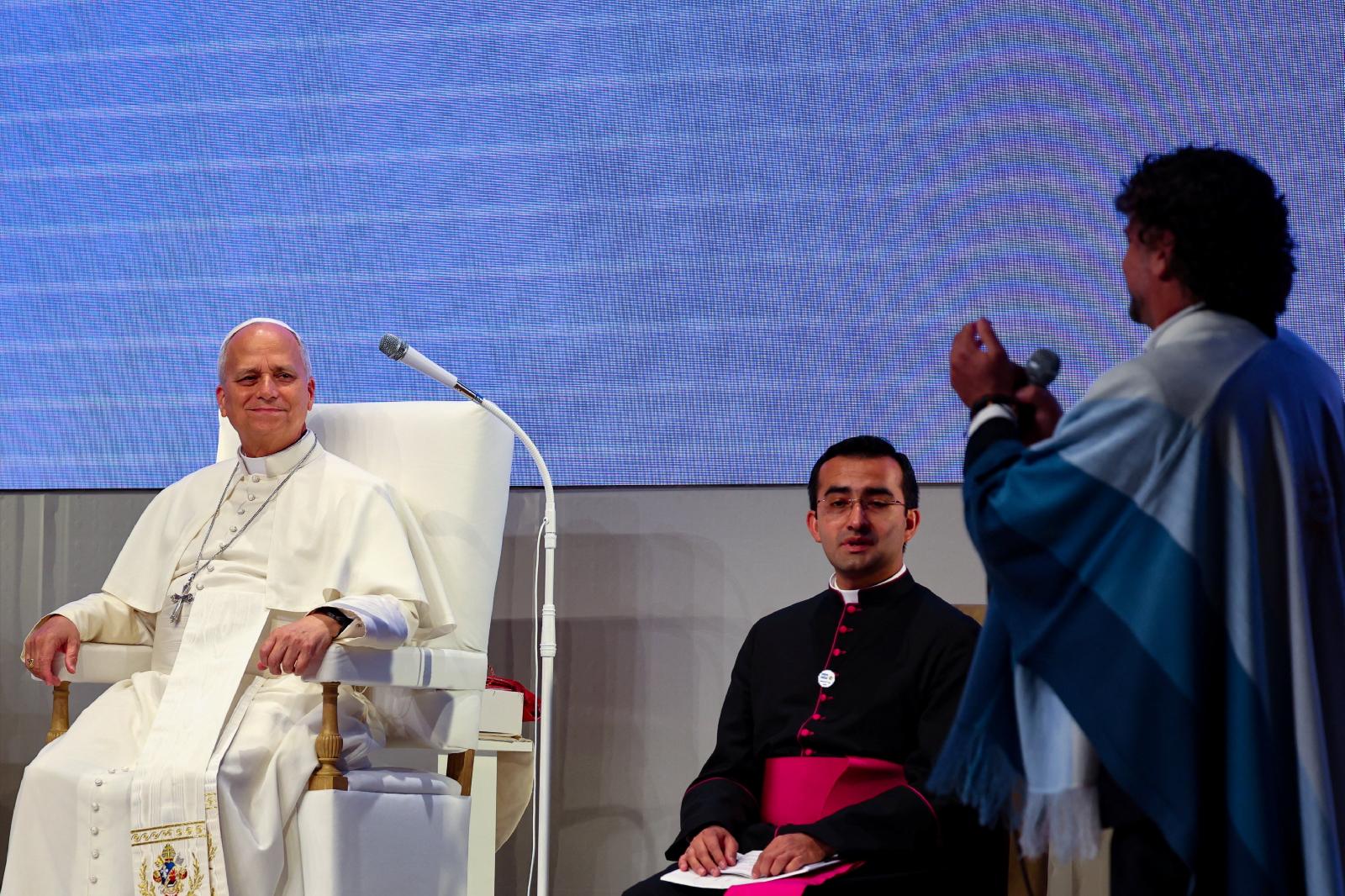
BUENOS AIRES, Argentina (OSV News) — Pope Leo XIV held up Enrique Shaw, an Argentine businessman and father of nine, as evidence that business can become a path to holiness when informed by the Gospel and Catholic social teaching.
Pope Leo spoke about Shaw Nov. 9 during an encounter with business leaders, trade unionists, workers and representatives of social movements at the Pontifical Catholic University of Argentina in Buenos Aires. Shaw supported the university’s establishment and served as its first treasurer and a member of its administrative council.
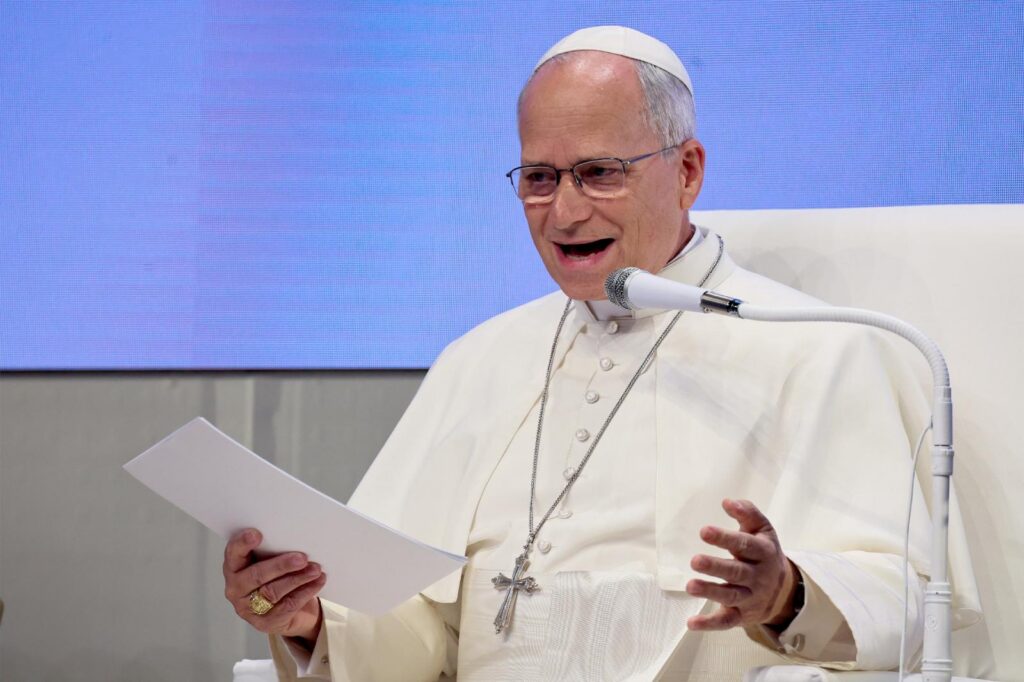
“In the business world, the life of Venerable Enrique Shaw, a Catholic entrepreneur who underwent a conversion after discovering the beauty of the Gospel as expressed in the Church’s Social Doctrine, speaks to us with particular force,” Pope Leo said.
Calling Shaw “the future Blessed,” the pope said his Christian understanding of the human person led him to recognize that industry “was not just a productive mechanism or a means of accumulating capital, but a true community of people called to grow together.”
Pope Leo then quoted Shaw’s own description of the vocation of a Christian business leader.
“It is necessary to form Christian business leaders and provide them with a specific way of living: that of contributing to a better world, principally through the action of each Christian business leader in his own sphere,” Shaw wrote. “This is a mission of religion and life: seeking to sanctify ourselves through our profession and to sanctify the profession.”
‘He embodied Catholic social teaching in business world’
For Shaw’s granddaughter María Elena Critto, Pope Leo’s attention to her grandfather also reflects a striking connection between the pontiff’s choice of name and the body of Church teaching that transformed Shaw’s life.
“Enrique’s conversion came about through the social doctrine of the Church, and his life and mission were deeply shaped by it,” Critto told OSV News.
Pope Leo has said he chose his name partly because Pope Leo XIII confronted the social upheavals of the Industrial Revolution with the 1891 encyclical “Rerum Novarum.” The document, considered foundational to modern Catholic social teaching, defended workers’ dignity and rights while addressing the responsibilities of employers and the state.
Shaw, Critto said, studied that teaching deeply and made it his mission to bring the Gospel into a sphere that can appear detached from faith: business and economic life.
“He embodied Catholic social teaching in the business world,” she said, demonstrating that an employer can look beyond the economic dimension of a company and recognize “the dimension of human dignity.”
Shaw was a holy man in everyday business
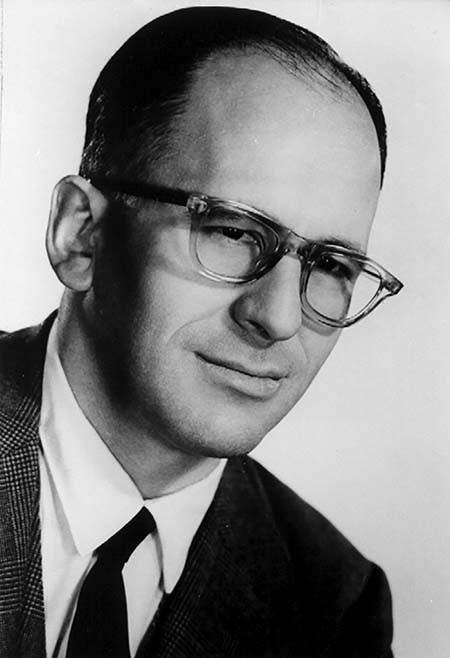
Born in Paris to Argentine parents in 1921, Shaw entered Argentina’s naval academy as a teenager and became one of its youngest commissioned officers. After discerning a possible religious vocation, he instead came to understand that his mission was to marry, raise a family and evangelize from within the world of business.
He married Cecilia Bunge in 1943, and they had nine children. After leaving the Navy, Shaw eventually became managing director of the Rigolleau glass company, which employed thousands of workers.
He also became active in Argentine Catholic Action and helped found the Christian Association of Business Executives, known by its Spanish acronym ACDE, in 1952. He also participated in the establishment of the Pontifical Catholic University of Argentina and Caritas Argentina.
At Rigolleau, Shaw pioneered robust health care programs and financial assistance for employees and their families. His commitment was put to the ultimate test in 1961 during a severe economic crisis. When the company’s majority shareholders, the U.S.-based Corning Glass Works, ordered the dismissal of some 1,200 workers, Shaw — already suffering from terminal cancer — traveled to their headquarters in the United States.
Leveraging his personal credit and presenting an innovative alternative to utilize the workforce for facility maintenance, he successfully convinced the American executives to rescind the layoffs and preserve every single job.
The ‘transcendent vision’ of Enrique Shaw
His understanding of a company extended well beyond its shareholders, Critto said. Shaw considered workers, their families, suppliers, customers, competitors and the wider community to be affected by the decisions of business leaders.
“He had a transcendent vision,” she said. “He promoted unity and growth together — and the growth of everyone.”
Pope Leo had previously presented Shaw as a model for the business world in a November 2025 message to the Argentine Industrial Conference.
In that message, the pope said Shaw’s life demonstrated that Catholic social teaching “is not an abstract theory or an unattainable utopia,” but a practicable path capable of transforming people and institutions.
“His life shows that it is possible to be both a businessman and a saint, that economic efficiency and fidelity to the Gospel are not mutually exclusive, and that charity can penetrate even industrial and financial structures,” Pope Leo wrote.
Shaw expressed the same principle with characteristic directness: “The factory must be humanized. To judge a worker, one must love him.”
For Critto, her grandfather’s example is not principally a list of accomplishments or enlightened employment policies. It is the story of a lay Catholic who refused to divide his life into separate religious, professional and family compartments.
His witness, she said, challenges Catholics to avoid becoming one person at work from Monday to Friday and another person at Mass on Sunday. Instead, holiness must be pursued coherently through every responsibility and relationship.
Shaw began that effort with prayer, the Eucharist and the sacraments, she said, while remaining close to the Church and attentive to spiritual direction.
When he initially considered evangelizing as an ordinary worker, he was advised that his greater responsibility was to influence the business world from the position he already occupied.
“He wanted to be a worker and evangelize the workers,” Critto recalled. Instead, he was told: “You are a businessman. You have to influence that world.”
During his illness, over 200 employees donated blood for transfusions
Shaw died of cancer in Buenos Aires Aug. 27, 1962, at 41. During his illness, more than 200 Rigolleau employees volunteered to donate blood for transfusions. On his deathbed, Shaw joked that nearly all the blood flowing through his veins was workers’ blood.
Pope Francis recognized Shaw’s heroic virtues in 2021, declaring him venerable. On Dec. 18, 2025, Pope Leo authorized the promulgation of a decree recognizing a miracle attributed to Shaw’s intercession, clearing the way for his beatification.
Critto described having Shaw as a grandfather not as a personal accomplishment or reason for pride, but as “an undeserved blessing” that carries a responsibility to share his witness.
“The testimony of Enrique transformed me,” she said. “The best way to give thanks for what I received is to give it to others.”
His central lesson, she said, is that holiness is not reserved for those who withdraw from the ordinary demands of family, work or economic life.
“God is waiting for all of us,” Critto said. “It is possible, but we have to set ourselves to it.”
Inés San Martin writes for OSV News from Buenos Aires, Argentina.
