


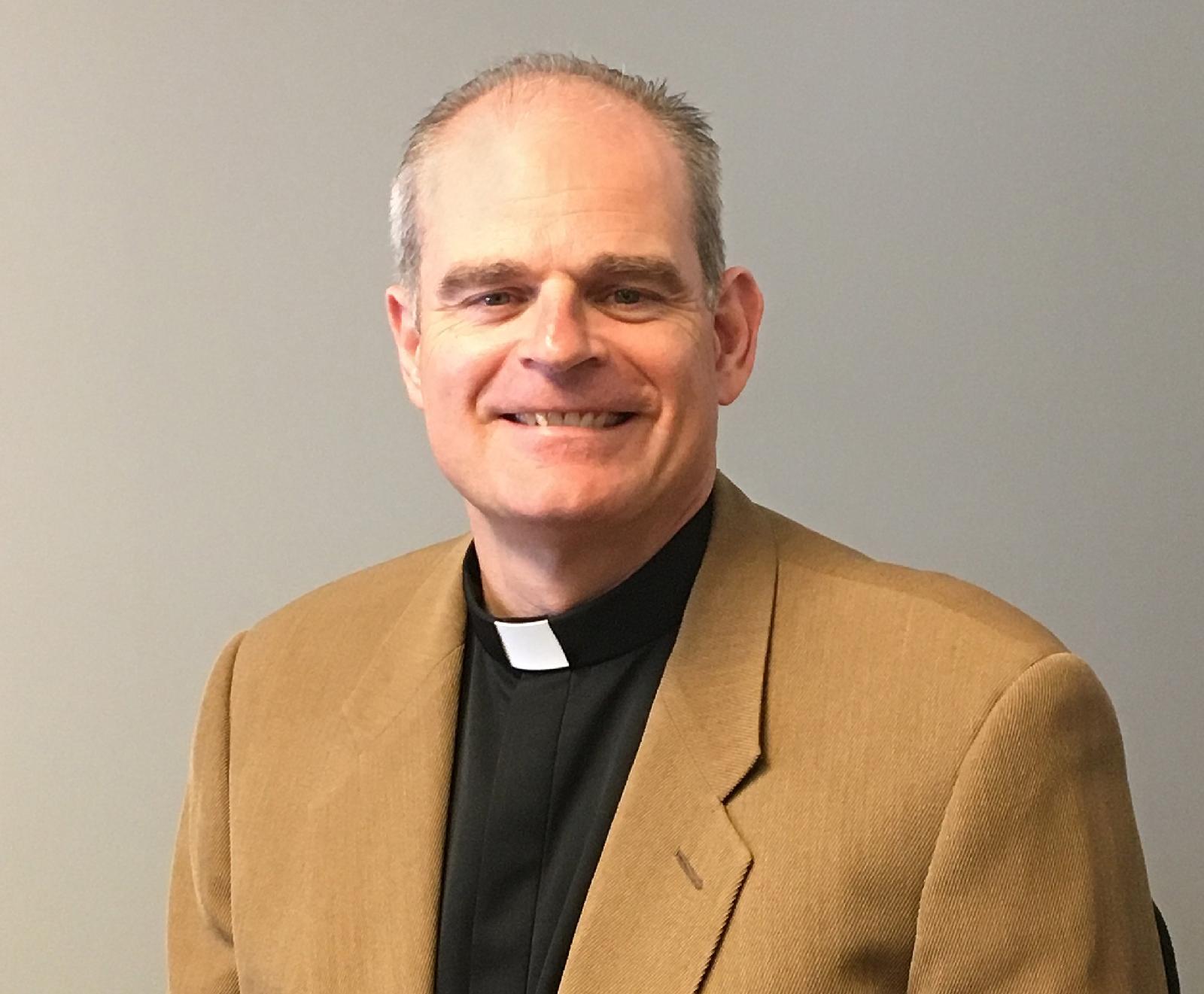
VATICAN CITY (OSV News) — Father Brendan McGuire used to be a Silicon Valley technology executive. Now he’s hearing their confessions. Today, the Irish-born pastor of St. Simon Catholic Parish in Los Altos, California, is helping to shape the moral conscience of the artificial intelligence industry.
Earlier this year, he was among the faith leaders invited by Anthropic, the AI company behind the chatbot Claude, to advise on the creation of an ethical framework to govern how the AI system handles complex moral questions.
Bridge for two worlds
Father McGuire, 60, holds engineering and computer science degrees from Trinity College Dublin and completed Stanford University’s executive business program. He spent years in Silicon Valley as a technology executive before leaving it all behind to be ordained a priest of the Diocese of San José 26 years ago.
“I came from the industry,” Father McGuire told OSV News. “My heart’s never left it, but my heart is really with the Lord.”
“I’ve always felt my role was to bridge those two worlds together,” he said.
In an interview at the Vatican after the May 25 promulgation of Pope Leo XIV’s encyclical “Magnifica Humanitas: On Safeguarding the Human Person in the Time of Artificial Intelligence,” Father McGuire underlined the urgency of the pope’s message.
“What I’m most worried about is us as humanity not taking this moment seriously,” he said. “If we stay silent and just be passive, then this could go very wrong for us.”
‘Disarmament of the algorithms’
The Silicon Valley priest said he was particularly struck by Pope Leo’s call for a “disarmament of the algorithms,” a deliberate slowing of the competitive race to develop ever more powerful AI systems.
“There’s an algorithmic race on,” Father McGuire said. “And to disarm that would mean that we need to be thoughtful about that. … It can be dangerous, just like the nuclear arms race is dangerous. And I thought that was really powerful.”
In 2019, Father McGuire co-founded the Institute for Technology, Ethics and Culture (ITEC), a formal partnership between Santa Clara University’s Markkula Center for Applied Ethics and the Vatican’s Dicastery for Culture and Education, bringing together business, academic and faith leaders to address the moral challenges posed by artificial intelligence.
“What Pope Leo’s encyclical today really brings to the fore is a recentering of artificial intelligence around human flourishing,” he said.
AI engagement is everyone’s responsibility
Father McGuire was emphatic that the pope’s challenge is not addressed to technologists alone. Governments, regulatory bodies, ordinary users and even those who never touch a smartphone have a stake in how this technology develops, he argued.
And, he said, everyone has a responsibility to engage.
“This isn’t just about technical people in Silicon Valley or investors or business people making a decision. This is for all of us to play a role and to be involved at all different levels,” he said. “Even the non-user needs to use his voice. Why? Because they’re going to be affected by this.”
Father McGuire is clear-eyed about the economic forces at play. Trillions of dollars are flowing into AI development, and investors will demand returns. That reality, he said, is precisely why the ethics of AI development cannot be left to the market alone.
“Capitalism needs human guidance. And this is the human guidance the pope is asking for,” he told a group of journalists after Anthropic co-founder Chris Olah spoke at the Vatican press conference with Pope Leo to present the encyclical.
‘Transparency leads to accountability’
The priest is also skeptical of industry self-regulation. Transparency, he argued, is the necessary first step toward accountability.
“Transparency leads to accountability, and accountability leads to trust. And with trust we’ll have responsible AI. But we can’t get there without transparency,” he said. “If we don’t know how these things are being developed and what they’re doing, then how could we regulate them? We can’t.”
Still, Father McGuire resists both techno-utopianism and techno-apocalypticism.
“There are those who … think it’s going to destroy humanity. And then there are those on the other end who think it’s going to be the great savior of humanity,” he said.
Father McGuire said that he sits in between these two extremes.
He acknowledges that many in the AI industry are acting in good faith, even as he insists that good intentions are not enough.
“I have seen men and women — and not just at Anthropic, of other AI companies — of genuine goodwill who are trying to do the right thing,” he said. “Unless we have those good intentions, we’re not going to get anywhere, so we need to meet the good intention and then have a dialogue.”
The opportunity is now
The window to shape this technology is open now, but, he warned, it may not stay open.
“It’s in the moment right now where it is still malleable. It is still changing. You can make changes to this. And if we can get in now to make changes for the good, then we will all benefit the whole of humanity,” he said. “Now is the moment.”
Courtney Mares is Vatican editor for OSV News. Follow her on X @catholicourtney.
