


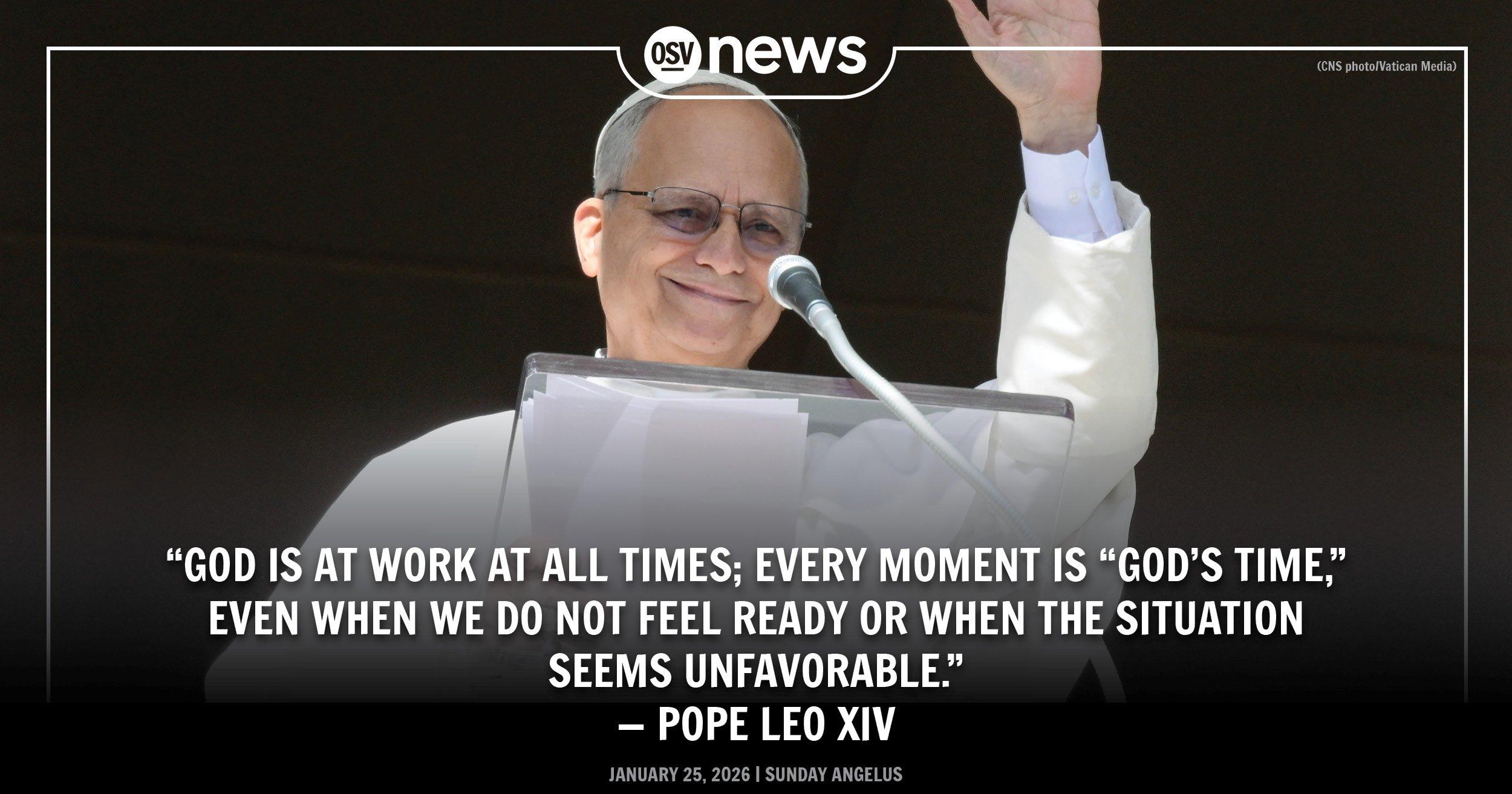
(OSV News) — The following is the full text of Pope Leo XIV’s Angelus address given Jan. 25 to those gathered in St. Peter’s Square.
Brothers and sisters, happy Sunday!
After his baptism, Jesus began his preaching and called his first disciples: Simon, who is called Peter, his brother Andrew, and James and John (cf. Mt. 4:12-22). Reflecting more closely on this scene from today’s Gospel, we can ask ourselves two questions. The first concerns the timing of Jesus’ mission, and the second regards the place he chose to preach and to call his apostles. We may ask: When did he begin? And where did he begin?
First of all, the Gospel tells us that Jesus began his preaching “when he heard that John had been arrested” (v. 12). He began, therefore, at what might appear to be an inopportune moment. John the Baptist had just been imprisoned, and the leaders of the people were seemingly reluctant to embrace the newness of the Messiah. Apparently, it was a time that called for caution. Yet, it was precisely in this dark situation that Jesus began to bring the light of the good news: “The kingdom of heaven has come near” (v. 17).
“God is at work at all times”
In our lives, both individually and as a Church, interior struggles or circumstances we deem unfavorable can lead us to believe that it is not the right time to proclaim the Gospel, to make a decision, to make a choice, or to change a situation. In this way, however, we risk becoming paralyzed by indecision or imprisoned by excessive prudence, whereas the Gospel calls us to dare to trust. God is at work at all times; every moment is “God’s time,” even when we do not feel ready or when the situation seems unfavorable.
The Gospel also offers us insight into the specific place where Jesus began his public mission. We are told that he “left Nazareth and made his home in Capernaum” (v. 13). By doing so, he remained in Galilee — a predominantly pagan territory that trade had transformed into a crossroads and a place of encounter. We might describe it as a multicultural region, traversed by people of diverse origins and religious affiliations. In this sense, the Gospel reveals that the Messiah, while coming from Israel, transcends the borders of his own land to proclaim a God who draws close to everyone. He is a God who excludes no one, and who comes not only for the “pure,” but enters fully into the complexity of human situations and relationships. As Christians, therefore, we too must overcome the temptation toward isolation. The Gospel must be proclaimed and lived in every setting, serving as a leaven of fraternity and peace among all individuals, cultures, religions and peoples.
Brothers and sisters, like the first disciples, we are called to embrace the Lord’s invitation with joy, knowing that every time and every place in our lives is permeated by his presence and his love. Let us pray to the Virgin Mary, that she may obtain for us this inner trust and accompany us on our journey.
Pope Leo XIV speaks after the Angelus about the Sunday of the Word of God, Week of Prayer for Christian Unity
Dear brothers and sisters,
This Sunday, the third Sunday in Ordinary Time, is the Sunday of the Word of God. Pope Francis instituted it seven years ago to promote throughout the Church knowledge of sacred scripture and greater attention to the Word of God in the liturgy and in the life of communities. I thank and encourage all those who are committed with faith and love to this priority.
Even in these days, Ukraine is being hit by continuous attacks, leaving entire populations exposed to the cold of winter. I am following the situation with sorrow, and I am close to and pray for those who suffer. The continuation of hostilities, with increasingly serious consequences for civilians, widens the rift between peoples and pushes further back the opportunity for a just and lasting peace. I invite everyone to intensify their efforts to end this war.
Today is World Leprosy Day. I express my closeness to all those affected by this disease. I offer a word of support to the Italian Association of Friends of Raoul Follereau and all those who care for leprosy patients, especially their commitment to protecting the dignity of patients.
I welcome all of you, faithful of Rome and pilgrims from various countries! In particular, I greet the parish choir of Rakovski, Bulgaria, the group of Quinceañeras from Panamá, the students of the Zurbarán Institute in Badajoz, Spain; as well as the confirmands from the parish of San Marco Vecchio in Florence, the school community of the Erodoto Comprehensive Institute in Corigliano-Rossano, and the Cuori Aperti Volunteer Association in Lecce.
I warmly greet the young people of Catholic Action of Rome, together with their parents, educators and priests, who have organized the Caravan for Peace. Dear children and young people, I thank you because you help us adults to look at the world from another perspective: that of cooperation between people and among diverse peoples. Thank you! Be peacemakers at home, at school, in sports, everywhere. Never be violent, neither with words nor with gestures. Never! Evil can only be overcome with good.
Together with these young people, let us pray for peace: in Ukraine, in the Middle East, and in every region where, unfortunately, there is fighting going on for interests that are not those of the people. Peace is built on respect for peoples!
Today concludes the Week of Prayer for Christian Unity. In the afternoon, as is tradition, I will celebrate vespers in the Basilica of Saint Paul Outside the Walls together with representatives of other Christian denominations. I thank all those who will participate, including through the media, and I wish everyone a happy Sunday.
