


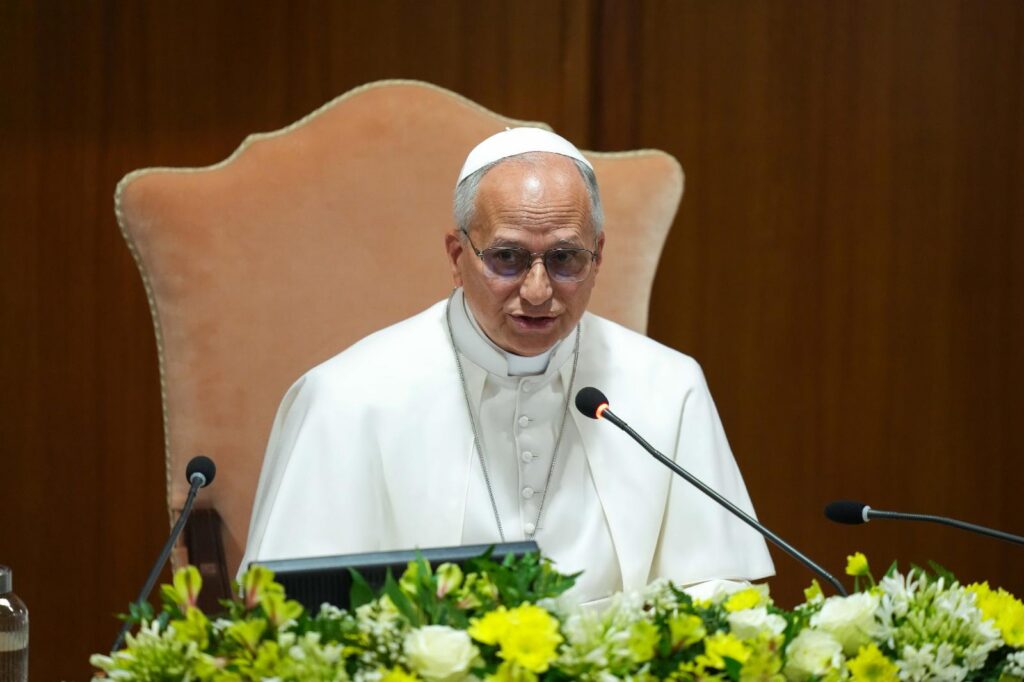
VATICAN CITY (CNS) — In his first encyclical, Pope Leo XIV used a sweeping reflection on artificial intelligence to question whether the Catholic Church’s centuries-old just war framework remains valid in modern warfare and to ask pardon for the church’s role in slavery.
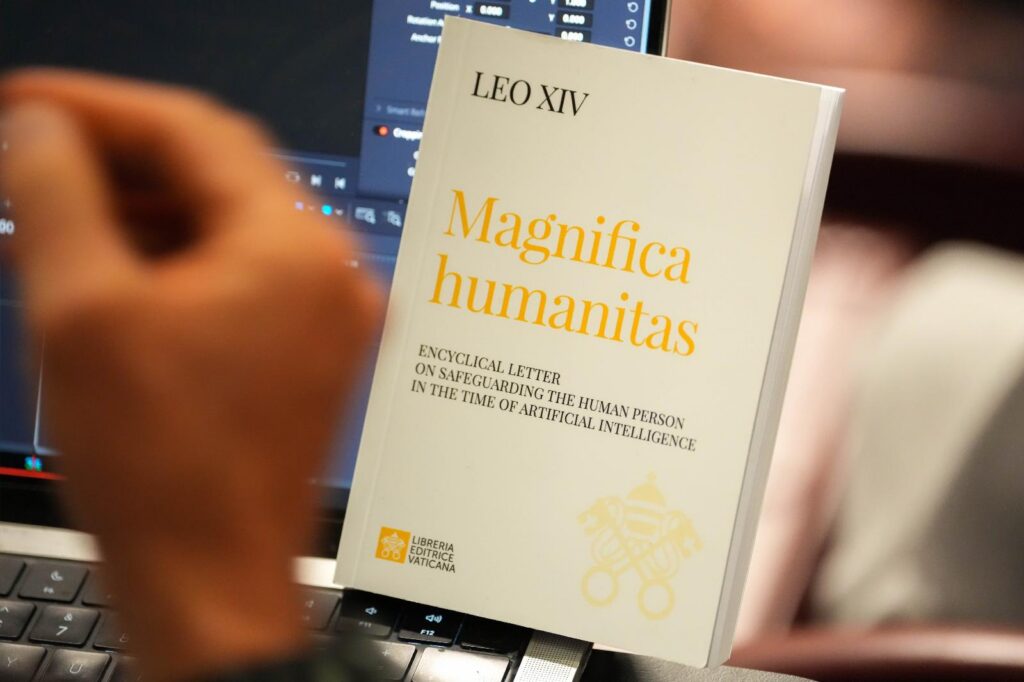
The pope’s 82-page encyclical, “Magnifica Humanitas” (“Magnificent Humanity”), primarily focuses on the ethical development of artificial intelligence and the dangers posed by autonomous weapons, concentrated technological power and the erosion of human dignity. But within the document, Pope Leo also makes several broader interventions on war, violence and historical injustice.
In discussing such topics, he questioned the Catholic teaching of just war theory in modern warfare and wrote about slavery in an unprecedented way.
Just war theory accepted for centuries
The just war theory, largely created through the writings of St. Augustine and St. Thomas Aquinas, has been accepted for centuries throughout Catholic teaching, to determine whether warfare could be morally justified under strict conditions. It states that a nation must try its best to avoid violence by considering the human cost, just cause and an effort to engage in diplomatic negotiations. It has recently been used by the Trump administration to justify the ongoing conflict in the Middle East.
But Pope Leo wrote the theory has become increasingly insufficient in an age shaped by advanced weaponry and artificial intelligence and “is now outdated.”
“Humanity possesses far more effective and capable tools for promoting human life and resolving conflicts, such as dialogue, diplomacy and forgiveness,” he wrote. “The use of force, violence and weapons reflects a relational poverty that always has disastrous consequences for civilian populations.”
Additional criteria to consider before warfare
The pope also introduced additional criteria he said should be considered before warfare, including ensuring a clear chain of responsibility when automated technologies are used in combat, establishing a “moral timeframe for making judgments” in an era when artificial intelligence can accelerate military decisions, and safeguarding civilians.
Elsewhere in the encyclical, Pope Leo addressed the Catholic Church’s participation in the “scourge of slavery,” in broader terms than many of his predecessors. Previous popes have apologized for more specific instances like Christian involvement in the transatlantic slave trade, but Pope Leo appeared to frame the Church’s responsibility more institutionally.
“It is impossible not to feel deep sorrow when contemplating the immense suffering and humiliation endured by so many in stark contrast to their immeasurable dignity as persons infinitely loved by the Lord,” he wrote. “For this, in the name of the Church, I sincerely ask for pardon.”
Novel approach to 2 subjects in particular
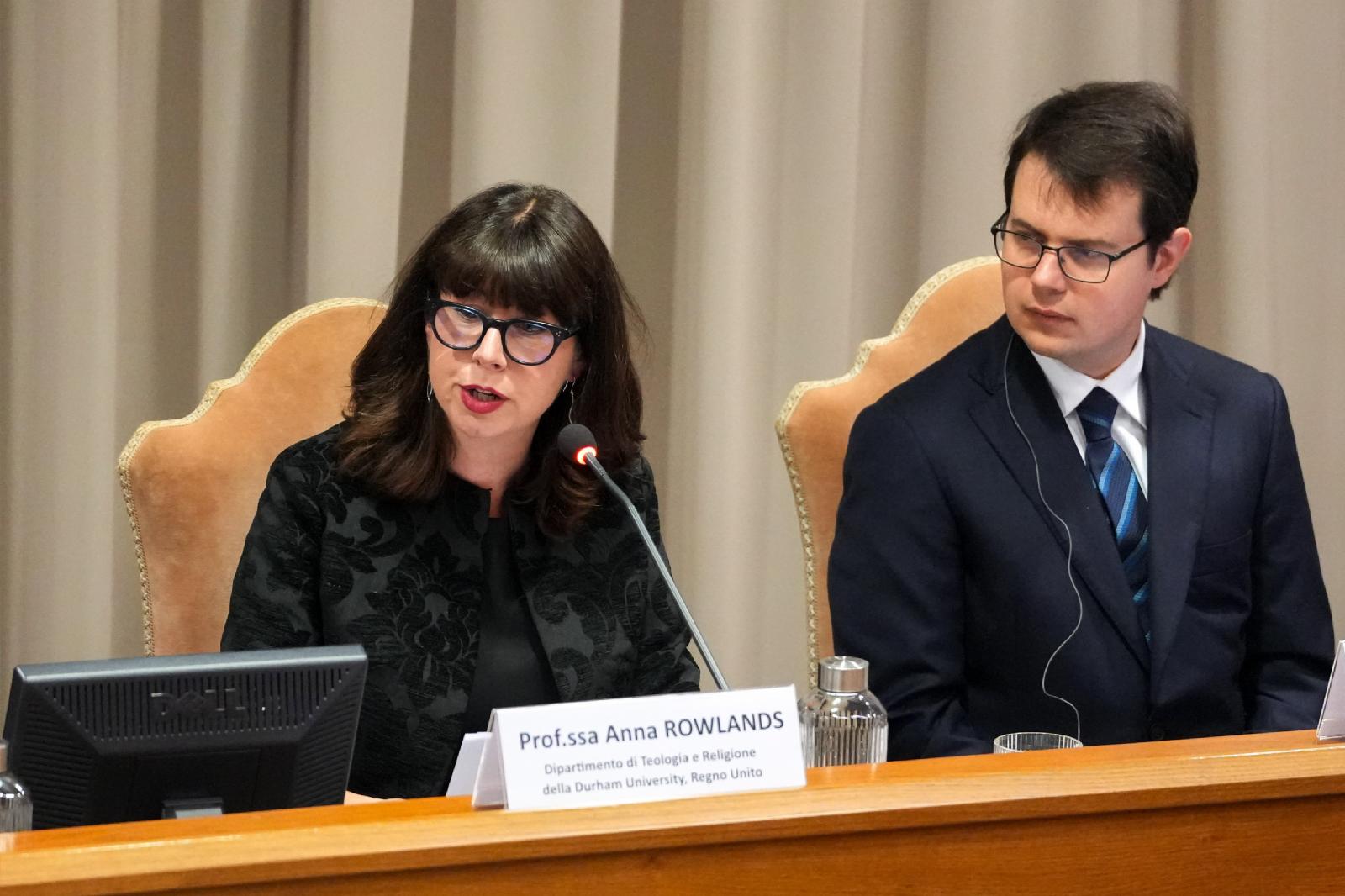
The pope’s comments immediately drew attention because both subjects, just war theory and institutional responsibility for slavery, are novel approaches. Anna Rowlands, professor of political theology and Catholic social doctrine at Durham University in England, spoke with Catholic News Service about the significance of the pope’s statements and how they fit within the broader themes of “Magnifica Humanitas.”
This interview has been edited for clarity and length:
CNS: So talking about the fact that this first encyclical is addressing a lot of the issues that he’s brought up throughout his papacy, something that really struck us was his just war theory and how he said that it was outdated. I wanted to get your thoughts on that. If it is outdated, is there going to be a new theory that replaces it? Do you see tenants of that throughout this encyclical?
Rowlands: So, actually, Pope Leo is joining a conversation that’s been going on for some time through recent encyclicals and wider documents of the Church about exactly how we keep the dynamism of the Church’s commitment to peace as the only true end goal in sight. So the just war tradition was developed obviously from the early Church, from the first centuries, including Augustine’s very significant contribution to that, St. Thomas Aquinas’ contribution, and then into the modern era, that tradition was developed in order to try to work out how you can keep peace to the world and a sense that you could build sustainable, stable human communities that were committed to justice.
‘A moral architecture’ for thinking about world
So the question is, how much does the just war theory — which is a theory, it’s a way of thinking together about how you achieve those ends — how fit is it as a framework, as a kind of moral architecture for thinking about the world that we’re in now.
And in recent papacies, not simply Pope Leo at this moment, but in recent papacies, there’s been an attempt to reevaluate the usefulness of that theory to the modern moment. Without rejecting the theory outright, the evaluation has been: sometimes it can be too easy to deploy the just war theory in the world we live in now, too quickly to defend violence and intervention and force, rather than to pause back from it.
So the question is, can just war theory sometimes be pushed towards justifying violence where we might want to see peace? So it’s not that the Church has refused that tradition, and we saw Pope Leo do this very recently, he drew from the just war tradition in relation to Iran and the conflict of Iran, to say you need to remember this doesn’t meet the criteria of just war theory. That’s what many of the American bishops, the U.S. bishops, are also saying. So we still deploy that. You can see its usefulness and importance there.
A just peace for all in global order
But what the encyclical is doing, is saying, but don’t rely on that alone, and we need to continue this live discernment about the performance, the moral performance of just war theory. How much does it help us reach the true ends, which are a just peace for all within a global order and also within nations. And so in this moment, the encyclical is pushing us to say, you can’t use just war theory as a legitimate way to rush towards aggression and violence. And we need to find almost just war theory plus in order to enable us to really reach the ends of just peace. And remember, that’s the focus. It’s not just is there a textbook consideration that allows us to legitimate domination.
And what’s really important here is he’s evaluating adjustable theory in a tech era. Because everything in this document is looking at what does it mean to live in a time, an era, a moment where tech — we’re sitting here mic’d up, now you’re in front of a laptop — we’re totally tech-mediated in the conversation.
What does that do to warfare? And he’s very clear that it pushes to impersonalization, it pushes to a rapidification, a speeding up of decisions. And it seems to mean that we have a much less embodied understanding of what any use of violence, even if it might be in self defense, legitimate, what that really entails and how you create reflective intervals, true transparency and accountability. So if you read the bit of the document that comes after his critical critique of just war theory, he sets out some of the conditions, he calls them criteria for judgment that help us think what would we do now given the context of modern warfare that we’re in now? So he wants us to morally evaluate performance and theory, almost look beyond it into a framework that includes it, but takes us beyond. And he gives us some new criteria for a very tech driven era of warfare.
Church’s long tolerance of slavery
CNS: Something else that we found very interesting was — I think this was kind of one of the rare moments where we saw him ask for forgiveness for the Church’s long tolerance of slavery. Can you tell me a little bit about what you thought about that, and do you think that it was time? Do you think that it really is going to be impactful?
Rowlands: Yeah. So when I first read those paragraphs in the document, I was really struck by them. And I was struck by them for two reasons from two different perspectives. One is that the apologies that we have for slaves from the Church before, from John Paul II’s time onwards, including Pope Francis, have by and large been an expression of the deepest of sorrow and regret for the involvement of individual Christians in legitimating what is always illegitimately ownership and subjugation of a another human being. What this text does is move us slightly more in the direction of talking about the Church and the language of the Church, not merely individual Christians.
So there’s much more of a sense of a collective ownership of what is done in the name of the Church. There’s a kind of movement of language frame there which I think is about bringing the question of slavery and the legacy of slavery into a collective space of accountability, responsibility and discernment.
That links to the second part that struck me really centrally, which is it’s not just a sort of sudden moment of sort of a apologizing for slavery, it’s in the context of thinking about contemporary slavery now and the fact that in a tech era where there are new forms of subjugation and slavery, and Dr. (Leocadie) Lushombo talked in her intervention today about those new forms of slavery in the digital era, the extracted industries, the mining, the trafficking of people and so forth. He’s basically saying to us, we don’t want to be in another moment of history in 100 years where we are finding that we are apologizing once again because we didn’t deal with the slavery of our own era now. So he’s saying, if I’m going to say that with authority, which I’ve mastered urgency now, I must also deal with the historical past.
