


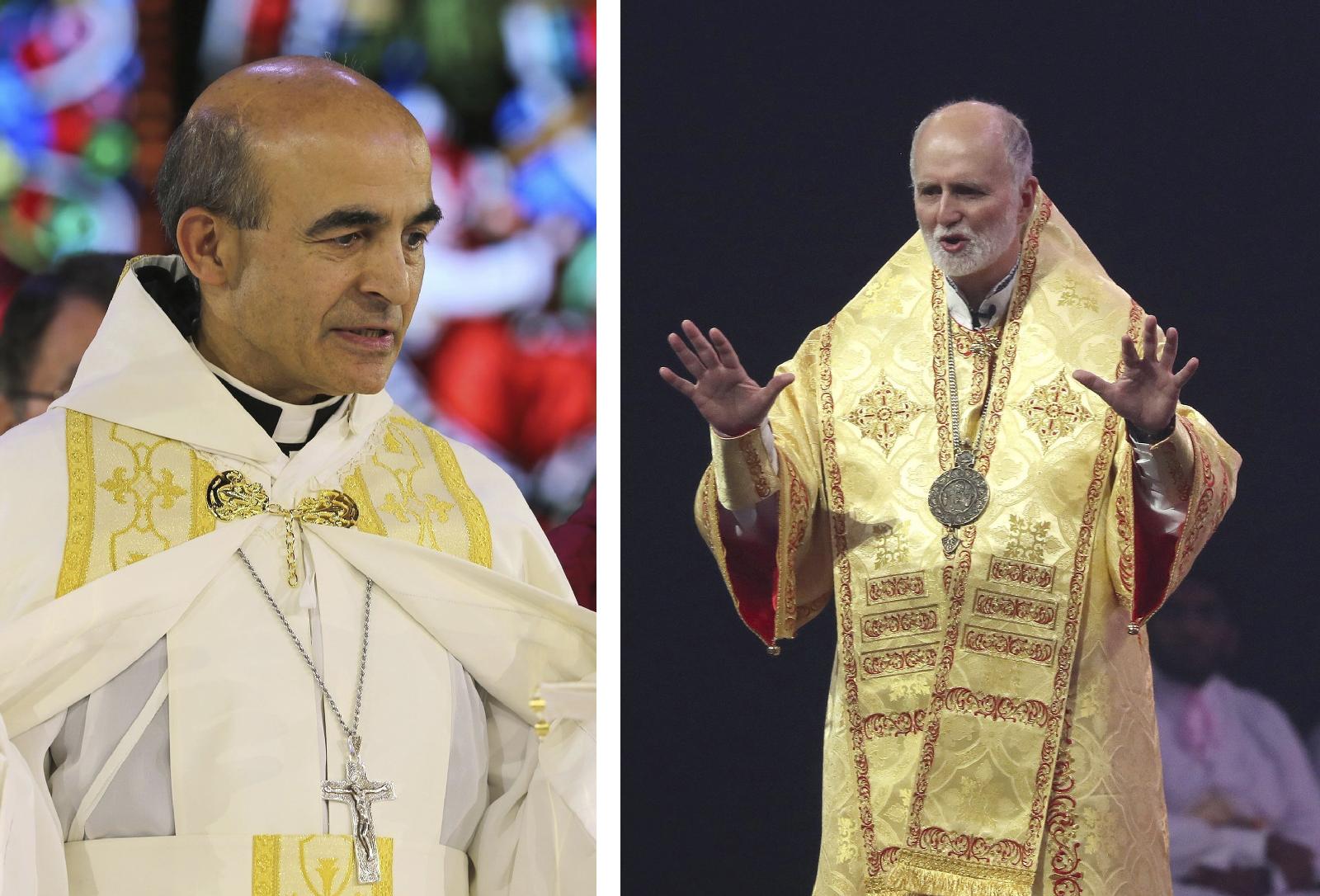
(OSV News) — The bishops of the Eastern Catholic Churches in the U.S. have issued “a cry for peace and justice,” as they are “anguished” by atrocities and suffering in the nations where their respective communities originated.
The prelates — representing several of the 23 Eastern Catholic Churches that with the Latin Catholic Church comprise the universal Catholic Church, headed by the pope — assembled March 17-19 for their annual spring meeting.
Following a longstanding custom, the gathering was hosted by Bishop A. Elias Zaidan of the St. Louis-based Maronite Eparchy of Our Lady of Lebanon of Los Angeles.
Situation in their ecclesial homelands
Amid the sessions, the bishops reflected on the current situation in their various ecclesial homelands, many of which are experiencing war and related violence.
In particular, Eastern Catholics in Ukraine and the Middle East have been in the crosshairs of conflict.
Russia’s war on Ukraine — which continues attacks launched in 2014, and which was accelerated by a 2022 full-scale invasion — has been assessed as a genocide in several joint reports from the New Lines Institute and the Raoul Wallenberg Center for Human Rights. Russian occupation officials have formally banned the Ukrainian Greek Catholic Church in at least one region, and occupied regions of Ukraine no longer have any priests.
Iran counterattacks on Middle East nations
Lebanon, the ancient home of Maronite Catholics, and several other Middle East nations have come under attack since the U.S.-Israel war on Iran was launched Feb. 28 and has been met with counterattacks.
The conflict has plunged the region — as well as global relations and markets — into uncertainty. More than 2,000 have been killed throughout the Middle East in the war, with 1 million in Lebanon displaced as Israeli and Hezbollah forces trade attacks. Father Pierre al-Rahi, a Lebanese Maronite Catholic priest, was killed by Israeli artillery tank fire March 9, having remained in his village to protect his community.
Ongoing violence, sectarianism in Syria
Melkite Catholics, who trace their roots to Syria, have witnessed that nation continue to grapple with violence and sectarianism following the toppling of the brutal Assad regime. Amid the current Middle East conflict, Israeli forces have struck government infrastructure in Syria’s south, in retaliation for alleged violence against the ethnoreligious Druze communities there.
In their statement, the Eastern Catholic bishops likened the sufferings of those in their ancestral homelands to a “passion they are enduring on account of war, persecution, assault against human dignity, and violation of personal and religious liberty.”
The bishops expressed “deep gratitude to Catholics and all Americans of good will for their prayer, advocacy for justice and peace, and humanitarian aid for all those victimized by escalating hostilities and autocratic rule, from India to the Middle East, from Ukraine to the Caucasus.”
Christ’s call to serve vulnerable
Pointing to Christ’s call to serve the vulnerable, they urged Americans “to remain steadfast in both spiritual solicitude with and concrete assistance to all those suffering from warfare, torture, and either political or religious oppression.”
Quoting Pope Leo XIV, they called upon world leaders “to begin a ‘disarmament of heart, mind, and life,'” seeking what the pope has championed as “a reasonable, authentic, and responsible dialogue.”
In particular, the bishops directed that message to U.S. leaders.
Appeal to those in power
“We appeal to those in power in the United States and globally to protect and defend the innocent and vulnerable and engage in diplomacy to forge just and lasting peace,” they said.
The bishops admitted that the extensive suffering in their home communities “could easily bring us to despair,” with clergy and civilians killed, churches and civilian structures destroyed, and widespread human rights abuses by aggressors.
“Hundreds of thousands slain, countless maimed, millions traumatized. Torment, rape, and massacre,” they said. “The menace of genocide.”
Yet, the bishops stressed, “we do not lose hope.”
“Instead, we find inspiration in those who are overcoming great hardships,” said the bishops, citing St. Paul’s message of hope amid suffering in 2 Corinthians 4:8-9. “Worlds apart, our suffering brothers and sisters bear witness to us, at great personal cost, the truth of God’s gifts of human dignity and of mutual love amidst desperation.”
Gina Christian is a multimedia reporter for OSV News. Follow her on X @GinaJesseReina.
