

WASHINGTON (OSV News) — A recent dialogue on “Faith, Democracy and the Common Good” at Georgetown University connected the thoughts of one of the most respected U.S. Catholic theologians of the 20th century — Jesuit Father John Courtney Murray — with challenges facing the United States today.
The conversation also included firsthand accounts of how Catholics in Washington and Minneapolis have reached out to help their immigrant neighbors impacted by the federal government’s mass deportation policy.
‘Assault on fundamental human dignity’
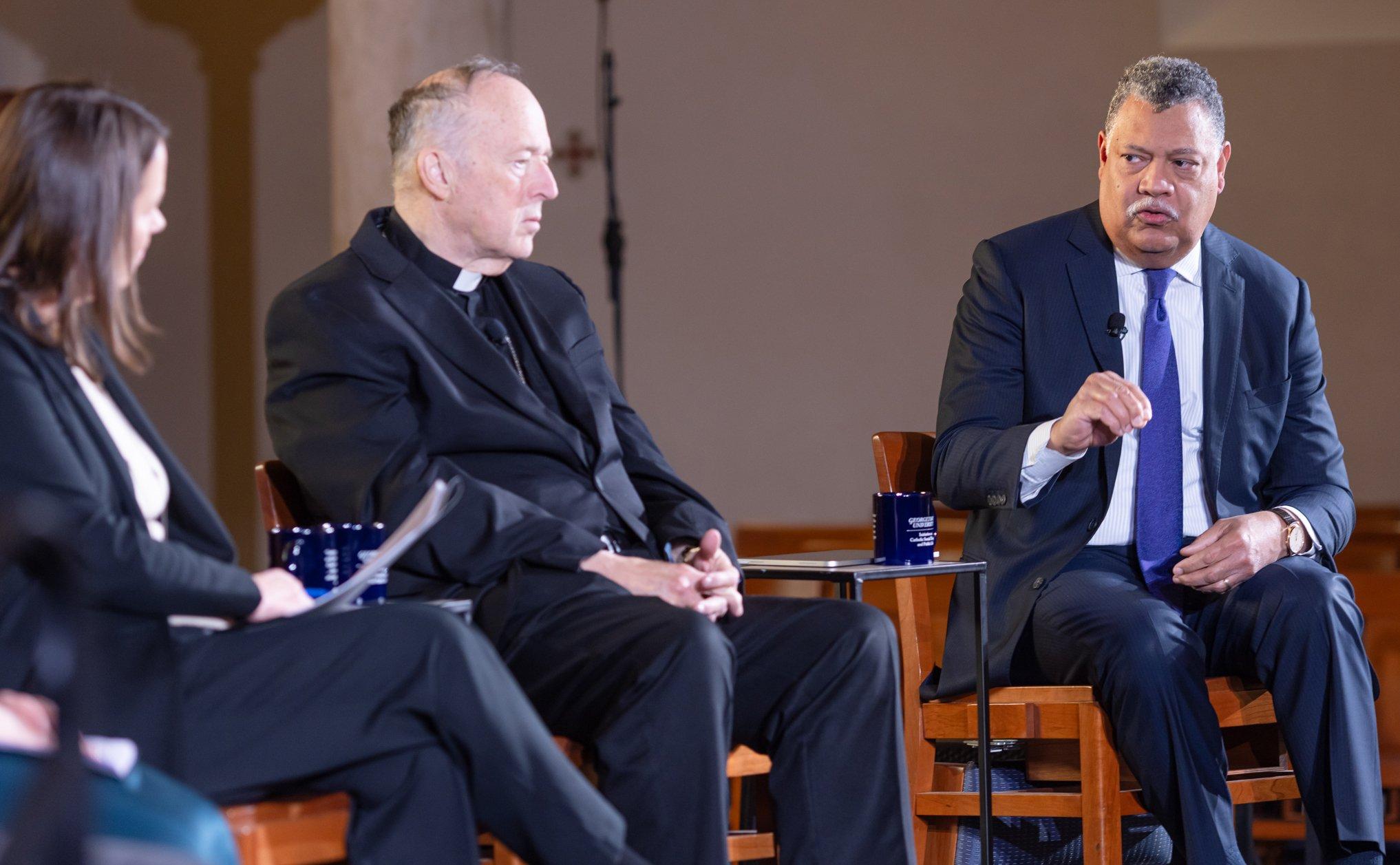
“The main thing going on with immigration (policy) is, it’s such an assault on fundamental human dignity,” said Washington Cardinal Robert W. McElroy, a participant in the dialogue. “In Washington, we have a parish where 30 people have been detained or deported.”
The archbishop noted that this past fall, Mass attendance at Spanish-language parishes in the Archdiocese of Washington went down 30%, “because people are afraid to come to Mass. So the parishes took steps to make people safe” in coming to church, with different ways of “how to be neighbors to undocumented people, who, all they want to do is come to Mass.”
Subtitled “Lessons from John Courtney Murray for Our Times,” the March 18 dialogue drew on the teachings on the role of faith in a democracy by Father Murray, a noted theologian who played a key role in drafting the Second Vatican Council’s landmark Declaration on Religious Freedom, “Dignitatis Humanae,” in 1965. Father Murray also wrote “We Hold These Truths: Catholic Reflections on the American Proposition” (1960).
Common good in society
Cardinal McElroy noted that the theologian emphasized the importance of human dignity and the common good in society, and that “we need to act” to safeguard those elements of our democracy.
The Dahlgren Dialogue — held at the Dahlgren Chapel of the Sacred Heart at Georgetown University — was sponsored by the university’s Office of Mission & Ministry and its Initiative on Catholic Social Thought and Public Life.
Introducing the dialogue’s topic, Kim Daniels, the initiative’s director, said Father Murray “taught that human dignity, which is of course the foundational principle of Catholic social thought, is best served when people pursue truth and the common good in a free and deliberative way, and when states defend the freedoms necessary for people to do so.”
Participants in dialogue
Besides Cardinal McElroy, others in the dialogue were Robert K. Vischer, president of the University of St. Thomas in St. Paul, Minnesota; Cathleen Kaveny, a professor in Boston College‘s theology department and law school; and Vincent D. Rougeau, president of the College of the Holy Cross in Worcester, Massachusetts.
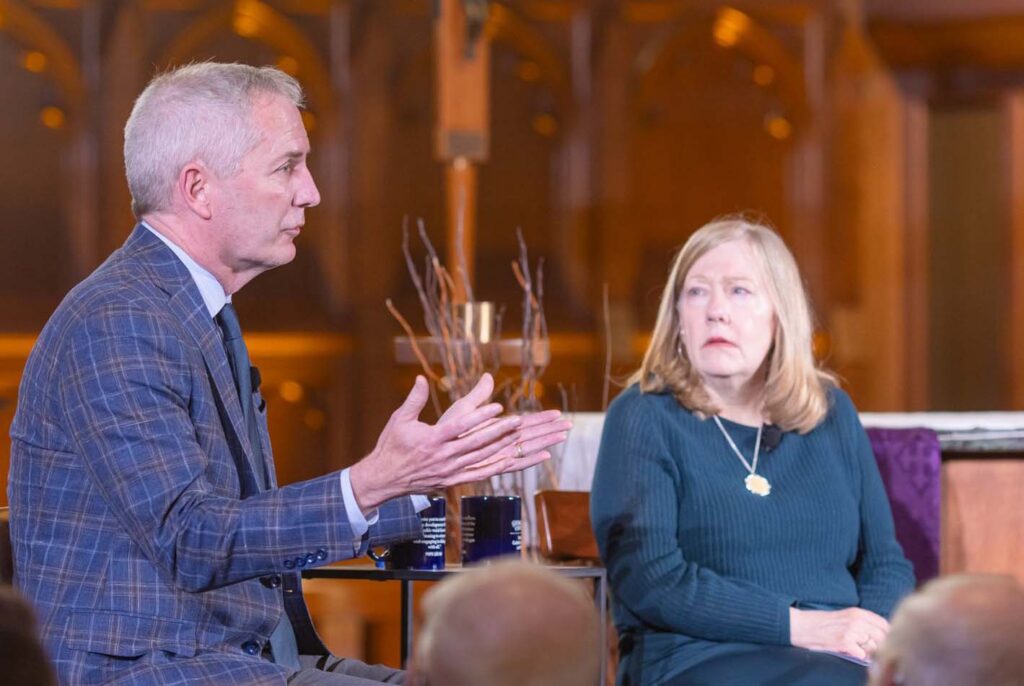
Cardinal McElroy, author of “The Search for an American Public Theology: The Contribution of John Courtney Murray,” said the theologian believed democracy has a two-fold meaning: Its processes have to be democratic, and it has a substantive element, defending the dignity of the human person and “all those sacred elements of society that could be at risk.”
The cardinal said he feared that “both of those elements are weakening in the moment in which we live.”
‘Processes of our democracy’
“Those who should be guarding the processes of our democracy that are so sacred are not doing so, or only are partly doing so,” he said. “On the substantive side, we’ve seen in these moments on the immigration question, basic human dignity is being assaulted in our streets now. We live in a country where the mask has become the new face of American justice, and that is a great tragedy for us.”
“In our own country, polarization has prevented us from coming” to a consensus, he continued. “Murray was big in believing, as were the founders of our country, … there needs to be a substantive consensus among the people of the country about basic issues they can come together on and agree with, and that is dissipating. Polarization is eating into that and corroding that.”
Those “are very ominous developments,” the cardinal said. “It doesn’t mean that we’re cascading out of a democracy, but it does mean that the institutions which are guardians of our democracy and sources of our democratic meaning, that those are in disarray now, and also that they are teetering. And we have to move to arrest that now.”
‘Role of morality in foreign policy’
Cardinal McElroy also said Father Murray believed strongly in “the role of morality in foreign policy,” which is “certainly at the core of the Catholic tradition on this.”
Regarding the current U.S. war with Iran, he said, “Our position is so clear. Within Catholic thought there are differences between those who stress active nonviolence and those who stress just war, but either way, the reasoning comes out the same. This war is not just.”
Catholic thought challenges the belief in society that “all that matters is power and wealth,” said Kaveny, the Darald and Juliet Libby millennium professor at Boston College. Her scholarship focuses on the relationship of law, religion and morality.
Society’s poor and vulnerable
“We believe that the poor and the vulnerable are at the center of the community, not at the margins,” she said, adding that the hallmarks of a democracy should include substantive fairness and opportunities for human flourishing and participation, where people have a right to things like health care and education.
She also said Father Murray believed in “living together reasonably and talking together reasonably.”
Vischer noted that Father Murray “consistently emphasized that freedom requires order, and not an order that can be imposed from top down. He used the term flowering, the natural flowering of the principles held by the people.”
Moral virtue, political engagement
In recent decades, Vischer said, the conception of politics and conversations about politics “may have contributed to a tendency to separate questions of moral virtue from questions of political engagement,” which he said should require soul searching on both sides of the political spectrum.
He also shared something he witnessed in the Twin Cities during the widespread immigration enforcement efforts there.
While the news focused on encounters with protesters and with people blowing whistles to alert the neighborhood of an ICE raid on someone’s house, “what was less remarked on or visible in the news was there were so many more people engaged in what I would call the radical ministry of accompaniment,” Vischer said.
‘Profiling people on the street’
“In Minneapolis and St. Paul, we had thousands of men, women and children who didn’t leave their houses for weeks because they knew that would increase the risk that they would be stopped,” he said, “and it is a matter of fact that I can verify that they were was profiling going on with people on the street, so families would stay in their homes.”
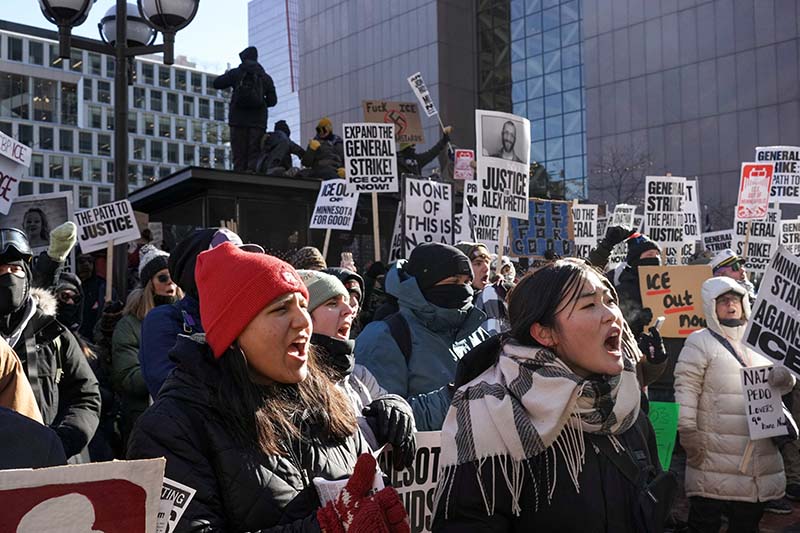
To help these families, residents of the Twin Cities “stepped up, and parishes and Catholic schools … kept weekly grocery deliveries going for thousands of households, from the boxing of the groceries to bringing them to the parish or school to sort through them and make sure they were meeting the needs of particular families for what they needed, and the ages of their kids, and then an army of vehicles going out throughout the Twin Cities to deliver them to the doorstep.”
“It was really powerful and inspiring,” he said.
‘Project of democratic pluralism’
Rougeau, the first lay and first Black president of the College of the Holy Cross, noted that in the United States, “we’re involved in one of the greatest projects in history, the project of democratic pluralism, that is, bringing together people of different backgrounds, all different religions, to be equal citizens in a democratic society.”
He said at a time when so much rhetoric is fueled by hate and division, that Catholics and Christians “have important tools and obligations” in promoting human dignity for individuals, and human dignity in the life of the community.
“The parish can serve as a building block of civic engagement in so many ways, and also as a place of invitation for conversation across differences,” Rougeau said. “We as citizens have to start reclaiming work to make democracy strong and healthy, and we can use the parish as a place to start doing that work.”
‘Forming citizens as moral actors’
He said a big part of his job as president of a Catholic Jesuit liberal arts college, “is forming citizens as moral actors, forming them as contributors, forming them as leaders, forming them as people for and with others.”
He warned that some of the defense of the harsh immigration enforcement actions in Minnesota echoed comments made criticizing his parents and others who marched for Civil Rights in the South. “We need to think a lot more how to create citizens who are not tempted to have blind adherence to whatever the state tells them is true,” Rougeau said.
In closing comments, dialogue participants were asked how people can be architects of hope in building the common good in this democracy.
“Look for opportunities to practice civil friendship, which might just mean showing up the next public park clean-up day (with) folks from every spot on the political spectrum,” Vischer suggested. “It is giving you and your neighbor an experience of civil friendship that Aristotle and Catholic social teaching have called us to do, to be in right relationship with God and neighbor.”
Mark Zimmermann is editor of the Catholic Standard, the news outlet of the Archdiocese of Washington. This story was originally published by the Catholic Standard and distributed through a partnership with OSV News.
