


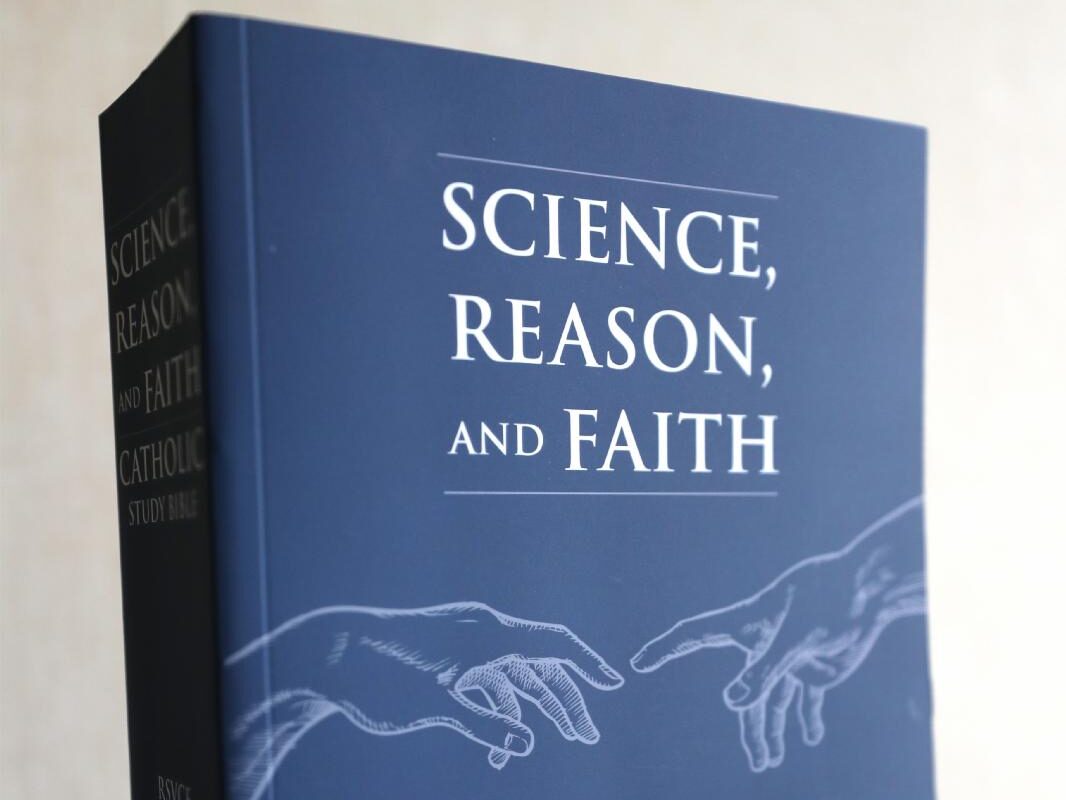
(OSV News) — When Jesuit Father Robert Spitzer realized a number of young Catholics were abandoning their faith in the name of science, he decided to do something about it: Create a new study Bible.
“We have a lot of young people who are leaving our church unnecessarily,” said Father Spitzer, author of “Science, Reason, and Faith: Catholic Study Bible,” a book published by Our Sunday Visitor (the parent company of OSV News) over the summer. “They think that faith and science are contradictory.”
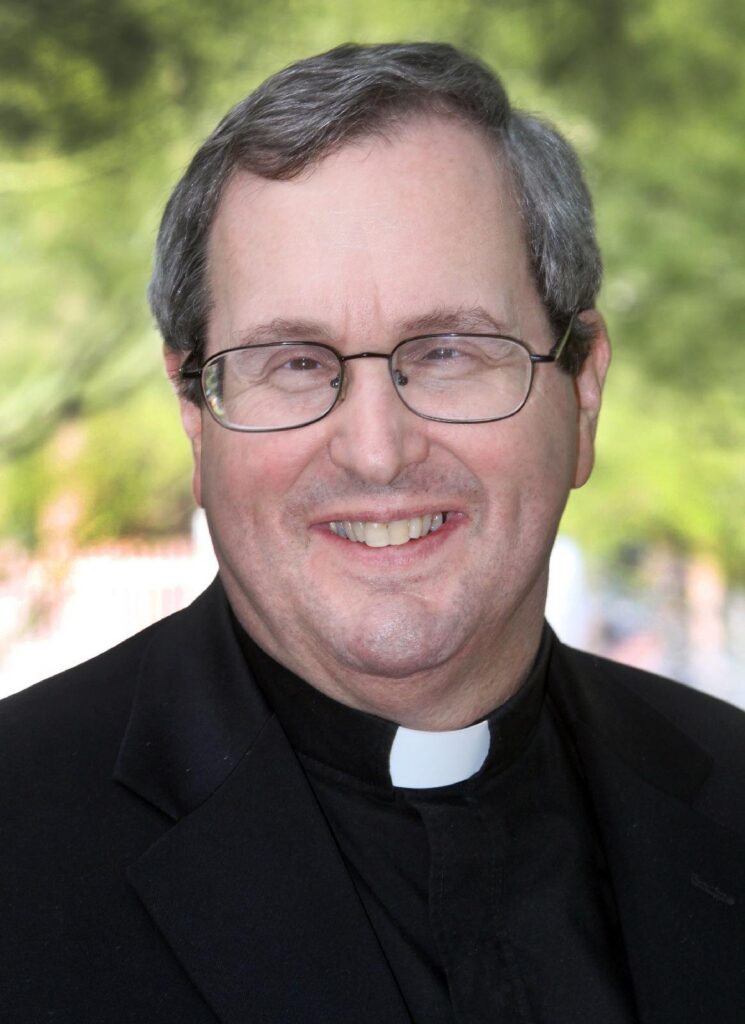
Father Spitzer, who also serves as co-founder and president of Magis Center, co-founder and vice chairman of The Napa Institute, and host of the weekly EWTN television program “Father Spitzer’s Universe,” recently spoke with OSV News about his new study Bible. He said it explores the relationship between science and faith, and promises to help students, teachers and Catholics in general by strengthening their own faith and by serving as an evangelization tool.
The massive book surpasses 2,000 pages but presents its contents in an organized, accessible way. The study Bible includes the entire Bible (Revised Standard Version Catholic Edition) alongside content from Father Spitzer. The additions from Father Spitzer include commentary before the Old and New Testaments, introductions before each book in the Bible, and comments in the margins of controversial or confusing Bible passages.
“As will be seen, scientific, historiographical, and exegetical research do not run contrary to the existence of God, the soul, and the Bible, but rather support them probatively, allowing each pursuit — reason and faith — to complement and elucidate the other,” the introduction reads. “Science and reason can tell us much about how the observable world operates, but revelation alone (seen through the eyes of faith) can tell us why we and the world exist.”
Answers to the big questions
In particular, Father Spitzer’s commentary before the Old and New Testaments is organized in a Q&A format, where readers can find the answers to questions about the Bible and its relationship with science, history and scriptural interpretation. Ahead of the Old Testament, readers can look up questions like “Is the Old Testament historical?” or “Can the existence of God be proved?” In the pages preceding the New Testament, people can search through questions such as “What is the extratestamental evidence for the historical Jesus?” and “Did Jesus intend to give us his real body and blood in the holy Eucharist?”
The study Bible addresses many more topics, including the Church’s role in the development of science; the Catholic view of evolution; the evidence for a transphysical soul; the historical evidence for Jesus Christ’s passion, crucifixion and resurrection; the eyewitnesses of the Gospel traditions; Jesus’ miracles; Eucharistic miracles; and the initiation of the Catholic Church.
Father Spitzer recommended readers begin his study Bible by picking out four or five questions that interest them most. After reading the answers, he suggested that they try reading Genesis’ first three chapters again.
“I’ll bet you anything you will get so much more out of those chapters than you ever got before,” he said. “It should really make the Bible come alive.”
For those who want to dig even deeper after going through the study Bible, Father Spitzer recommended another of his books, “Science, Reason, and Faith: Discovering the Bible,” published by OSV in 2023.
A resource for young Catholics
The study Bible also follows a 2025 survey published by Pew Research Center finding that the top reason former Catholics in the United States say they no longer identify as Catholic is because they stopped believing in the religion’s teachings.
Another publication in 2018, “Going, Going, Gone: The Dynamics of Disaffiliation in Young Catholics,” from Georgetown University’s Center for Applied Research in the Apostolate and St. Mary’s Press found that young people who no longer identify as Catholic cited a conflict with scientific beliefs as a reason for why they left the Church.
“Our church has always been at the intersection of faith and science, and yet it’s our kids who are leaving,” Father Spitzer said.
Father Spitzer, who has taught high school and university students, said his new study Bible tries to reach young Catholics from seventh graders to postdocs. He listed two areas in particular where young people struggle: They think that the Old Testament contradicts the scientific account of nature and evolution, and they think that Jesus is not a historical figure.
“I tried to say, OK, what are the big questions?” he said. “And I know a seventh grader is not going to have the same capacity to read this, but I’m hoping seventh grade teachers do.”
A resource for Catholic teachers and catechists
In addition to students, Father Spitzer encouraged teachers and catechists to read his study Bible.
“Why aren’t we giving (students) these answers, so that they don’t feel like they have to leave because faith is naive?” Father Spitzer said. “The Catholic Church has been the forerunning church in putting together faith and science.”
He pointed to the Catholic Church’s relationship with science, which he also highlights in his study Bible. In his commentary before the Old Testament, Father Spitzer highlights the Church’s Pontifical Academy of Sciences filled with Nobel Prize laureates, the no less than 286 Catholic clergy and religious pivotal in the development of science since the time of astronomer Nicolaus Copernicus, the Church-supported departments of natural science in 1,800 universities, and more.
A fuller vision of God
Father Spitzer hoped readers recognize that the relationship of science and reason with faith are complementary and corroborative instead of contradictory.
“They bring two different perspectives that bring out the fullness of God’s mind, God’s heart, God’s beautiful aesthetic sense, God’s morality and conscience,” he said. “You put the two together, and you’re going to get just the most amazing vision of the mind and heart of God.”
“Think complementarity and corroboration,” he added. “If you just have that one message, and you want to have a much bigger and wider vision of God’s mind and heart, and you want to have all the evidence you can get for God, Jesus, life after death, transphysical soul … Mary, the Holy Eucharist, then I would say this is the Bible for you.”
Katie Yoder is an OSV News correspondent. She writes from Maryland.
