


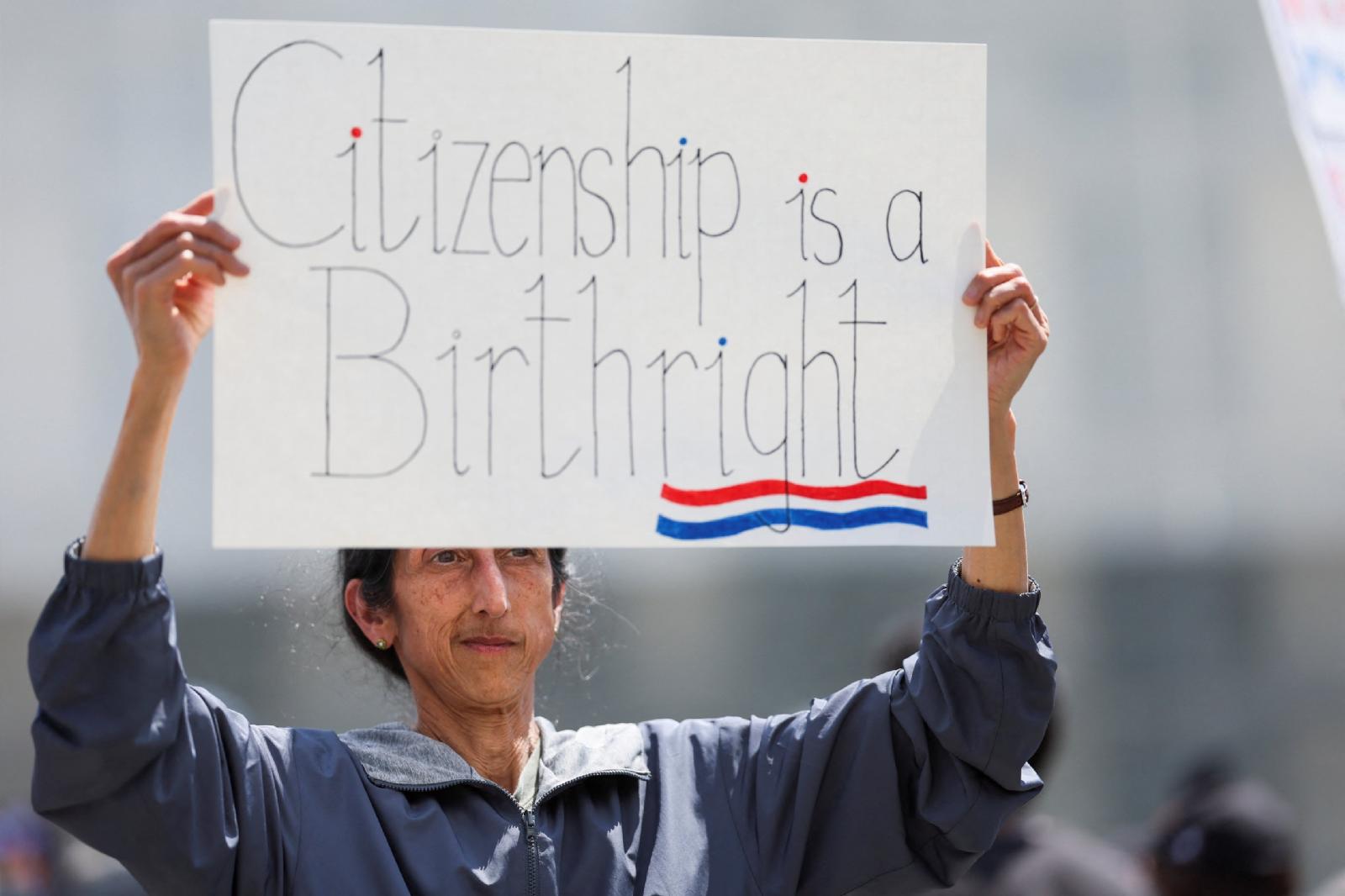
WASHINGTON (OSV News) — As the U.S. Supreme Court prepares to consider a challenge to President Donald Trump’s executive order limiting birthright citizenship, the mother of a U.S.-born infant, who is displaced from her own country of origin, told OSV News her son “should belong to this country.”
The woman, who came to the U.S. under the Uniting for Ukraine program that granted eligible Ukrainians permission to come to the U.S. amid Russia’s invasion of that country, asked to be identified only by her first name, Lily. The temporary humanitarian program is not a direct pathway to permanent residency or citizenship in the U.S.
U.S.-born infant son and citizenship
Lily told OSV News that she and her husband, who is an asylum-seeker from another nation, are both concerned that their U.S.-born infant son will not be granted U.S. citizenship.
“I think he deserves to have citizenship and nationality here, and to be under U.S. Constitution protection, to have equal rights as other children have, and the right to vote here, because he was born here, when he is 18 years old,” she said.
Oral arguments in the case, Trump v. Barbara, take place April 1.
Within hours of returning to the Oval Office Jan. 20, 2025, Trump signed an executive order seeking to change the longstanding legal interpretation of the 14th Amendment, which states, “All persons born or naturalized in the United States, and subject to the jurisdiction thereof, are citizens of the United States and of the State wherein they reside.”
Part of broader efforts to restrict immigration
Trump’s order, part of his administration’s broader efforts to restrict immigration, sought to end birthright citizenship for children born in the U.S. to parents who either lack permanent legal status or are temporary visa holders. The order said that after 30 days from the executive order’s date, only children born to at least one U.S. citizen or lawful permanent resident parent would automatically acquire citizenship. It was promptly challenged in court.
The U.S. Conference of Catholic Bishops submitted a friend-of-the-court brief in the case, arguing that ending the practice of birthright citizenship would weaken families and risk leaving children stateless, thereby making them targets for violence, trafficking and exploitation.
Catholic social teaching on immigration balances three interrelated principles — the right of persons to migrate in order to sustain their lives and those of their families, the right of a country to regulate its borders and control immigration, and a nation’s duty to regulate its borders with justice and mercy.
‘Subject to the jurisdiction’ of U.S.
“The key question for the justices is what it means for a person to be ‘subject to the jurisdiction’ of the United States, a phrase that courts have for more than 125 years interpreted as meaning nearly everyone born on U.S. soil,” Ashley Feasley, the legal expert in residence at the Immigration Law and Policy Initiative at The Catholic University of America Columbus School of Law, told OSV News.
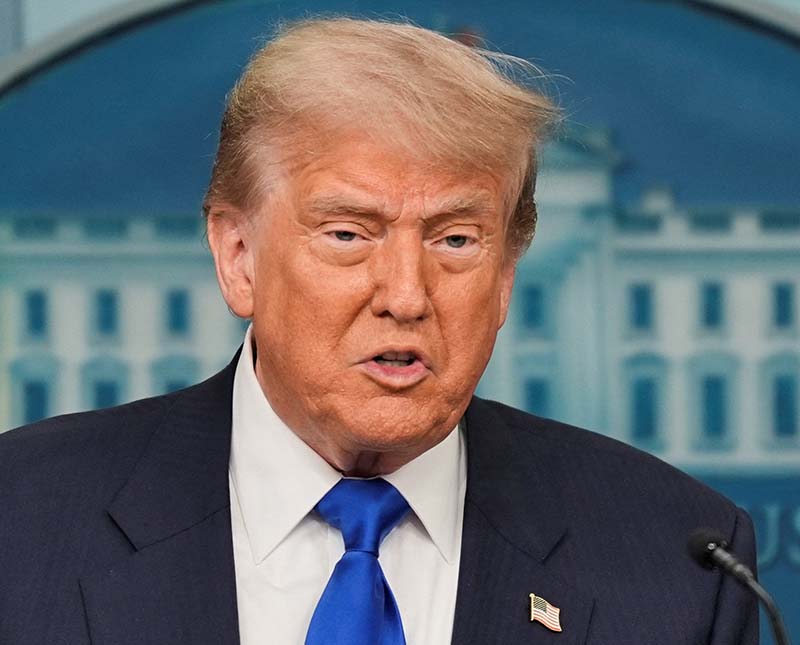
“The Supreme Court could uphold the precedent and the longstanding 14th Amendment application and maintain birthright citizenship,” she said. “However, if the justices are willing to accept the administration’s interpretation, they would likely need to consider how and when the prohibition of birthright citizenship will occur. For example, would it apply to every situation listed in the executive order? Or would the court narrow that?”
Amicus brief from Republican senators
An amicus brief filed in the case from a group of Republican U.S. senators in support of Trump’s order — Sens. Ted Cruz, Texas; Lindsey Graham, S.C.; Ted Budd, N.C.; Bernie Moreno, Ohio; Jim Banks, Ind.; Mike Lee, Utah; Kevin Cramer, N.D.; Cindy Hyde-Smith, Miss.; and Marsha Blackburn, Tenn. — argued, “the Fourteenth Amendment does not confer citizenship on the children of aliens unlawfully present in the United States.”
“Notably, the Jurisdiction Clause does not say that the person must be subject to the laws of the United States, but rather subject to its jurisdiction. The distinction matters,” the brief argued.
Previously, the Supreme Court limited the ability of federal judges to issue nationwide injunctions against the order while litigation over it proceeds, but did not directly address the merits of the order itself.
Court precedent, constitutional statute
In an interview with OSV News, Conchita Cruz, co-counsel in the previous birthright citizenship case, CASA v. Trump, pointed to both Supreme Court precedent and congressional statute as evidence for the longstanding legal interpretation of the 14th Amendment. She argued the high court could base a decision on either its own precedent or federal law.
“The history of the debate in Congress is clear on birthright citizenship,” she said.
“If the law is going to change, it needs to be through a constitutional amendment, and there has to be a different process, but not an executive order,” Cruz said.
Birth certificate, proof of citizenship
The prospect of a loss at the Supreme Court, Cruz said, most likely means “that in the future, a birth certificate wouldn’t be enough proof of citizenship, and that would not just be an issue for the children of immigrants. It would be an issue for all children born in the U.S.”
“All of a sudden, expecting parents would have to prove that they themselves are U.S. citizens or permanent residents or wherever the line is drawn,” she said. “Not everyone is going to have that proof.”
As an example, she said, U.S.-born children of survivors of domestic abuse could have a U.S. citizen father withhold his name from a child’s birth certificate — leaving the child without evidence of their parentage and thus their citizenship.
‘Cannot choose to live in Ukraine’
Lily said that because of Russia’s ongoing war on Ukraine, “I cannot choose to live in Ukraine.” She said her family cannot reside in her husband’s country of origin, citing political persecution there.
“I just want to say that I really am thankful to the United States that gave me a shelter here and gave me this opportunity to be safe,” she said. “I understand that I cannot have this life as a U.S. citizen. It doesn’t apply for me, because I’m an alien, but my baby, I think, he deserves it.”
Feasley added, “It’s so important to dispel this idea that U.S. citizen children, infants, born here in the U.S., can automatically provide their parents with citizenship or legal status of any sort. This is just false.”
“In fact, these children cannot sponsor their parents for any form of immigration status for many years, until they are 21, and then at that point, there are numerous requirements of both the parents and their U.S. citizen child who are sponsoring them,” she said, stressing such a scenario is not “automatic.”
Kate Scanlon is a national reporter for OSV News covering Washington. Follow her on X @kgscanlon.
