



(OSV News) — NASA’s first crewed lunar flyby in half a century has sparked wonder, reflection and prayer — both in space and on the ground.
“I think, as we go into Easter Sunday, thinking about all the cultures all around the world, whether you celebrate it or not, whether you believe in God or not, this is an opportunity for us to remember where we are, who we are, and that we are the same thing, and that we’ve got to get through this together,” astronaut Victor Glover, pilot of the Artemis II mission, told CBS News.
From aboard Orion spacecraft
Glover spoke to the outlet on Easter Sunday, April 5, from aboard NASA’s Orion spacecraft Integrity, which launched April 1 from the Kennedy Space Center in Florida.
Joining Glover in space are commander Reid Wiseman and two mission specialists — Christina Koch and Canadian astronaut Jeremy Hansen, who is the first from that nation to undertake a lunar mission.
The 10-day journey will take the crew around the moon, spanning 695,081 miles from launch to splashdown off the coast of San Diego. Artemis II will travel a maximum distance of 252,760 miles from the Earth, or more than 4,100 further than the 1970 Apollo 13 mission.
Preparing for deep space exploration
The mission’s priorities focus on preparing for deep space exploration by humans and laying the groundwork for what NASA calls “a sustained presence on the Moon.”
But with the flight taking place amid widespread geopolitical conflicts and tensions — from Ukraine to a widening war in the Middle East— an emerging goal of the mission appears to be a reaffirmation of human dignity, as well as the need for both unity and gratitude amid entrenched strife.
Asked by CBS News’ Mark Strassmann if he had an Easter message, Glover — a Christian who has spoken publicly about his faith, citing Psalm 30 during his previous mission to the International Space Station — reflected on “the beauty of creation.”
‘A spaceship called Earth’
“When I read the Bible and I look at all of the amazing things that were done for us who were created — you have this amazing place, this spaceship,” he said. “You guys are talking to us because we’re in a spaceship really far from Earth, but you’re on a spaceship called Earth that was created to give us a place to live in the universe.”
He added, “Maybe the distance we are from you makes you think what we’re doing is special, but we’re the same distance from you. And I’m trying to tell you — just trust me — you are special.”
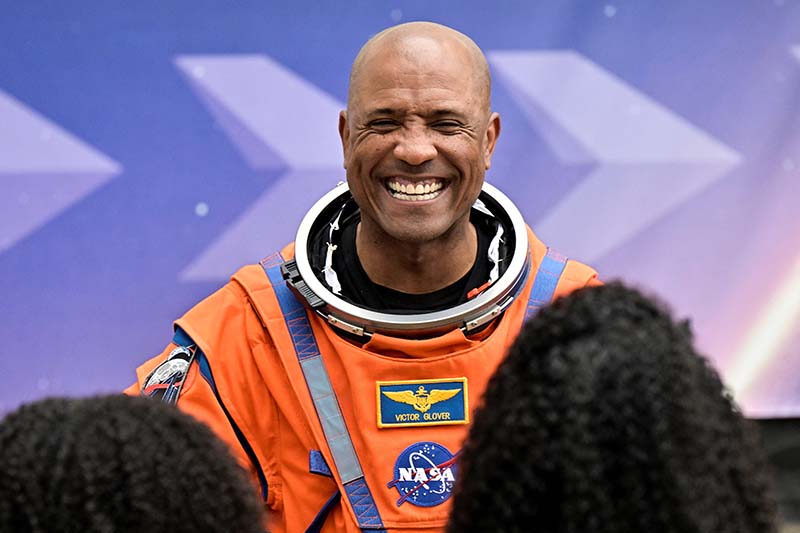
Glover — the first Black astronaut to travel around the moon– pointed to “all of this emptiness” and “whole bunch of nothing” that “we call the universe,” describing Earth as “this oasis, this beautiful place” where “we get to exist together.”
‘We’ve got to get through this together’
Easter Sunday, “whether you celebrate it or not, whether you believe in God or not” is “an opportunity for us to remember where we are, who we are, and that we are the same thing, and that we’ve got to get through this together,” said Glover.
That message took on an immediate urgency as the crew faced a 40-minute communication lapse with ground control April 6, as the Orion spacecraft was to pass behind the moon, blocking radio and laser signals.
Speaking to BBC News ahead of the mission, Glover said, “When we’re behind the Moon, out of contact with everybody, let’s take that as an opportunity. Let’s pray, hope, send your good thoughts and feelings that we get back in contact with the crew.”
Gina Christian is a multimedia reporter for OSV News. Follow her on X @GinaJesseReina
