


INDIANAPOLIS (OSV News) — The people gathered for a dinner in Indianapolis Oct. 20 erupted into cheers and applause when Bishop Andrew H. Cozzens of Crookston, Minnesota, made the announcement: “I’m privileged to announce that in 2029, the 11th National Eucharistic Congress is going to be back here in Indianapolis.”
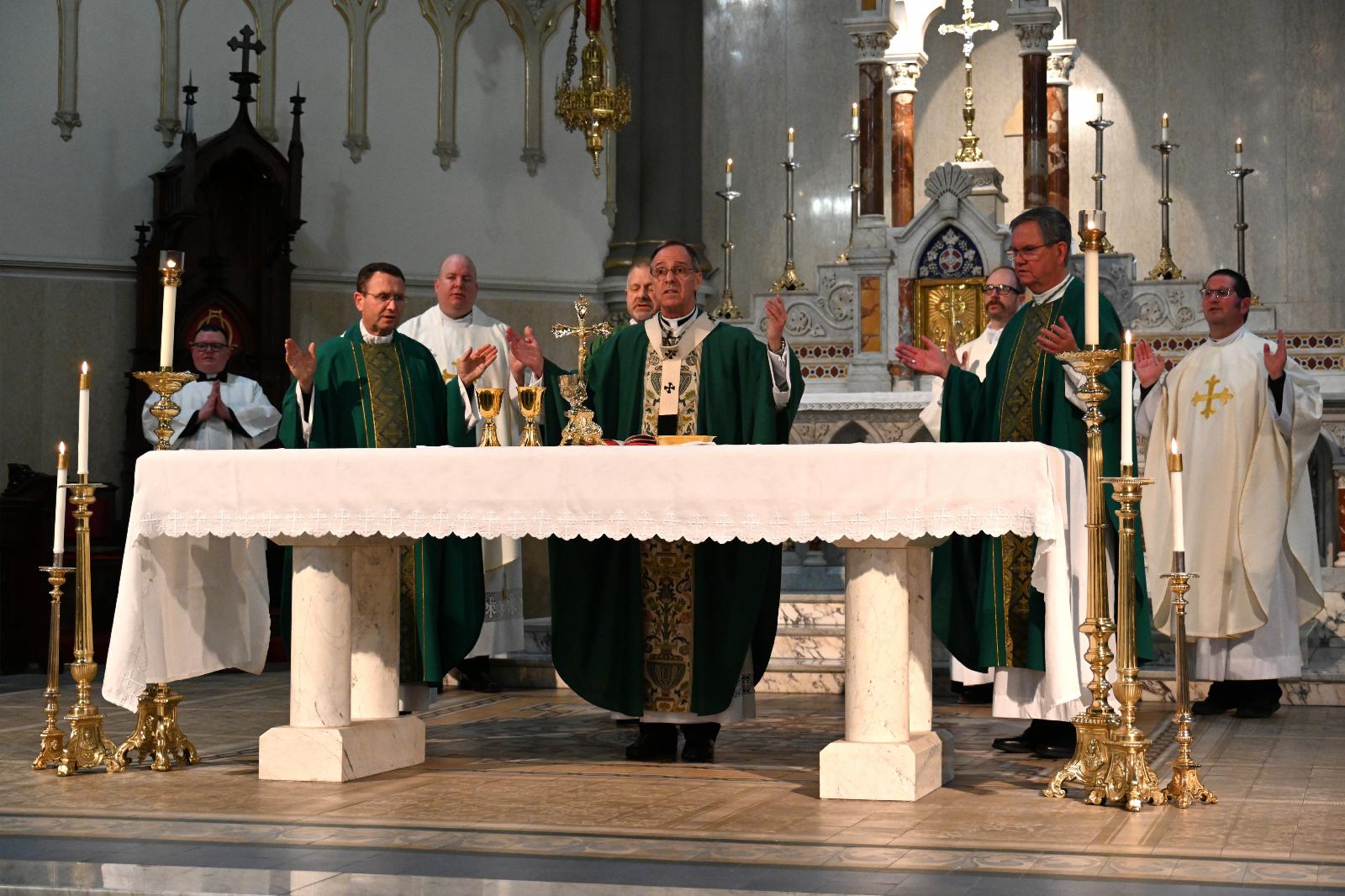
The dinner at the Omni Severin Hotel followed a Mass at St. John the Evangelist Church in Indianapolis. Concelebrating were Bishop Cozzens and Bishop Timothy L. Doherty of Lafayette, Indiana, with Indianapolis Archbishop Charles C. Thompson as principal celebrant.
“As we look toward the 11th National Eucharistic Congress in 2029, we do well to keep before us the continued outpouring of graces and blessings stemming from the National Eucharistic Revival that continues to bear fruit throughout the Church, local and universal,” Archbishop Thompson said in his homily.
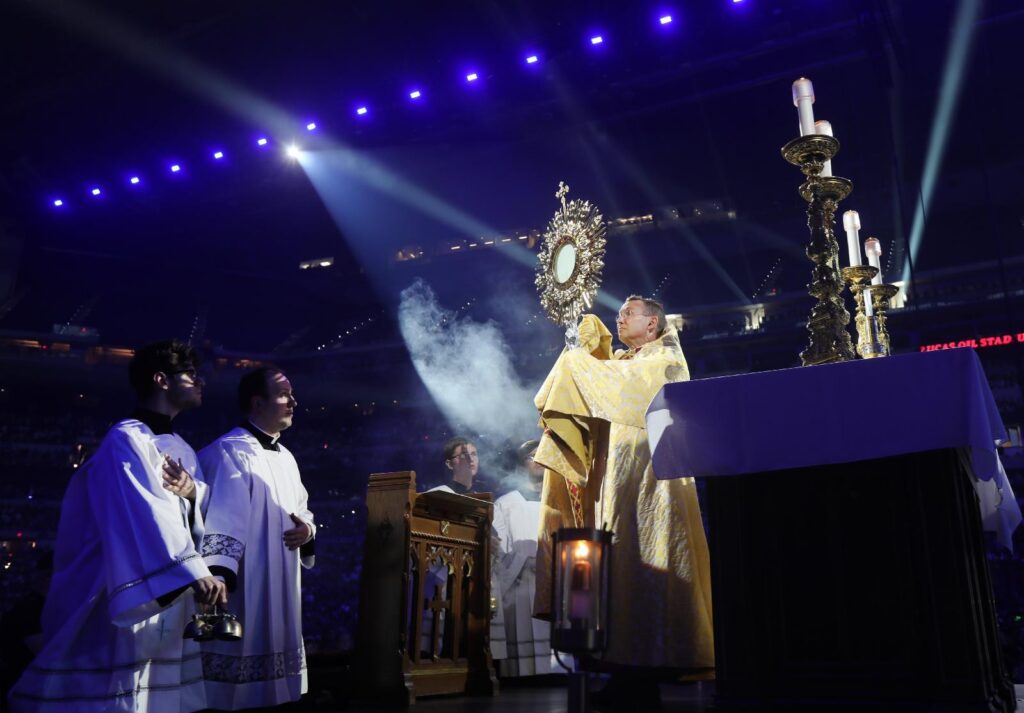
Before announcing the location of the 2029 congress at the dinner, Bishop Cozzens, board chairman of National Eucharistic Congress Inc., spoke of the impact of the 10th congress, held in Indianapolis July 17-21, 2024.
Stories on how 2024 congress impacted people abound
“Everywhere I go now, people tell me stories about how the congress impacted them,” he said. “I really want to say thank you to the people of Indianapolis and to your role in that.”
A press release announcing the 2029 congress identified specific impacts of the 2024 gathering, including “renewed participation” in Eucharistic adoration and confession, “greater reverence at Mass, increased confidence among clergy in preaching about the Real Presence, and growth in parish evangelization and service.”
The congress also has resulted in new adoration chapels opening, local Eucharistic initiatives flourishing, seminarian enrollment growing, new religious vocations and increasing numbers of people entering the Church, the release said.
To “really have an impact on the country,” Bishop Cozzens said the plan is to hold a National Eucharistic Congress every four years in various cities around the country.
In deciding where to hold the 2029 congress, several aspects were considered, he said. Among them were centrality, facilities, accessibility, hospitality and a proven ability to host national events.
Indianapolis ‘just came out on top again’
“We looked at several potential hosts … but Indianapolis just came out on top again,” said Bishop Cozzens.
Of particular note was the “Hoosier hospitality here in Indianapolis and the way that you all welcomed the whole country here” in 2024, he said.

He also noted that returning to the city for the 2029 congress “really helps us to build on what we’ve done already. And it helps us in that way to do something that’s both bigger and better. … We expect it to be an event that will affect a generation of Catholics.”
Archbishop Thompson also shared his thoughts that evening on Indianapolis hosting the 2029 congress.
“We are grateful, we are honored to celebrate, to serve and to be the host,” he said after thanking Bishop Cozzens and the National Eucharistic Congress Inc. team “for all the great work that you do.”
Several speakers at the event noted the impact of the last congress, an impact Archbishop Thompson connected to the closing words of every Mass: “Go forth.”
Every baptized person has ‘co-responsibility’ in Church’s mission
He spoke of the “co-responsibility” of “every baptized person to take their role in that mission,” noting that the National Eucharistic Congress must “always be connected to service” and “has to be connected always with the larger Church.”
Archbishop Cozzens called the 2029 congress a “launching point” for two “great anniversaries for the Church.”
First is the 500th anniversary of the 1531 apparition of Our Lady of Guadalupe in Mexico.
“Because of the 9 million people who converted to the Catholic faith in the decade after she appeared, “she’s been declared the patroness of the new evangelization in our country,” he said.
“It’s part of why we chose the rose as the logo (for the next congress) with the Eucharist there at the center, because we want the congress actually to be a moment for us to devote to Mary and to teach us how to love the Eucharist,” said Bishop Cozzens.
Next major anniversary for the Church is 2033
He called the next major anniversary for the Church in 2033 “the great jubilee of our redemption,” when Christ was crucified and when the Church came into being at Pentecost.
“So, we want to help prepare the country for these two moments,” said Bishop Cozzens. “In 2029, you can think of it as a launching point for what we hope will have a great impact on the evangelization of the world.”
Seminarian Antonio Harbert is “really stoked” for that moment. The member of St. Joseph Parish in Shelbyville is a senior at Bishop Simon Bruté College Seminary in Indianapolis.
He is a witness to the increase in seminarians noted in the press release.
The college seminary, which accepts men from the archdiocese and four other dioceses, had 18 new seminarians enroll this fall. Last year, there were 20 seminarians total at Bishop Simon Bruté.
“We’ve almost doubled in seminarians from last year to this,” Halbert told The Criterion, the archdiocesan newspaper. “I would say that fruit comes from the Eucharistic Congress.”
Hosting the 11th National Eucharistic Congress will take effort, Archbishop Thompson noted.
“Whether it’s time, talent or treasure, it takes a lot of people to make this happen,” he said, but he is “eager” to start the process.
The planning process is just beginning, with information such as specific dates, event speakers and more to come later.
Natalie Hoefer is a reporter at The Criterion, newspaper of the Archdiocese of Indianapolis. This story was first published in The Criterion and distributed in partnership with OSV News.
