


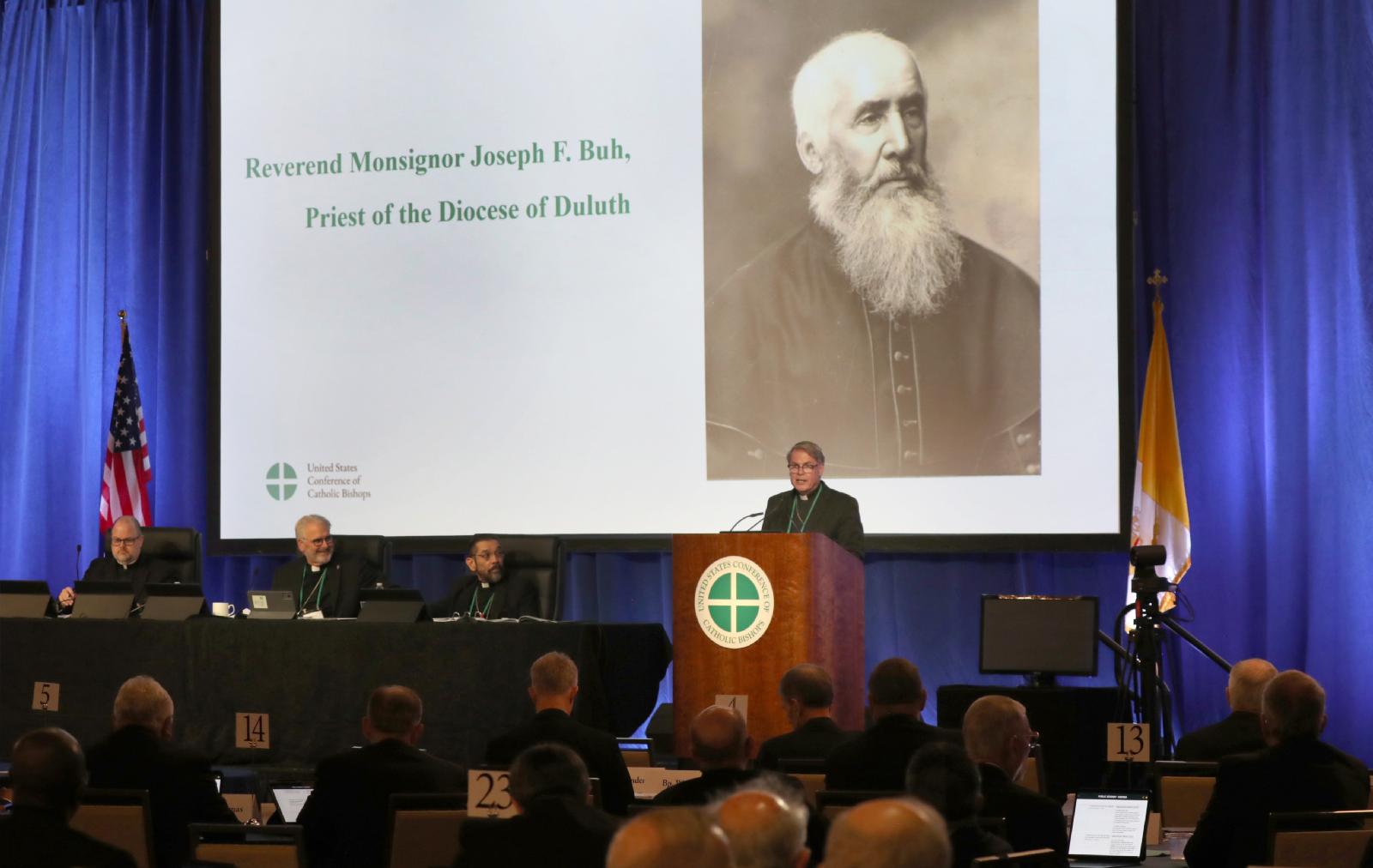
(OSV News) — Msgr. Joseph Francis Buh has been granted the title “servant of God” with a Sept. 22 Mass opening the cause for his canonization.
The Slovenian immigrant priest heroically ministered and evangelized in northern Minnesota beginning in the late 1860s until his death in 1922 at age 88.
Bishop Daniel J. Felton of Duluth celebrated the Mass at the Cathedral of Our Lady of the Holy Rosary in Duluth, where Msgr. Buh’s remains were reinterred in 2025.
“I can think of no better description of Joseph Buh than ‘servant of God,'” Bishop Felton said in his homily. “As we look at his life from the very beginning, that was his one desire, was to be a servant of God.”
Inspired by adventurous Michigan bishop
Born in 1833 in Slovenia, Msgr. Buh (pronounced “Boo”) was inspired by the ministerial adventures of his fellow countryman Venerable Frederic Baraga, who served as the first bishop of Marquette, Michigan, from 1853-1868. After ministering for several years as a priest in his home country, then-Father Buh left for Minnesota to live as a missionary and pioneer, arriving in 1864.
Over the course of his ministry, the priest lived in central Minnesota among Ojibwa people and immigrants in northern Minnesota, and established as many as 57 parishes. He also mentored young priests eager to emulate his hearty approach to ministry. One of them wrote of Msgr. Buh: “Not often in a lifetime is it one’s privilege to know a holy, zealous, and God-fearing man like Monsignor Joseph Buh … who labored endlessly to bring the work of Christ to these northern parts of America.”
Entrusted with northern Minnesota ministry
In 1888, the Benedictine Bishop Rupert Seidenbusch of St. Cloud, Minnesota, entrusted the missions in northern Minnesota to Msgr. Buh, who traveled among the faithful by rail, horse, snowshoes and canoe. After the Diocese of Duluth was established a year later, Msgr. Buh was appointed vicar general and chancellor by its founding bishop in 1890. According to a biography printed by the Diocese of Duluth, the diocese considers the priest its “patriarch.”
U.S. bishops’ unanimous support
In June, Bishop Felton presented the cause of canonization for Msgr. Buh to his fellow U.S. bishops, who, in a unanimous vote, showed their support for its advancement. The consultation of a body of bishops — at either the regional or national level — is required by Church legislation governing the canonization process as a cause gets underway.
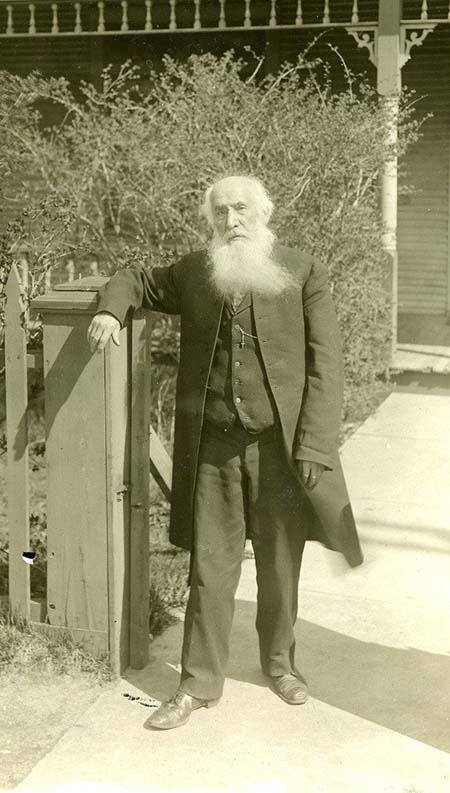
While Msgr. Buh was called to serve northern Minnesota a century ago, “he is also a servant of God in our own time,” Bishop Felton said in his homily. “He is calling you and me to be a servant of God as well.”
Pointing to the Gospel reading from John 20:19-23, which described Jesus breathing the Holy Spirit upon his disciples, Bishop Felton said Msgr. Buh lived amid a moment of revival for the fledgling Diocese of Duluth, and the Holy Spirit moves similarly through the Church today.
“A revival has nothing to do with you and me,” he said. “A revival has everything to do with the Holy Spirit. And the Holy Spirit was stirring in the early Christian Church. The Holy Spirit was stirring in the time of Joseph Buh, and the Holy Spirit is in our own time and our own day and age.”
He encouraged the congregation “to put Jesus Christ on center stage once again” and follow the model of Msgr. Buh, who “would live with his people to listen to them with his heart, to learn the language of the people in his heart, and it was only when he knew that language … did he begin to talk about Jesus … to say Jesus is healing to your hurts, Jesus is hope to your despair, Jesus is joy to your tribulations.”
Enthusiasm from native Slovenia
After his homily, Bishop Felton read a letter from Archbishop Stanislav Zore of Ljubljana, Slovenia, where Msgr. Buh was ordained, who expressed enthusiasm for the opening of Msgr. Buh’s cause. “We are deeply moved and honored that a son of our local church, who left his homeland in May of 1864 with such admirable missionary zeal, is now recognized in this profound way,” Bishop Felton said Archbishop Zore wrote in his letter, noting that Msgr. Buh was among candidates for sainthood the archdiocese recognized at a special Sept. 20 Mass.
As a nod to Msgr. Buh’s heritage, the Mass’ prelude was the Angelus sung in Slovenian.
The end of the Sept. 22 Mass included the first session of the diocesan inquiry into Msgr. Buh’s cause, during which officials leading the inquiry took an oath to discharge their duties according to Church law. Among those swearing an oath was Amanda Zurface, a canon lawyer serving as the diocesan postulator of Msgr. Buh’s cause. Also taking an oath were Bishop Felton and other diocesan leaders, and members of the cause’s historical commission.
“With these oaths duly taken, the special Diocesan Tribunal formally begins its work of gathering and examining the evidence concerning the life, heroic virtues, reputation for holiness, and reputation for intercessory power of the Servant of God Joseph Francis Buh, so that the Church may discern and judge whether he lived the Christian virtues to a heroic degree,” explained the Mass’ worship aid.
What happens next
Msgr. Buh is the second “servant of God” from Minnesota whose cause for canonization has recently begun. The Diocese of Crookston is investigating the cause of Benedictine Sister Annella Zervas, who demonstrated extraordinary holiness in the midst of tremendous suffering as she died of a mysterious illness in 1926 at age 26. Bishop Andrew H. Cozzens officially opened her cause with a Mass in October 2025. Zurface also serves as the diocesan postulator for Sister Annella’s cause.
After information for a cause is collected on the diocesan phase, the documentation is sent to the Holy See’s Dicastery for the Causes of Saints. Then, in what is known as the Roman phase, that documentation is reviewed, and may be sent to the pope for a decree of heroic virtues. If the pope grants that decree, the person is given the title “venerable.”
For a cause to proceed to beatification, in general a confirmed miracle must be attributed to the venerable’s posthumous intercession. A second such miracle must be confirmed before a person is canonized
Maria Wiering is senior managing editor for OSV News.
