


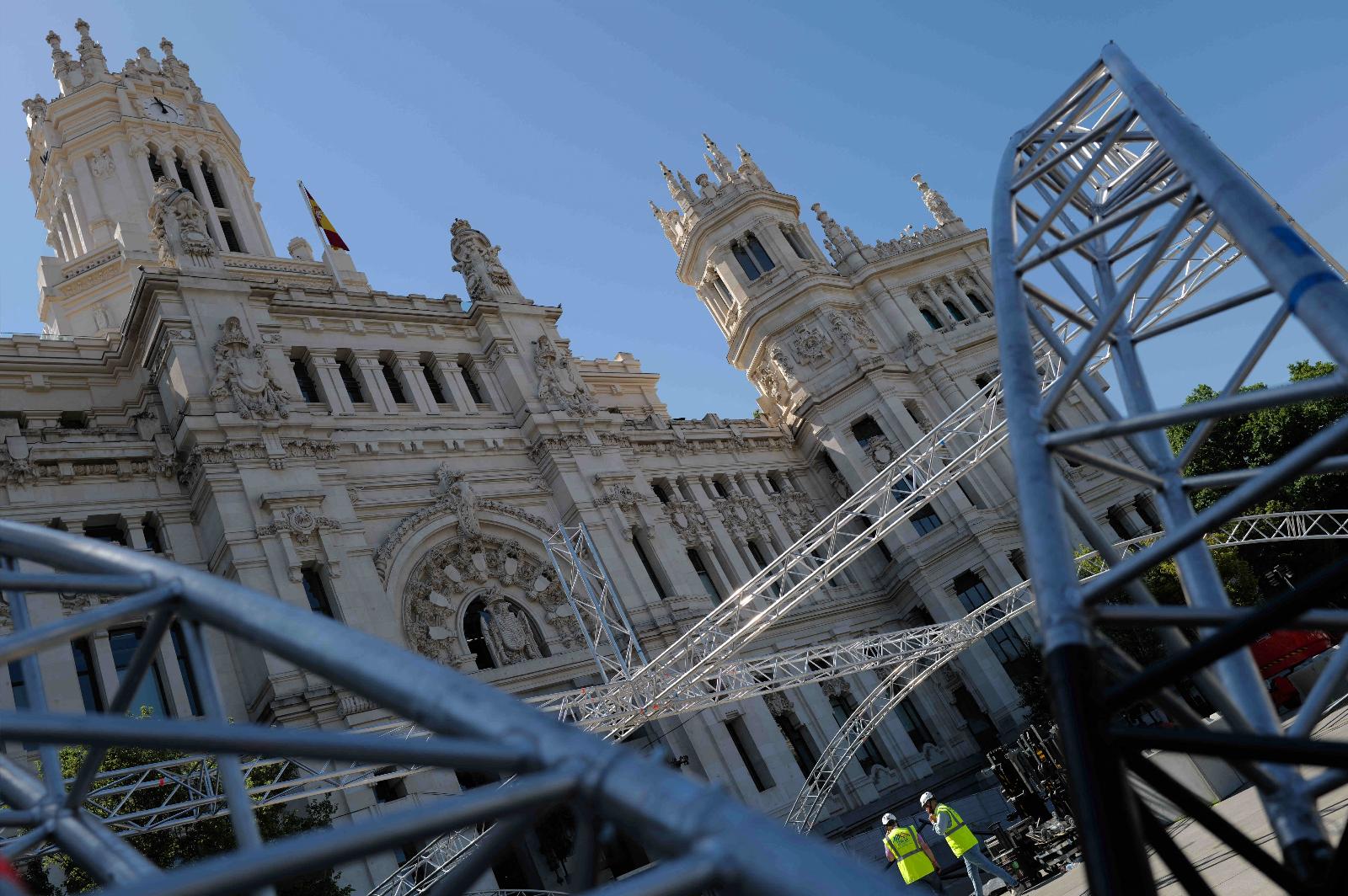
MADRID (OSV News) — The Palacio de Cibeles was built so that messages could cross a growing city.
Now, on June 7, it will become the place where a different kind of message is sent — this time not by telegraph, but by a pope standing at the heart of Madrid, before leading the body of Christ through its streets.
When it opened in 1919, the building was a temple to modern communications. Designed by the young architects Antonio Palacios and Joaquín Otamendi, it housed the post office and telegraph service in Spain just discovering the electricity momentum.
They had little personal experience, so they experimented: References to cathedrals and royal palaces blended with mythological symbols and modern engineering.
“It was, from the beginning, a bridge between tradition and modernity,” a representative of Palacio de Cibeles — today the headquarters of City Hall — told OSV News and a small group of media representatives in Madrid prior to the June 6-12 apostolic trip of Pope Leo XIV to the country.
When iron and marble met hum of new technology
Back in the 20th century, it was a place where iron and marble met the hum of new technology, and where Madrileños learned that the world could be reached from a single counter. “It was a bridge between tradition and modernity,” the City Hall representative told journalists.
While Madrid’s mayor is probably one of a few, or maybe even the only one in the world who works in a building that is also a museum tourists can visit, in June that paradox will deepen: More than a thousand priests will vest for Mass with Pope Leo in City Hall, which is designed as an immense sacristy.
In fact, from the outside, the building has always looked like a cathedral. For decades Madrileños — at the time Catholic in immense majority — called it “Our Lady of Communications.”
Palacios, the artist of the duo (Otamendi was the engineer), scattered the façade with Gothic lines that evoke Valencia and other Spanish churches, royal motifs and, crowning it all, the figure of Hermes — the pagan god of communication and messenger.
It is here, at “Our Lady of Communications,” where Pope Leo will meet Madrid’s Church at a crossroads.
Much of the beautiful architecture is hidden
Much of the palace’s most beautiful architecture is hidden. The workers’ entrance of the old telegraph office, with its Sevillian tiles and delicate details, is one of the most striking spaces, yet closed to most visitors.
Pope Leo, arriving at Plaza de Cibeles, will circle the fountain in the papamobile, receive the keys to the city at an entrance to Palacios’ splendid courtyard, and then celebrate Mass at an open-air altar, which will take place — according to forecasts — in weather resembling Madrid’s frying pans.
It is not known yet what Pope Leo will tell Madrileños during Sunday Mass homily, but a message that would touch on building the common good in a country scarred by internal conflicts could be anticipated.
At a May 6 press conference Archbishop Luis Argüello of Valladolid, president of the Spanish bishops’ conference, said the pope would prepare “the speeches as he sees fit,” but told journalists that the Church was awaiting “a possible new encyclical that seems likely to emphasize the centrality of the human person, human dignity, the common good, dialogue and encounter.”
Pope Leo indeed issued his landmark document, “Magnifica Humanitas: On Safeguarding the Human Person in the Time of Artificial Intelligence,” on May 25, prior to the trip and — one which redefines the common good for the digital and artificial intelligence era.
High-tech data and service to all humanity
Algorithms, data and technological infrastructure, the pope stressed in his encyclical, are shared goods that must serve all of humanity rather than being monopolized by a privileged few.
“The risk of dehumanization — of building a future that excludes God and reduces the other to a means — is an ancient and ever-new temptation that today takes on a technical guise,” Pope Leo wrote in his first encyclical, something he may repeat in a country that is not only polarized, but also secularized.
Today roughly half of Spaniards still call themselves Catholic, but fewer than 1 in 5 practice their faith regularly. The Church has shrunk in numbers and social weight, yet in recent years there are signs of a quiet return, especially among young people who discover new communities, music and forms of prayer.
Pope has called Spain a ‘missionary nation’
While many children still grow up without baptism and Spanish society is polarized by unresolved memories of civil war and new ideological battles, it is also one that remains, in the pope’s words, a “missionary nation.”
By celebrating Mass at Cibeles and then carrying the Eucharist through the city center, Pope Leo will walk the bridge between old and new, Archbishop Argüello told a small group of media representatives in Madrid, including OSV News, by phone.
A visit to Madrid, Archbishop Argüello pointed out, will be about “the challenge of evangelization in a large metropolis,” with the procession being “a great manifestation of the Church on the street, of the Church in the midst of the world, so that from there we too might have this drive to proclaim the Gospel, especially in the challenge of doing it in the public square, in public presence,” he stressed.
Paulina Guzik is international editor for OSV News. Follow her on X @Guzik_Paulina
