


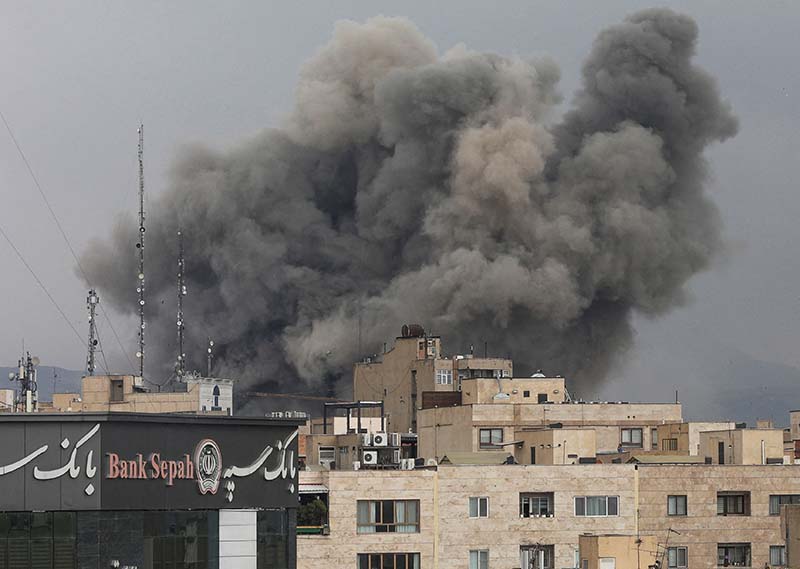
WASHINGTON (OSV News) — President Donald Trump’s decision to initiate major combat operations against Iran in concert with Israel has raised debate within Congress over its war powers prerogatives. It has also raised questions about the justice of committing the U.S. into a new Middle East war.
Joint attacks on Iran launched Feb. 28 by the U.S. and Israel, which killed Iran’s longtime supreme leader, 86-year-old Ayatollah Ali Khamenei, also prompted retaliatory strikes by Iran across the region, with deaths and casualties — including the loss of at least four U.S. military personnel — on all sides.
‘Last best chance to strike’
In comments at the White House on March 2, Trump called the operation “our last best chance to strike” to “eliminate the intolerable threats posed by this sick and sinister regime.”
Trump said that Iran “would have missiles capable of reaching our beautiful America.” However, American intelligence agencies have indicated that while Iran has a large arsenal of short- and medium-range ballistic missiles capable of hitting Israel and American military bases in the Middle East, Iran was likely years away from having missiles capable of hitting the U.S. mainland.
Mary Ellen O’Connell, a professor at Notre Dame Law School who specializes in international law and conflict resolution, argued in written comments shared with OSV News that “February 28, 2026, will forever mark the day that the United States began a war on Iran that will be compared with the disastrous March 2003 invasion of Iraq.”
War on Iran could be ‘worse’ than Iraq
“Like Iraq, this war egregiously violates the prohibition of force,” O’Connell said. “This is international law’s most fundamental principle. The violation in Iraq’s case turned out to be the U.S.’s worst foreign policy decision ever. The war on Iran may turn out to be worse.”
O’Connell argued the strikes carried out on Feb. 28 have “even less basis in legality. And the results may be worse.”
O’Connell argued that the “moral principles that the law against war operationalizes will remain. These norms are too old, too sacred, too necessary to crush. But the United States will need a generation of goodwill and compliance to be trusted under them again. President Trump has used a few words about United States self-defense in carrying out this unnecessary war of choice. He has not really tried to make a case under law as President George W. Bush did. Bush’s case was inadequate. Trump’s is nonexistent.”
Path for passage is not clear
The strikes are expected to prompt Congress to consider a war powers resolution, but the path for its passage is unclear, as most Republicans and a few Democrats, such as Sen. John Fetterman, D-Pa., have voiced support for the military operation. However, some Republicans, notably Sen. Rand Paul and Rep. Thomas Massie, both from Kentucky, have pushed for passage of the resolution.
Sen. Jim Risch, R-Idaho, chairman of the Senate Foreign Relations Committee, argued in a Feb. 28 statement that Trump “took decisive action to neutralize the threat that the Islamic Republic of Iran has posed to the United States for 47 years.”
“The Ayatollah’s regime has American blood on its hands and continued to present a grave threat to the American people,” Risch said. “Unlike in previous administrations, ‘death to America’ chants, negotiations that drag on for years, and consistently unfulfilled promises will not go unchecked under President Donald Trump.”
Iran ‘must face’ consequences
“President Trump and Republicans in Congress have said over and over that Iran cannot have a nuclear weapon — it is far too dangerous. Despite repeated warnings, Iran continued to build its nuclear program and now it must face the consequences of failing to take the President of the United States seriously,” he said.
Sen. Jeanne Shaheen, D-N.H., ranking member of the Senate Foreign Relations Committee, argued in a Feb. 28 statement, “The Iranian regime has murdered Americans and its own people and has been a deeply destabilizing force in the region. No one will be sad to see them go. However, I am deeply concerned about the President’s lack of clear strategy for yet another open-ended war and particularly for the safety of our troops, American citizens and U.S. interests in the Middle East region.”
‘More sophisticated armed forces’
“While the long-term diplomatic strategy was similarly not articulated or clearly planned for before the strikes in Venezuela, Iran is very different — and much more dangerous with a large missile arsenal, more sophisticated armed forces and a network of proxy groups,” Shaheen said.
Shaheen argued Trump “has also failed to address critical questions about the objectives, authorization, economic impact and potential for rapid escalation.”
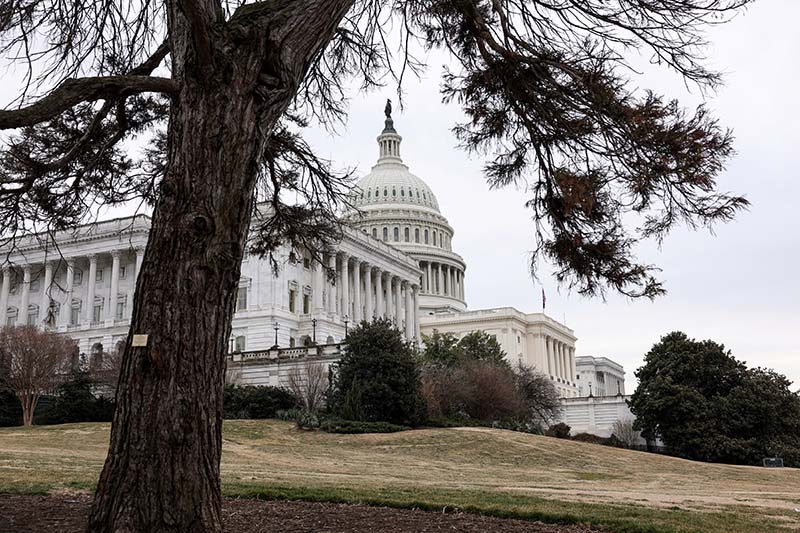
“The American people and Congress deserve immediate answers. Transparency and a clear articulation of long-term objectives are critical to preventing yet another open-ended conflict in the Middle East and ensuring the safety of Americans at home and abroad,” she said. “There is a bipartisan war powers resolution on the floor now, ready for a vote. Before this entanglement grows, Congress should come back into session and vote on it immediately.”
Use of force is ‘unlawful’
O’Connell argued that “as the war began, the United Kingdom government said the United States could not use military bases under U.K. control because the U.S. and Israeli use of force is unlawful.”
“The U.K. Prime Minister, Sir Keir Starmer, following U.S. criticism, is modifying the restriction,” she said. “The U.S. will be allowed to use bases for defensive purposes, as opposed to offense. This is a very thin line that the U.K. must know will be difficult for the U.S. to maintain, even if the U.S. tries. The U.K. says the change is owing to Iran’s unlawful counter-attacks. It is true that, while Iran is the clear victim in this war and that it has a right to defend itself, its defense has been erratic. International law requires that self-defense be carried out in a way that is necessary and proportionate. Force must be carefully calibrated to lawful defensive purposes. The principle of necessity also requires that the use of force be a last resort.
‘Persuade’ Trump to end the war
“There is a step the U.K. is legally obligated to take before opening its bases. It must use all the means in its power to persuade President Trump to end the war. No use of UK bases will be needed if those who started this unlawful conflict end it,” O’Connell said.
O’Connell also pointed to a requirement by the United Nations Charter that “the United States or an ally be a victim of a significant armed attack ‘occurring.'”
“It is aggression pure and simple to use force without a basis in the Charter’s rules on self-defense or with a Security Council authorization,” O’Connell said. “The outcome of this war cannot be predicted. The U.S. thought it could install new leadership in Iraq in 2003. That did not happen. Chaos ensued and is still playing out, only to be made worse by the war beginning today.”
Kate Scanlon is a national reporter for OSV News covering Washington. Follow her on X @kgscanlon.
