



WASHINGTON (OSV News) — The U.S. House of Representatives approved a war powers resolution on June 3 rebuking the conflict in Iran.
The same week, the Senate approved legislation providing another $70 billion for an immigration enforcement bill the U.S. bishops expressed concern to lawmakers about, and President Donald Trump said he will nominate Acting Attorney General Todd Blanche to keep that role.
House passes war powers resolution rebuking Iran conflict
The resolution directing Trump to remove U.S. armed forces from hostilities with Iran unless Congress authorizes the war or approves of military force is largely a symbolic statement of disapproval of the war with Iran, as it does not force compliance from Trump.
A similar measure in the Senate would carry more weight; however, Trump is expected to veto such a measure if it reached his desk.
The Democratic-led measure directing Trump to end his war with Iran passed over objections from House Republican leadership after four Republicans also voted to object to the conflict.
The resolution passed in a 215-208 vote, and the Republicans joining all Democrats in voting in favor were: Reps. Brian Fitzpatrick, R-Pa., Thomas Massie, R-Ky., Tom Barrett, R-Mich., and Warren Davidson, R-Ohio.
In a June 4 post on his social media website Truth Social, Trump called the vote “meaningless” and took aim at “4 bad Republicans” who voted with Democrats.
“They’re GRANDSTANDERS! They should be ashamed of themselves,” he wrote.
An Economist/YouGov survey, released June 2, found a record-high 61% of Americans disapprove of how Trump is handling his job as president. Pollsters attributed that rating to corresponding concern about inflation and the war in Iran.
Pope Leo XIV has also been a critic of the conflict in Iran and has called for peace in the region.
Senate Republicans pass immigration enforcement bill

The approximately $70 billion legislation would fund Immigration and Customs Enforcement and Border Patrol for the next three years, through the end of Trump’s second term in the White House.
The bill was passed in a largely party-line 52-47 vote shortly before 5 a.m. on June 5, with Sen. Lisa Murkowski, R-Alaska, the lone Republican to oppose it. Sen. Michael Bennet, D-Colo., missed the vote.
The bill’s Senate passage came after Trump’s attempt to attach a controversial $1.8 billion “weaponization fund” stalled it the previous month. Senators on both sides of the aisle raised strong objections to that attempt.
In a June 1 letter, Bishop Brendan J. Cahill of Victoria, Texas, chair of the U.S. Conference of Catholic Bishops‘ Committee on Migration, wrote to the top senators on the Committee on Appropriations that he hoped they would consider key policy reforms aimed at protecting the dignity of migrants, such as efforts to prevent the separation of families.
“Whatever disagreements may arise on specific policy questions, migration is fundamentally about the movement of human persons, each of whom is created in the image and likeness of God,” he wrote. “In the course of contemporary debate, this reality is frequently overlooked or dismissed entirely, paving the way for dehumanizing rhetoric and policy responses that fail to advance the common good.”
Judge strikes down Trump policy barring migration from 39 countries
A federal judge on June 5 ruled that the Trump’s administration’s policies barring people from 39 countries from receiving decisions on applications for asylum, work permits, green cards and citizenship were unlawful.
Chief U.S. District Judge John McConnell in Providence, Rhode Island, struck down the policies, finding they left migrants in “indeterminate legal limbo.”
“USCIS’s hold on adjudications cannot be attributed to anything that these individuals did wrong; rather, it arises solely by the happenstance of their birth,” he wrote. “USCIS” is the U.S. Citizenship and Immigration Services agency.
Trump announced the policies on Thanksgiving Day in 2025, saying he would “permanently pause” all immigration from what he called “Third World Countries,” after the shooting of two West Virginia National Guard members in the nation’s capital. Authorities identified an Afghan national as the assailant.
Catholic immigration advocates were among those who objected when those policies were implemented last year.
Trump to nominate Blanche as attorney general
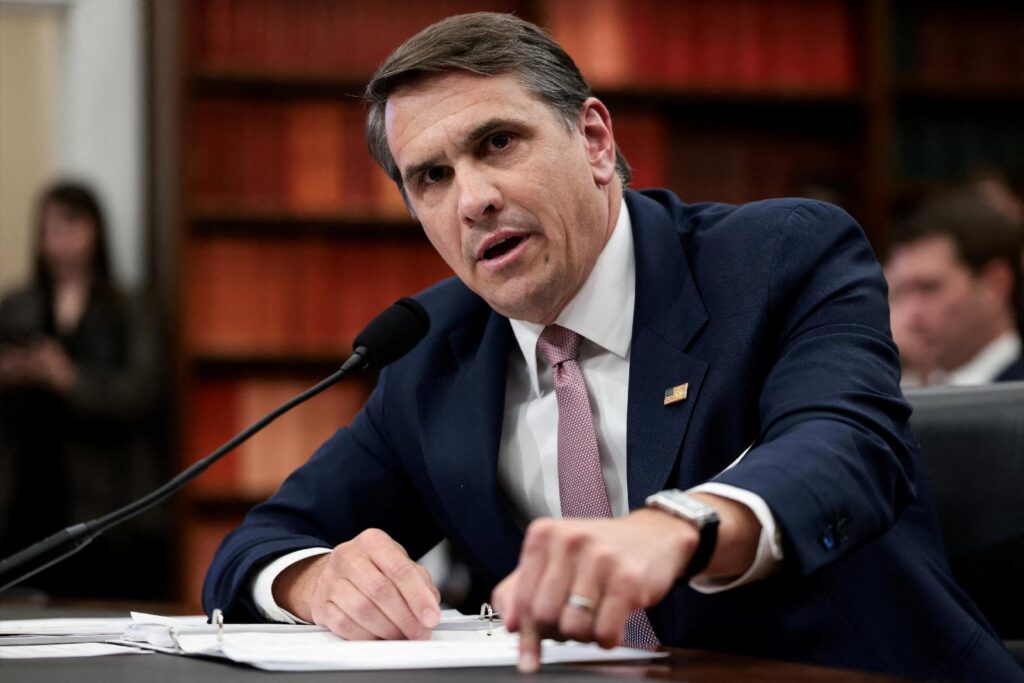
Trump said he planned to nominate Blanche June 3 during comments at a dinner at the White House.
“We are going to make him permanent attorney general,” Trump said of the planned nomination.
But Blanche’s path to Senate confirmation might be challenging, as many Senators objected to the “weaponization fund” Blanche had advocated. One of the senators who opposed that fund is the retiring Sen. Thom Tillis, R-N.C., who is a key vote on the Senate Judiciary Committee. Blanche’s nomination could only afford to lose one vote on that committee to proceed to the full Senate.
Blanche, who was previously Trump’s criminal defense attorney, took on the role of acting attorney general after Trump removed Pam Bondi from the role.
Pro-life groups have urged Blanche to stop the Department of Justice from asking courts to dismiss or pause state lawsuits seeking to roll back the Biden administration‘s eased restrictions on mifepristone.
Kate Scanlon is a national reporter for OSV News covering Washington. Follow her on X @kgscanlon.
