


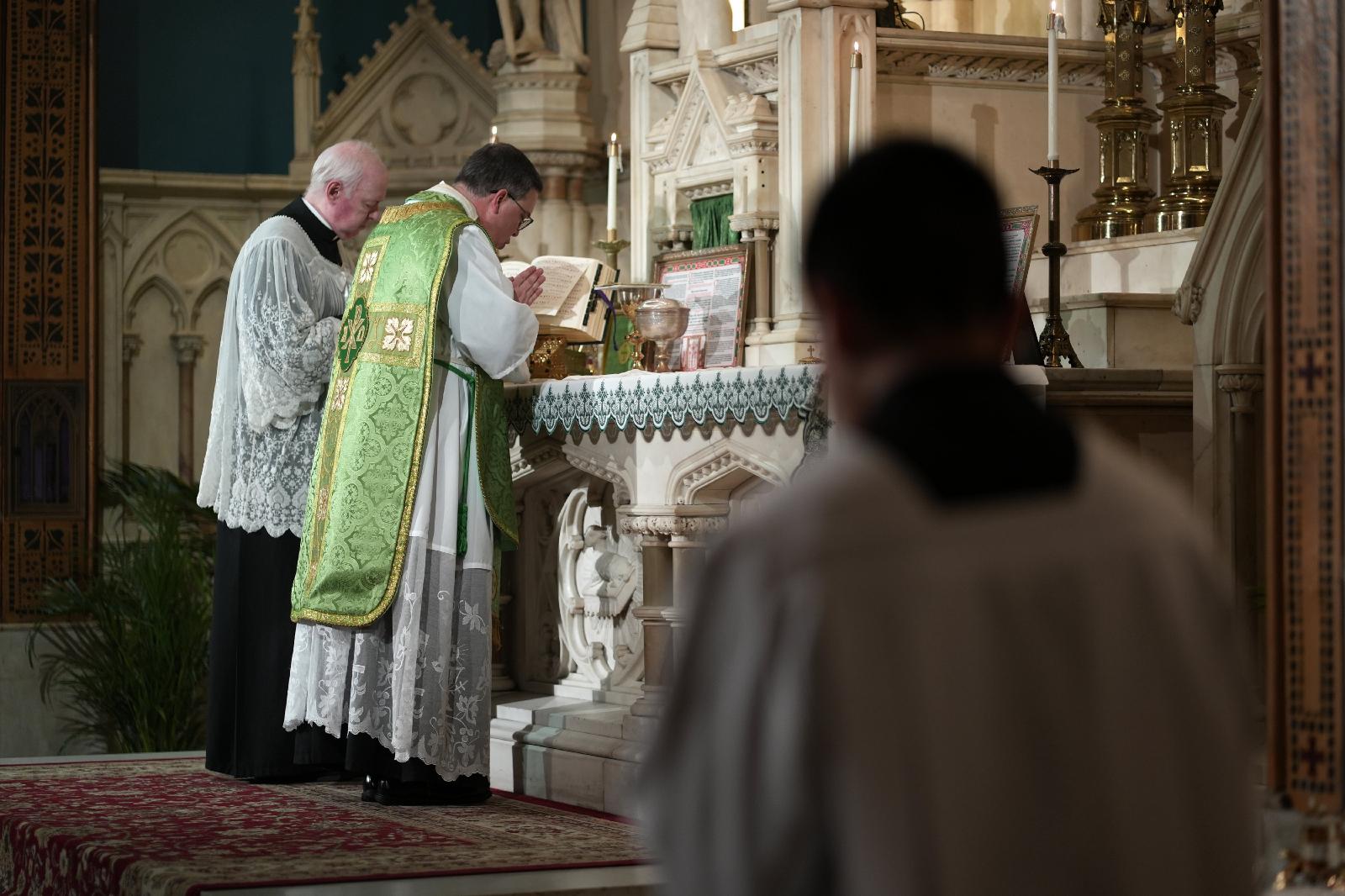
(OSV News) — Five years after its release, a papal document on the preconciliar form of the Mass, commonly called the “traditional Latin Mass” and abbreviated as the “TLM,” continues to prompt reflection and debate — with the Holy See’s recent excommunication of the Society of St. Pius X adding a new element to the discussion.
“Traditionis Custodes,” Pope Francis’ motu proprio on the use of the Roman rite liturgical form that existed prior to the Second Vatican Council, was released July 16, 2021.
Accompanying the document was a letter from Pope Francis to the bishops explaining his intention for the motu proprio, which he said in both that document and the letter had followed a 2020 consultation with the bishops by what is now the Vatican Dicastery of the Doctrine of the Faith.
In the letter, Pope Francis explained that his predecessors St. John Paul II and Pope Benedict XVI had permitted the use of the Roman Missal used before the 1962-1965 Second Vatican Council, hoping to restore unity with the traditionalist Society of St. Pius X, or SSPX.
But, said Pope Francis, use of the former rubric had increasingly become associated with a broad rejection of Vatican II itself.
He also stated two principles for the motu proprio’s application. Bishops were to provide for those “rooted in the previous form” but to ensure they “return in due time” to the postconciliar Mass form, with no further establishment of new parishes for the celebration of the earlier form of the Mass.
At the same time, Pope Francis called upon bishops to ensure the current liturgical form — for which an approved Latin-language version is available — be celebrated “with decorum and fidelity” to the conciliar norms, “without the eccentricities that can easily degenerate into abuses.”
‘A different tack’
Pope Francis’ approach in “Traditionis Custodes” marked “a different tack” from the course taken by Pope Benedict, said Father John Paul Kimes, associate professor of the practice at Notre Dame Law School and the Raymond of Peñafort Fellow in canon law at Notre Dame’s de Nicola Center for Ethics and Culture.
Father Kimes explained to OSV News that both popes “saw the same problem” — namely, that disagreement and division had arisen over the two liturgical forms — but “reacted to it very differently.”
In July 2007, Pope Benedict had issued the motu proprio “Summorum Pontificum,” which declared the preconciliar liturgical form to be a permitted “extraordinary expression” of the Roman Catholic Church’s liturgy, broadly allowing for its celebration with certain conditions.
Pope Benedict’s “fundamental insight was that the liturgy was being ‘politicized'” and becoming “a sign of division in the Church” rather than “the source of unity,” Father Kimes said.
He also noted that St. John Paul II had “previously addressed (at least twice)” the same “open wound in the Church.”
Pope Benedict’s motu proprio allowing for both forms was “an attempt to ‘depoliticize’ the Mass,” which is properly “the salvific sacrifice that unites,” said Father Kimes.
In contrast, Pope Francis opted in his motu proprio “to rescind this broader permission and to impose further restrictions” on the older form of the Mass — while he had meanwhile given the SSPX “broader permissions,” said Father Kimes.
One example of those permissions was granting the society’s priests the faculty to hear confessions, beginning in the 2015 Year of Mercy.
“Many people were left with a confused understanding” of the late pope’s aims on the issue of the traditional Latin Mass, Father Kimes said.
Immediate impact of ‘Traditionis Custodes’
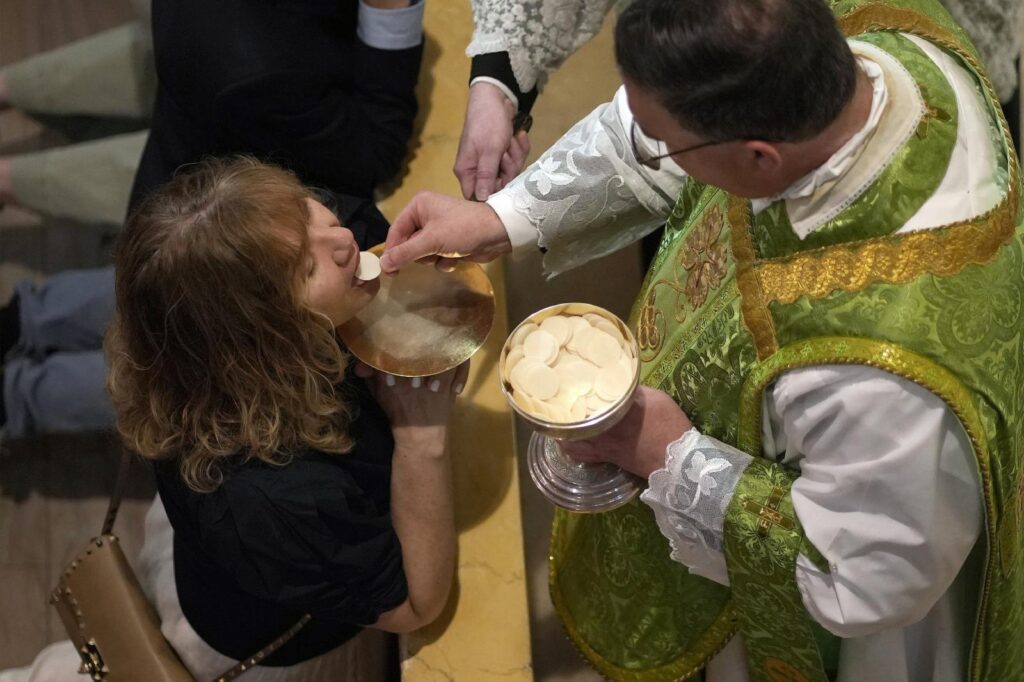
Shortly after the motu proprio’s promulgation, two-thirds of the nation’s Catholics remained unaware of Pope Francis’ restrictions on the preconciliar form of the Mass, according to a September 2021 Pew Research Center survey. A Pew report published in June 2025 found that 2% of the nation’s Catholics weekly attend the preconciliar form of the Mass.
Several experts consulted by OSV News said a forthcoming book is expected to shed greater light on the pastoral effects of “Traditionis Custodes.”
“Trads: Latin Mass Catholics in the United States,” scheduled for release in December by Oxford University Press, offers data-driven and ethnographic insights on the preconciliar form.
The book’s authors, scholars Stephen Cranney of The Catholic University of America in Washington and Stephen Bullivant of St. Mary’s University London, met with Pope Leo XIV privately at the Vatican in March.
Without providing further details of the meeting, Cranney told OSV News in July that he and Bullivant had discussed their research with the pope.
Cranney also placed the number of U.S. Catholics attending the traditional Latin Mass on a weekly basis at a “lower estimate” than the one offered by Pew.
In the U.S., “Traditionis Custodes” had an “immediate impact” of making attendance of the preconciliar liturgical form “difficult for a lot of traditional Latin Mass Catholics,” since it “reduced the venues” for celebration, said Cranney.
“It’s hard to get solid numbers for this, but I do strongly suspect that it decreased the total number of traditional Latin Mass-attending Catholics, just because it made it so much less convenient,” he said.
A need for more data
In a 2024 Substack post, Bullivant and Cranney had pointed to a “clear lack of objective, systematically collected data” on any correlation between attending the preconciliar form and holding “negative attitudes” toward Vatican II.
Speaking to OSV News, Australian scholar Richard Rymarz affirmed the need for more overall data regarding adherents of the traditional Latin Mass.
Rymarz, a professor at the University of Notre Dame Australia, was in the midst of his own 2021 case study on a group of 27 young adult traditional Latin Massgoers in a large, unspecified Australian city when “Traditionis Custodes” was issued.
He noted in his findings that “young adult Catholics” attending the traditional Latin Mass have “not been the subject of much empirical research, as they are small populations.”
His research, which he stressed in his paper was “not intended to be a representative or indicative sample,” identified three broad types of young traditional Latin Massgoers among those he interviewed — “continuers, joiners and converts.”
“Continuers” were raised in the traditional Latin Mass community Rymarz studied, or had at least attended Mass in that form since childhood.
Massimo Faggioli, professor of theology and religious studies at Villanova University in suburban Philadelphia, confirmed to OSV News that the traditional Latin Mass has “now become a multigenerational thing.”
“There’s a process of transmission in this,” he explained. “Now, especially in some areas in the United States, there are (traditional Latin Mass) families who have kids born after 2007” — when “Summorum Pontificum” was issued — “and this complicates enormously the pastoral solutions.”
Faggioli described the from-childhood adherence to the older form as “less ideological and more part of a lived experience,” adding, “It’s a different picture now than when it started in full almost 20 years ago, when Pope Benedict published his motu proprio.”
Rounding out the born-and-raised attendees in Rymarz’s study were “joiners,” baptized Catholics who had then become members of the traditional Latin Mass community, and “converts,” whose entrance into both the Catholic Church and the traditional Latin Mass community closely coincided.
Faggioli also highlighted that preferences for the traditional Latin Mass vary globally.
“It seems to me this is really a European and North American phenomenon,” one largely found in “English-speaking countries,” he said.
‘Reverence,’ ‘aesthetics’ and a love of Latin
Faggioli said that concentration was “not a surprise,” asserting that Vatican II’s liturgical shift from Latin to the vernacular was more dramatic for English speakers.
“It’s one thing to make the transition from Latin to Italian, Spanish or French,” he said. “But for many in the Anglo-American context, it gave the impression of a sell-out to the Protestants. It sounded (like) the loss of a very specific Catholic marker, which was Latin.”
At the same time, said Faggioli, “language is not everything” in the preference for the traditional Latin Mass, adding that Vatican II’s biblical renewal, which saw “more Bible in the (Mass) readings,” was “seen in certain contexts as a less Catholic, more Protestant” church.
Cranney also pointed to the “aesthetics” of the preconciliar Mass form, which for adherents is seen as “a lot more elegant” compared to “more stripped-down modern Masses.”
In addition, he said, “some” of the attraction is a sense of “tradition.”
Adherents “feel like by going to the TLM, they’re sort of hearkening back to their ancestors, or the older Church,” said Cranney, describing the preconciliar form as “a heuristic for being guaranteed a reverent Mass.”
In his study, Rymarz found that traditional Latin Massgoers in the community he studied “shared a commonality of belief and practice” that was “hard to separate from strictly theological views about preference for the TLM.”
“If one notion could act as a useful summary of views on the TLM, it would be the very commonly expressed view, albeit articulated in slightly different ways, centred on the idea of ‘feeling at home’ or ‘where I belong,'” he wrote.
SSPX excommunications
Speaking to OSV News, Rymarz said the community he studied was “blindsided” by “Traditionis Custodes” — and he warned that “it’s almost a maxim in sociology” that groups who feel marginalized are at greater risk for radicalization.
“I can imagine those feelings would be exacerbated after the document,” he said, referring to “Traditionis Custodes.”
Father Brian Austin — a canon law scholar at St. Paul University in Ottawa, and a member of the Priestly Fraternity of St. Peter currently ministering in Atlanta — said the document ultimately had a divisive effect.
While not applying to his own Vatican-approved community, which was founded in 1988 for the exclusive celebration of the Mass according to the older form, “Traditionis Custodes” actually “re-opened wounds that had taken decades to heal,” Father Austin told OSV News.
He added, “some of these wounds — self-inflicted though they may be, as in the case of the schismatic SSPX — may perdure for the foreseeable future,” referencing Pope Leo’s July excommunications of six bishops of the traditionalist society, following unauthorized episcopal ordinations in defiance of Vatican orders.
A look ahead
But “ironically, the temerity of the SSPX might be a godsend for traditionalists within the Church,” said Shaun Blanchard, senior lecturer in theology at the University of Notre Dame Australia.
Blanchard told OSV News the SSPX excommunications “provide a timely chance” for traditionalist Catholics “to publicly and vehemently assert their loyalty to Pope Leo.”
He said his 2021 mapping of “four basic camps” of reaction to “Traditionis Custodes” — those who celebrated the “TLM crackdown,” those who saw it as a “sad necessity,” and those who opted to “mourn and move on” or “reject and resist” — still holds five years later, “albeit in mutated form.”
Blanchard said those groups in turn “showed that the real dispute was ecclesiological and not liturgical.”
Specifically, said Blanchard, the presence of such groups “put the controversy into a historical context that went beyond the issues that Francis and his supporters and critics typically circled around” — such as the reception or rejection of Vatican II or opinion on the benefit of Pope Benedict’s “Summorum Pontificum.”
Pope Leo will likely not rescind “Traditionis Custodes,” but the motu proprio could die “a death-by-a-thousand-cuts,” with the pope possibly deciding to make “exceptions” that become the norm, while the document would serve as a “safety valve” to “corral and control renegade traditionalist communities,” Blanchard said.
Jesuit Father Anthony Lusvardi, associate lecturer in theology at the Pontifical Gregorian University in Rome, told OSV News that “taking a bit of a step back” and determining “the theological principles that we’re trying to protect” can “lead to a more accommodating and flexible approach” towards those who have “legitimate desires” regarding the preconciliar liturgical form.
“The fact that people are attracted to an alternative should cause us to ask a number of different questions,” said Father Lusvardi, a sacramental theologian. “It may cause us to ask, ‘Is there something wrong with these people?’ But it may also cause us to ask, ‘Is there something wrong with the way that we are celebrating the Novus Ordo (the postconciliar form of the liturgy)?'”
Father Lusvardi added, “Being a theologian, I don’t think the fact that criticism exists is necessarily a bad thing. When I see or hear criticism, I say, ‘That’s interesting. Let’s talk about this. Let’s dig into what the issues are.'”
He also echoed the call for “more research” — along with “genuine listening” and “person-to-person conversations, because those are very different than the social media sort of conversations.”
Gina Christian is a multimedia reporter for OSV News. Follow her on X @GinaJesseReina.
