

BOSTON (OSV News) — It was a sight that, had they lived to see it, would have made the Puritans of colonial times spit out their beans and cod.
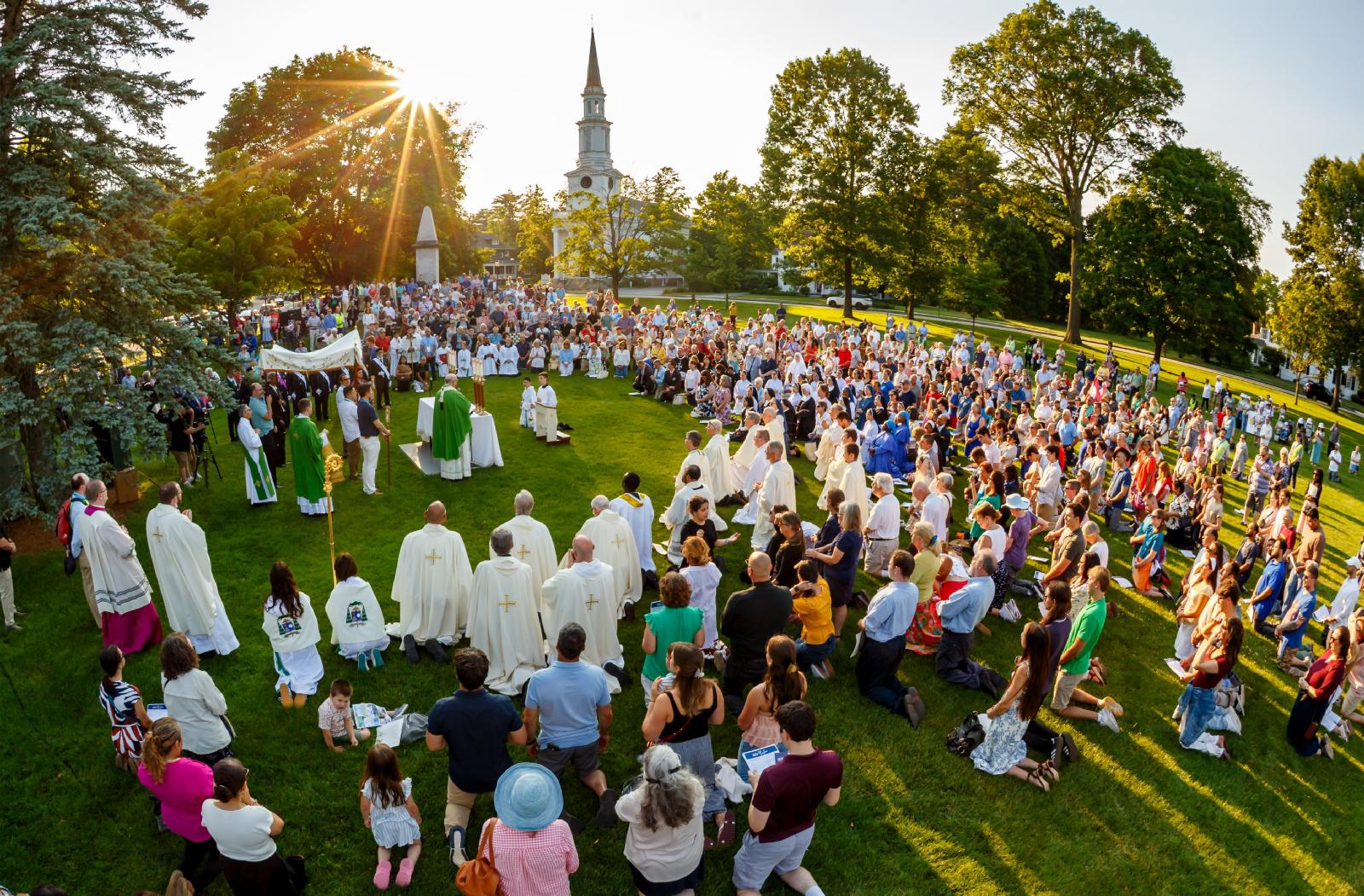
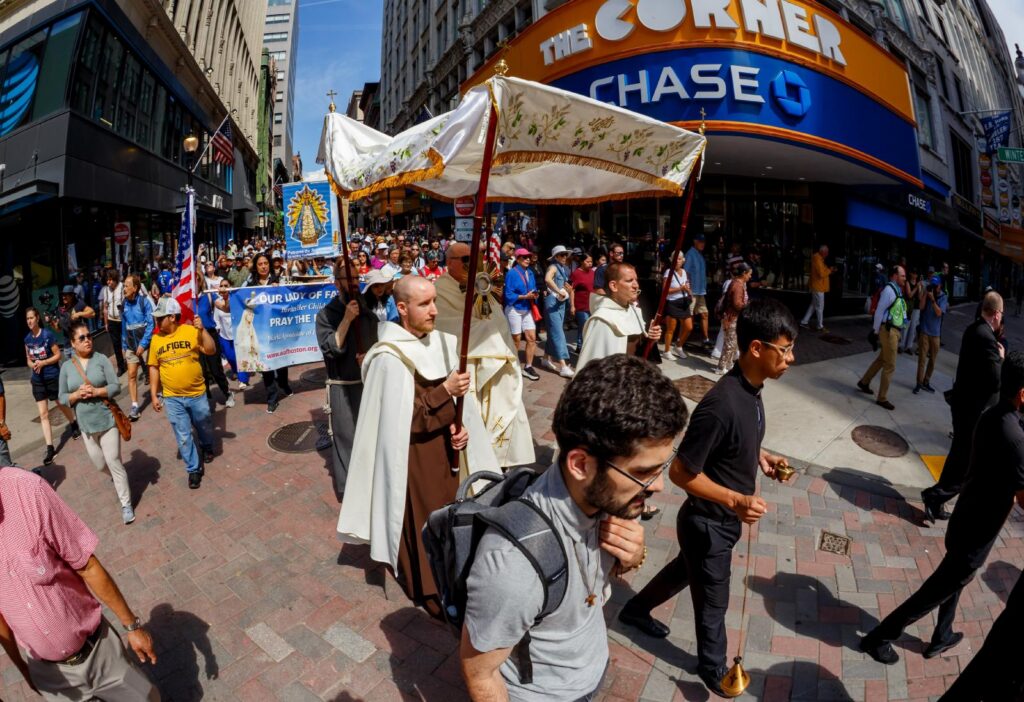
Over 2,500 Catholics, united and proud in their faith, marching through Boston and bringing the real presence of Jesus in the Eucharist to everyone in their midst, led by their archbishop and dozens of priests, praying the rosary in a place where the celebration of Mass was once illegal.
The 2.5-mile Eucharistic procession, which took place on June 27 as part of the 2026 National Eucharistic Pilgrimage, was a celebration of the 250th anniversary of the U.S. and the history of Boston itself. The procession roughly followed the Freedom Trail, itself a sort of pilgrimage route honoring Boston’s Revolutionary past. The theme of the six-week, national pilgrimage along the East Coast is “One Nation Under God.”
Boston’s history, culture on display
On Boston Common on the morning of June 27, tour guides milled about in colonial garb, surrounded by massive crowds who had come to adore the Blessed Sacrament: priests in cassocks and baseball caps, men and women religious in habits, throngs of parishioners who had arrived on buses, and musicians with drums and guitars.
The display of international solidarity was enough to rival the World Cup. The Archdiocese of Boston’s Hispanic, Portuguese, Brazilian, Vietnamese, Cape Verdean and Korean communities, among others, proudly displayed banners honoring their countries of origin, parishes and patron saints.
“God bless you all, God bless the city of Boston, God bless the Commonwealth of Massachusetts, and God bless America,” Archbishop Richard G. Henning of Boston said, welcoming the pilgrims.
He told them that, while walking past some of the most historic sites in the U.S., they would make history themselves. He encouraged them to pray for the nation.
“Today we are witnesses, he said. “We are witnesses to the grace and mercy of Jesus Christ.”
Revolutionary War landmarks
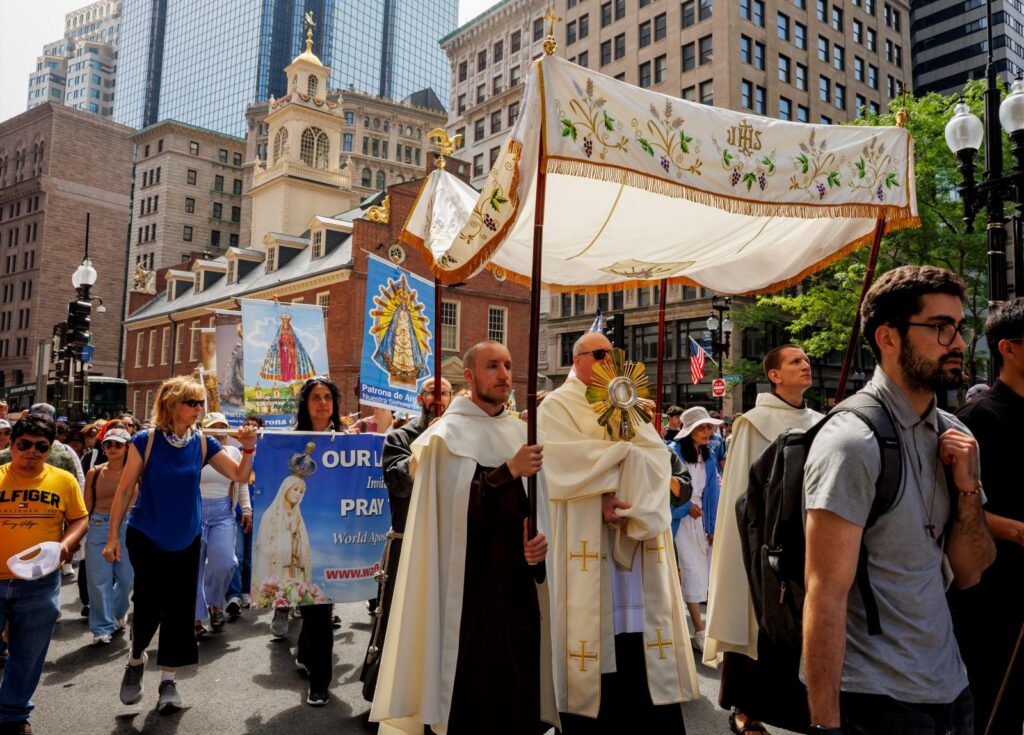
A sea of people parted so the Eucharist, shaded under an embroidered canopy, could make its way to the archbishop. The gold monstrance glittered in the sun. The procession moved toward the State House, a huge, curving mass of people. Some sang, others kept a reverent silence. Members of the archdiocese’s many ethnic communities provided music.
The procession passed the Robert Gould Shaw Memorial, then went back down the hill through the Common. A sister stepped out of the crowd to offer food to a homeless man resting under a tree. The smoke of incense mixed with steam rising from manhole covers.
The procession passed Old South Meeting House, where the Boston Tea Party was organized; the Old State House, which witnessed the Boston Massacre; City Hall; and the Paul Revere House. A fog blowing in tinged the tips of the skyscrapers looming above the historic landmarks.
Archbishop Henning and the pilgrims briefly stopped to adore the Blessed Sacrament in front of Sacred Heart Church in the North End — the archbishop would later that day celebrate a Votive Mass of the Sacred Heart at the Cathedral of the Holy Cross.
Jesus on the Freedom Trail
“The Church in America has been so important to the American journey,” said Mark Riley, who came from Amesbury, Massachusetts, to join the procession. “You think of the Church and the United States, both are powerful forces for good, improving the world so beautifully, but also going through troubled times and fighting back against the difficulties that present along the way, and so I’m here. Land of the free, home of the brave.”
Riley had never walked the Freedom Trail before. His friend Peter Mercier, of Salem, pointed out that Riley was now walking it with Jesus.
“The whole Church is my life, really,” Mercier said.
Growing up, there were three heroes in his household: Pope St. John Paul II, Mother Teresa and Larry Bird.
“It’s a gorgeous, gorgeous day, beautiful day,” he said. “So many faithful people here. We’re so blessed to be a part of it, and Archbishop Henning is leading it, and I really feel it’s a great revival for the faith in Boston and in New England.”
The procession made its way through the narrow, winding streets of the North End, filled with tour groups and Italian restaurants. A man in full Yankees gear crossed himself when he saw the procession. The USS Constitution and the Bunker Hill Monument, the procession’s final destination, were visible across the harbor.
‘You have done a beautiful thing’
Tourists, construction workers, sanitation workers, businesspeople, cyclists, softball players and sunbathers all stopped to watch the pilgrims. Stretching for blocks into the distance, the praying multitudes crossed the Bill Russell Bridge into Charlestown. A boat named “Indiscretion” from Newport, Rhode Island, carrying a bachelorette party, honked its horn in salute. The women on board waved at the pilgrims.
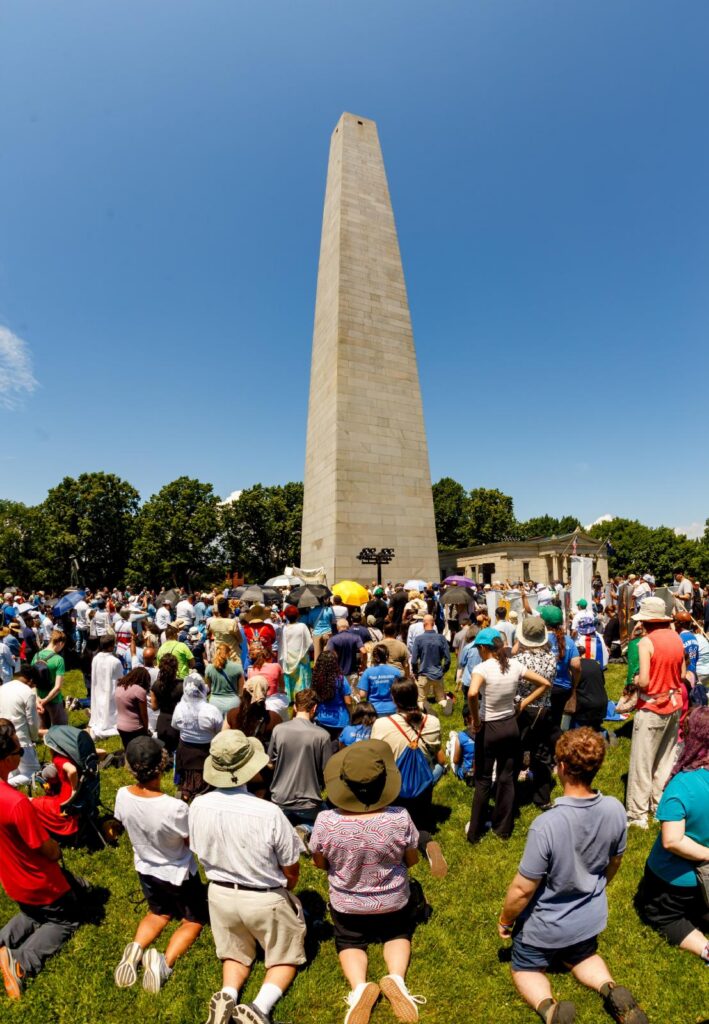
Passing St. Mary Church in Charlestown, the procession finally made its way up Monument Avenue to the 221-foot-tall obelisk, where an altar had been set up.
“We made it,” Archbishop Henning said to applause.
He added, “You have done a beautiful thing. You have given witness to your faith in Jesus Christ. We have joined together, we have prayed, honoring the promises of the past and praying for the hopes of the future.”
He recalled the famous words of Puritan John Winthrop, who called on his fellow colonists to make Boston “a city upon a hill,” an image from the Gospel of Matthew. Generations later, on Bunker Hill, Patriots did battle against the British. The archbishop said they bore witness to “liberty, and for a vision of the dignity of each person, equal before God.”
“We honor their sacrifices and their vision,” he said. “We too are called to be the light, to give example, to point to the truth of God.”
Poetry commemoration
The faithful knelt on the grass to adore the Blessed Sacrament. They sang hymns of praise, followed by “God Bless America.”
Finally, Dominic Smethurst, a fourth grader at St. Mary of the Annunciation School in Danvers, read his poem “Mission Faith” for the crowd. Dominic won a poetry contest hosted by the Archdiocese of Boston Catholic Schools Office in honor of the National Eucharistic Pilgrimage. Students were asked to reframe Longfellow’s “Paul Revere’s Ride” as “The Midnight Ride of Faith.” The words of Dominic’s poem must have resonated with the pilgrims who had journeyed from Boston Common to Bunker Hill.
“I start my route,” his poem reads. “I roam around town. I preach my message, and never get down. The route is hard, but I have faith. I always keep steady, because I am ready. I preach to everyone, ‘Have faith in God! Have hope in life! Have courage to solve every strife!'”
This story was originally published by The Pilot, the news outlet of the Archdiocese of Boston, and distributed through a partnership with OSV News. Wes Cipolla is on the staff of The Pilot.
