


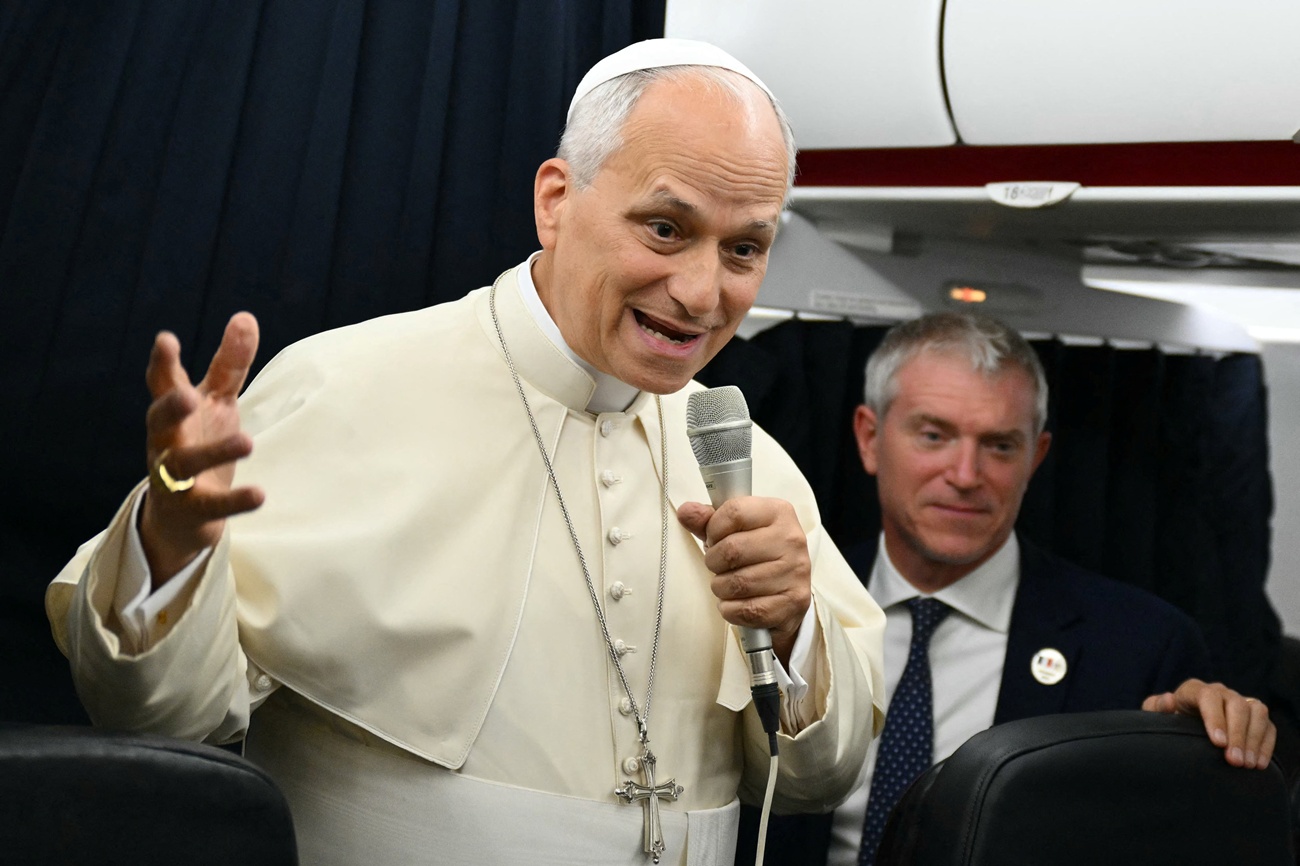
ABOARD THE PAPAL PLANE (OSV News) — On the return flight to Rome from his four-day visit to France Sept. 28, Pope Leo XIV said that the prospect of artificial intelligence destroying humanity does not keep him up at night.
During an in-flight press conference on the papal flight from Metz, France, the pope was asked if he was worried that AI could pose catastrophic risks to humanity or even wipe it out entirely.
“If someone were to ask me, am I in panic mode? No, I’m not. I sleep at night,” the pope replied.
“I do think that the concerns raised by many of the experts, specialists in AI, should be taken seriously. I don’t think that is fake news, as some have said, to try and cause … financial or some other kind of benefit,” he told the more than 80 journalists on board the papal plane, a chartered Air France jet, which touched down in Rome a little before 9 p.m. local time.
AI leaders should meet
The pope’s comments come after the publication of his landmark encyclical on artificial intelligence, “Magnifica Humanitas,” which has led to the pope being recognized as one of the leading global voices on the need for ethical guardrails in the development of the technology, amid recent warnings from technology leaders that AI could destroy the world.
Earlier this month, Evan Hubinger, a top safety researcher at the AI company Anthropic, claimed that he believed the chance of AI-powered human extinction within 10 years at greater than 10%.
The pope noted that he had just read that “the head of Nvidia claims that he has found some way of inserting into AI certain guardrails.”
“He’s the same one, however, that says there should be no limits placed and no government regulation,” he added.
“This is a problem that I think we need to sit down and talk about,” the pope said, expressing hope political leaders, the leaders of AI, social organizations and associations could meet to discuss what is happening.
Vatican’s role in AI dialogue
Pope Leo was specifically asked what the United States and China should do to ensure their technologies are safe for humanity. While not mentioning China or the U.S. directly, the pope responded that it would not be responsible to “close our eyes” to the risks posed by AI.
“The Vatican has organized its own commission on artificial intelligence,” he said. “Since ‘Magnifica Humanitas’ was published, we have received many contacts from people in many different areas and fields.”
“And so, we are trying to continue to promote dialogue, study, investigation, to find ways to make sure that AI does not get to a point where it could destroy humanity or remove humanity from the conversation,” the pope said.
Church’s response to abuse
During the 23-minute press conference, the pope also responded to questions about clerical sexual abuse, the housing crisis in Spain, the rise of the far right in Europe, and why he chose to speak out about the assisted dying law recently passed in France.
A French journalist asked Pope Leo about his meeting with seven victims of sexual abuse in Lourdes the day prior, specifically a comment made by one of the victims, Jerome Guillement, who after the papal meeting said that it was clear to him that Pope Leo views abuse as “systemic” within the Church.
At the victims’ press conference after their nearly two-hour meeting with Pope Leo on the evening of Sept. 27, Guillement said that it was his impression that from Pope Leo’s point of view “what creates the space and allows these abusers to keep offending is the systemic structure within the institution — a structure that was there in the past, but in his eyes, is still very much in place.”
On the papal plane, Pope Leo clarified that several of the victims spoke about systemic abuse, but personally he would prefer to express it in a different way.
“Sexual abuse is first and foremost a human problem,” the pope said. “When it happens within the Church, it actually has another whole dimension added to it, because people’s lives of faith are deeply wounded and sometimes even destroyed.”
“There’s a particular responsibility of the Church to walk with them and to help them seek healing,” Pope Leo said. “In those terms I spoke with them about how the Church, in certain ways, has been seen as being responsible, but in the same way that the Church, I think, is an important part of helping them to find healing.”
Ahead of Pope Leo’s visit to Lourdes, mosaics by Father Marko Rupnik on the front wall of the Basilica of Our Lady of the Rosary were covered out of sensitivity to victims of abuse who come to the Marian shrine seeking healing and consolation. Rupnik, whose canonical trial is still under review by the Dicastery for the Doctrine of the Faith, has been accused of spiritual and sexual abuse by more than 20 women.
Paris, Lourdes, Metz
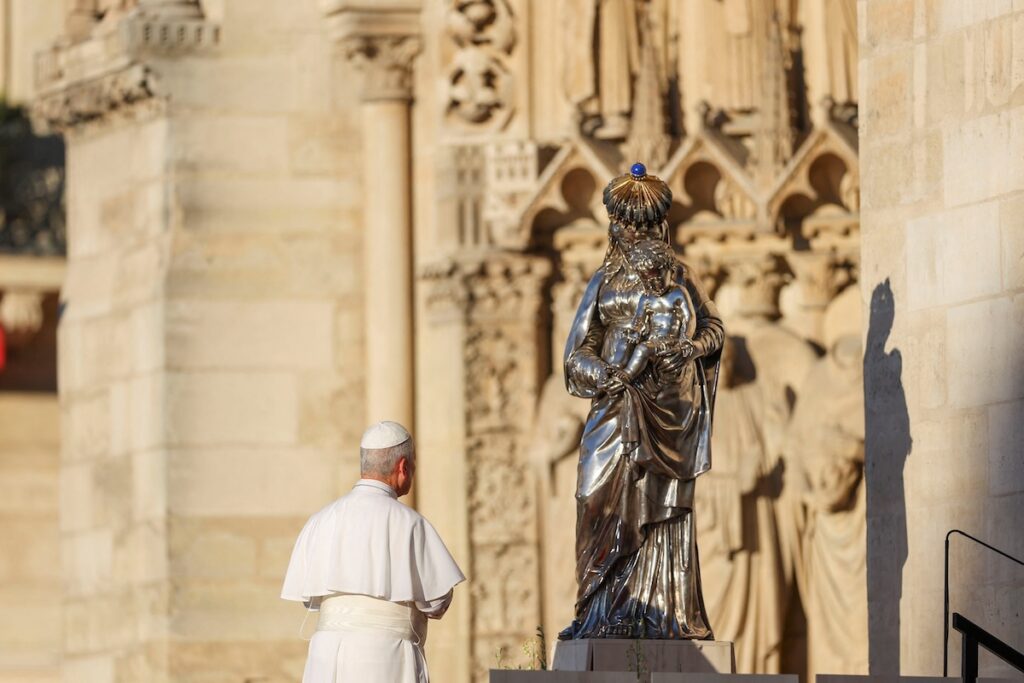
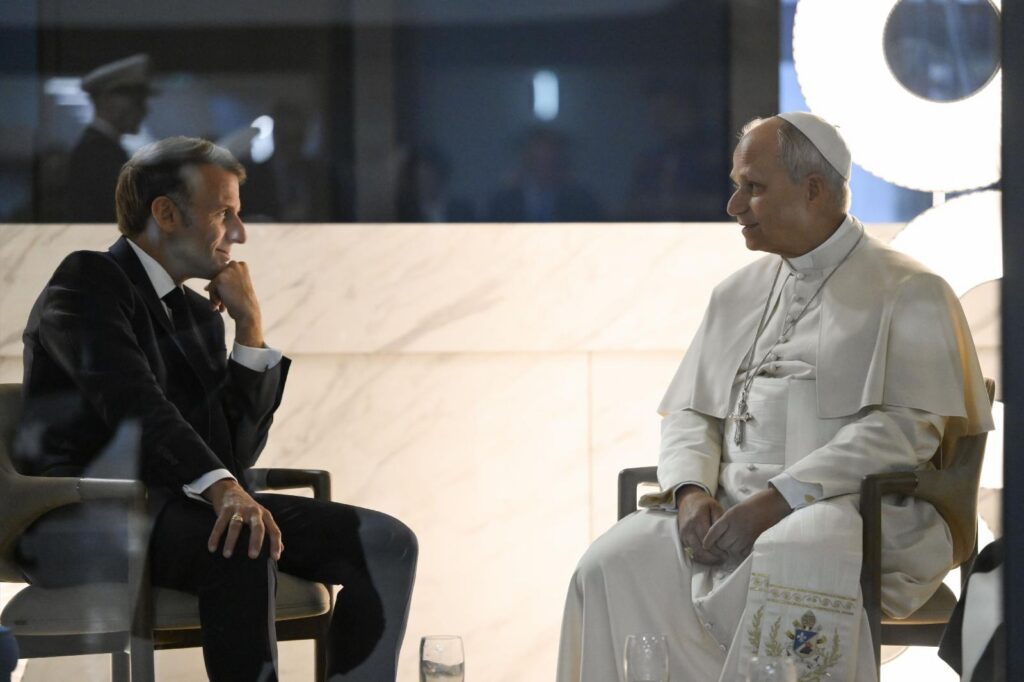
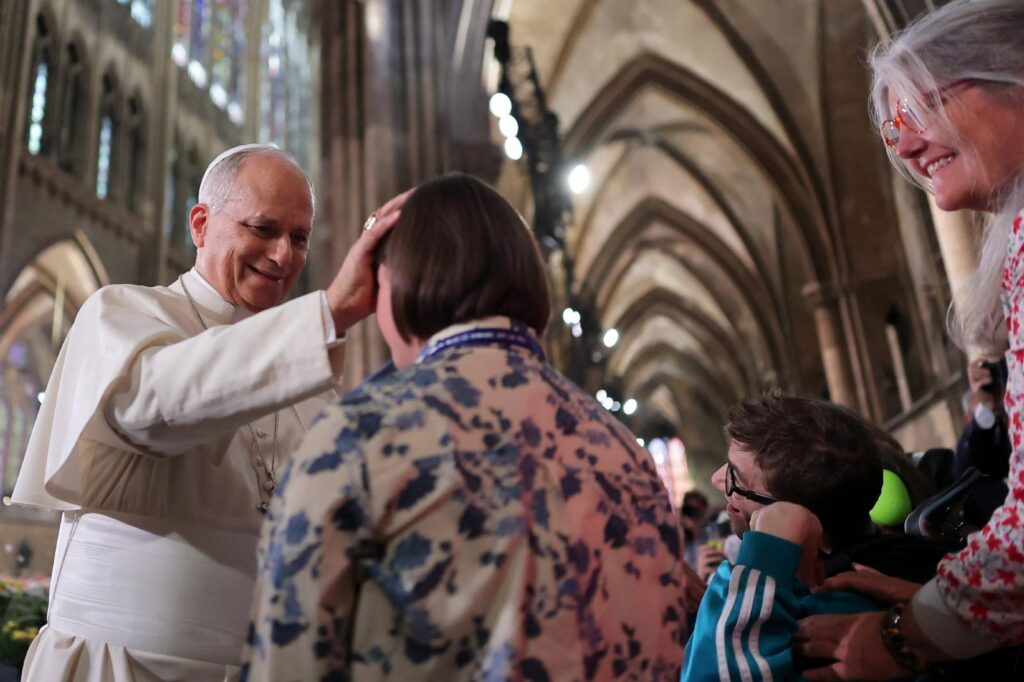
The in-flight press conference concluded Pope Leo’s four-day apostolic journey to France Sept. 25 to 28 in which the pope visited three cities. Beginning in Paris, he prayed in Notre Dame cathedral for the first time since its reopening after the devastating 2019 fire and celebrated a Mass that drew upwards of 800,000 Parisians lining the Champs-Elysees.
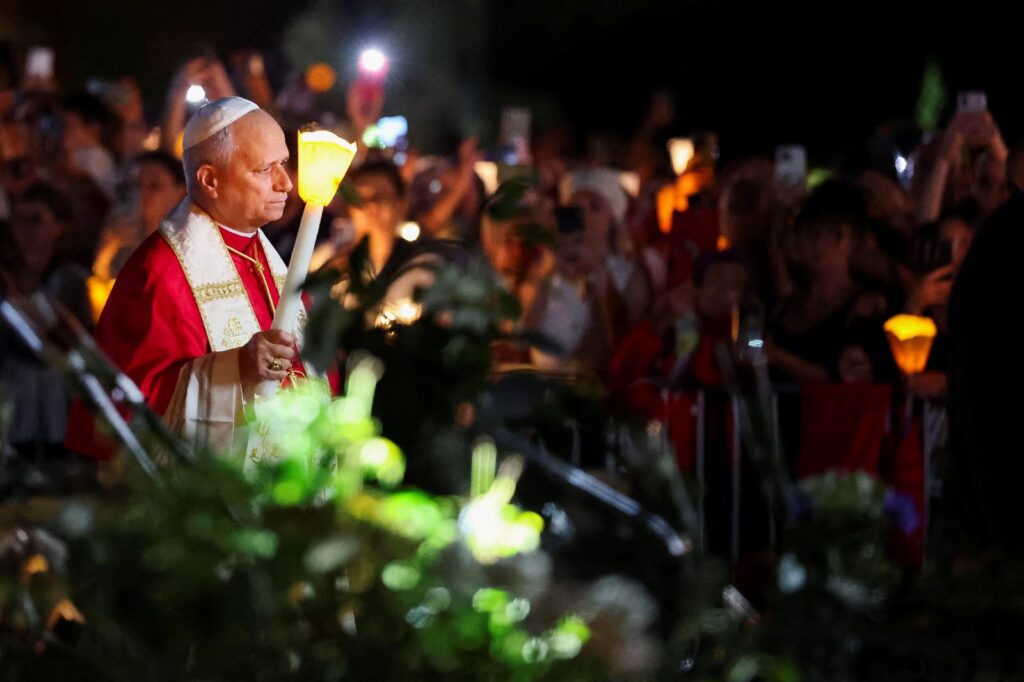
Pope Leo then flew to the Marian shrine of Lourdes, one of the most visited Catholic pilgrimage sites in the world, where in addition to meeting with abuse victims, he prayed for the sick and suffering in the Grotto of the Apparitions, addressed French bishops and led a candlelight rosary procession.
The pope concluded his first apostolic journey to France in the northeastern city of Metz, near the German border, to honor Venerable Robert Schuman, a statesman known for his Franco-German reconciliation efforts after World War II who is considered one of the founding fathers of European integration.
Highlights: Lourdes, vigil with young people
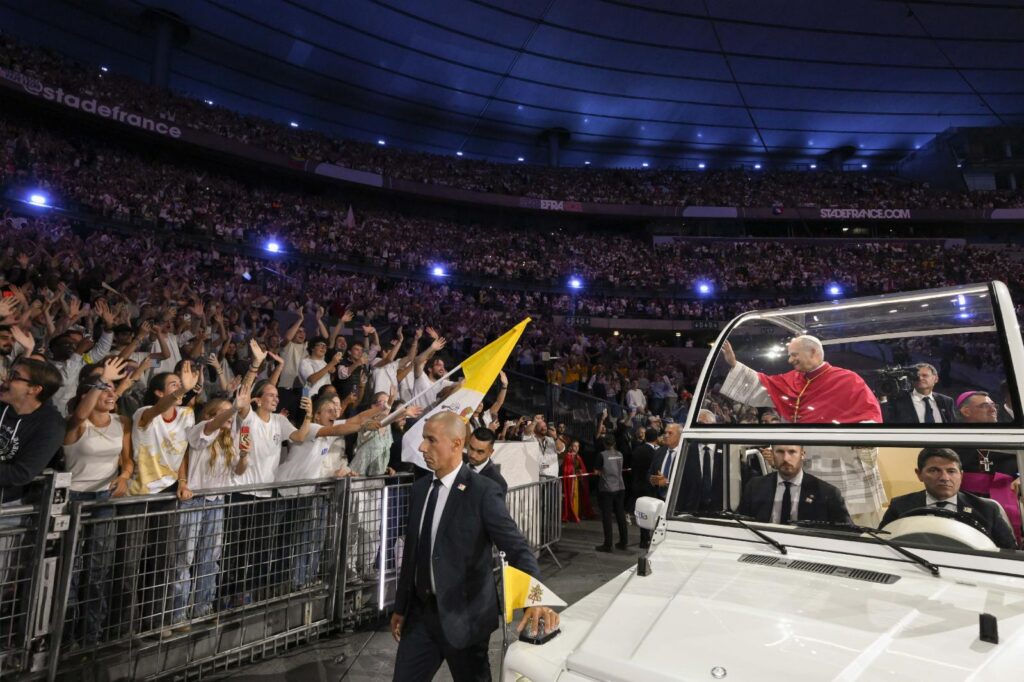
Pope Leo said that the personal highlights for him were the pilgrimage to Lourdes and the stadium prayer vigil near Paris with 80,000 young people.
“The four days were literally filled with many blessings — almost miracles, I would say — especially the time at Lourdes, walking with, accompanying so many people who are sick and suffering and seeing how the grace of God’s presence manifested in many different ways, touches people’s hearts, transforms their lives, and — to use an expression that I mentioned there — restores dignity to the sick, the elderly, those who in some parts of society are discarded,” he said.
Courtney Mares is Vatican editor for OSV News. Follow her on X @catholicourtney.
