

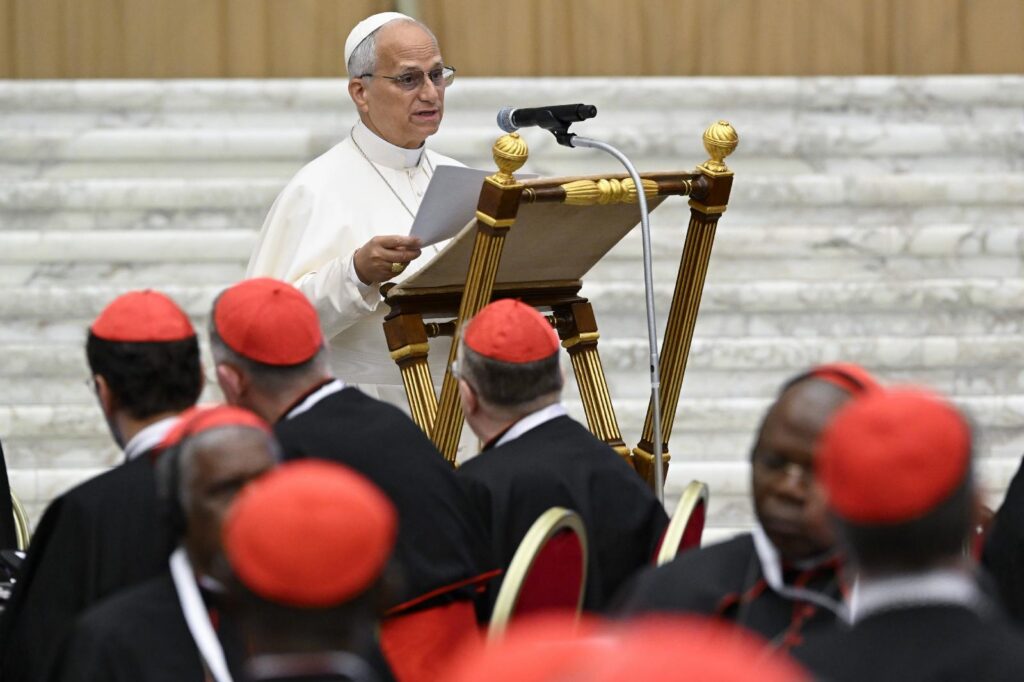
VATICAN CITY (OSV News) — Pope Leo XIV opened the second extraordinary consistory of his pontificate June 26, urging cardinals to help him discern what the Holy Spirit is saying to the Church today and reminding them they are not “guardians of particular interests,” but disciples called to communion in Christ.
In his opening speech for the two-day meeting June 26-27, the pope told the cardinals gathered in the Vatican’s Paul VI Hall, his ministry “cannot be carried out alone” and called on the College of Cardinals to support him by offering frank and sincere counsel.
“I am counting on you to help me discern what the Spirit is saying to the Church today. I need your support: strong, explicit, and public. I need to feel sustained by you, as by brothers,” Pope Leo said.
‘Sincere advice’ an ‘act of communion’
“Help me to listen to what is emerging in the Churches, to recognize the signs of hope that often grow in silence, but also to not ignore the struggles, misunderstandings, and resistance that can slow down our journey. I need your freedom, your frankness, and your loyalty. Sincere advice is always an act of communion,” he told the cardinals.
It is the second time this year that Pope Leo has gathered the world’s cardinals together. Out of the 241 current members of the College of Cardinals, 178 cardinals participated in the June consistory.
Cardinals from Africa, Asia, Europe, Oceania and the Americas traveled to Rome for the consistory, in which they are set to discuss evangelization, synodality and the pope’s recent encyclical “Magnifica Humanitas” on safeguarding of the human person in the age of artificial intelligence.
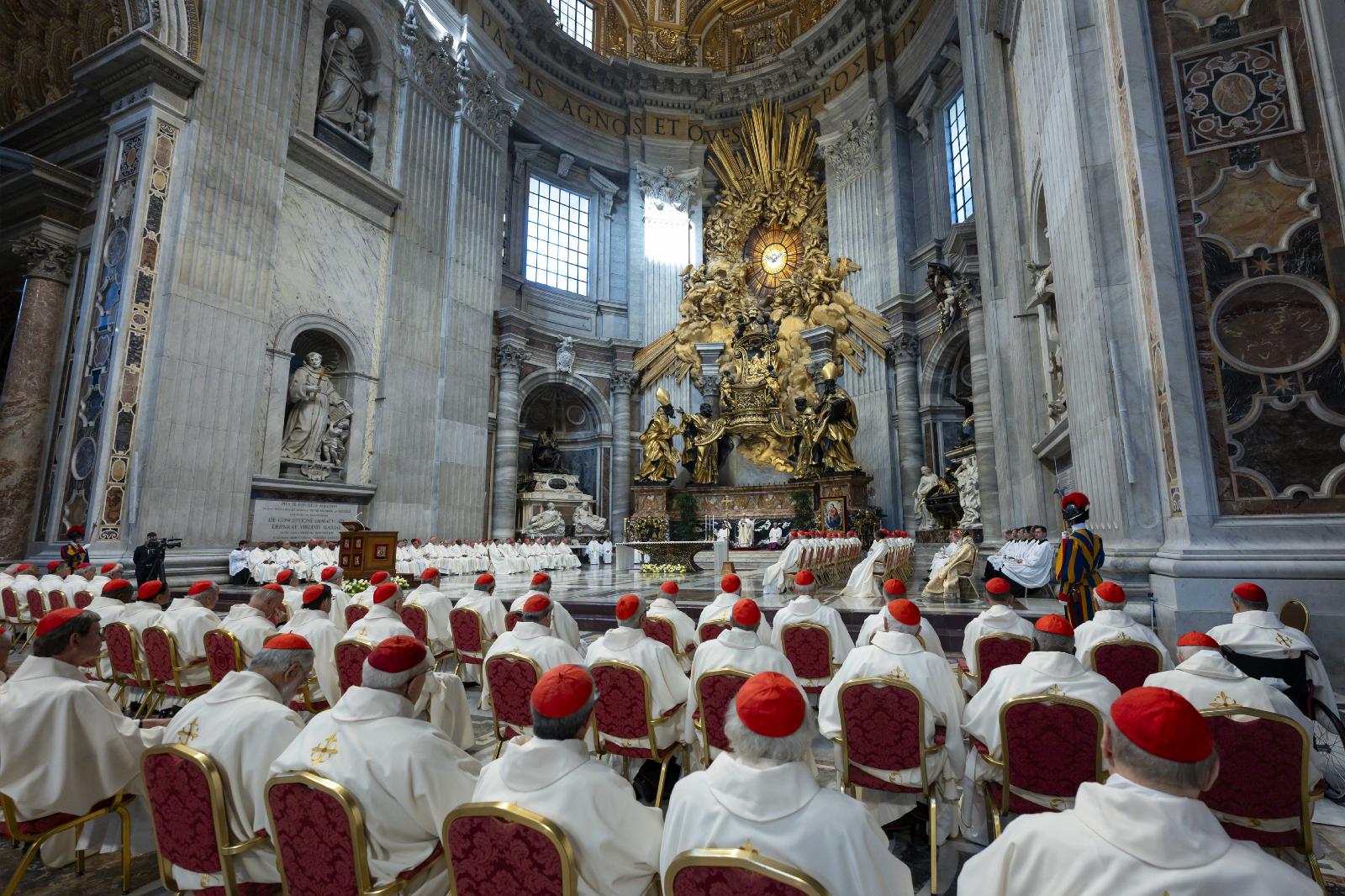
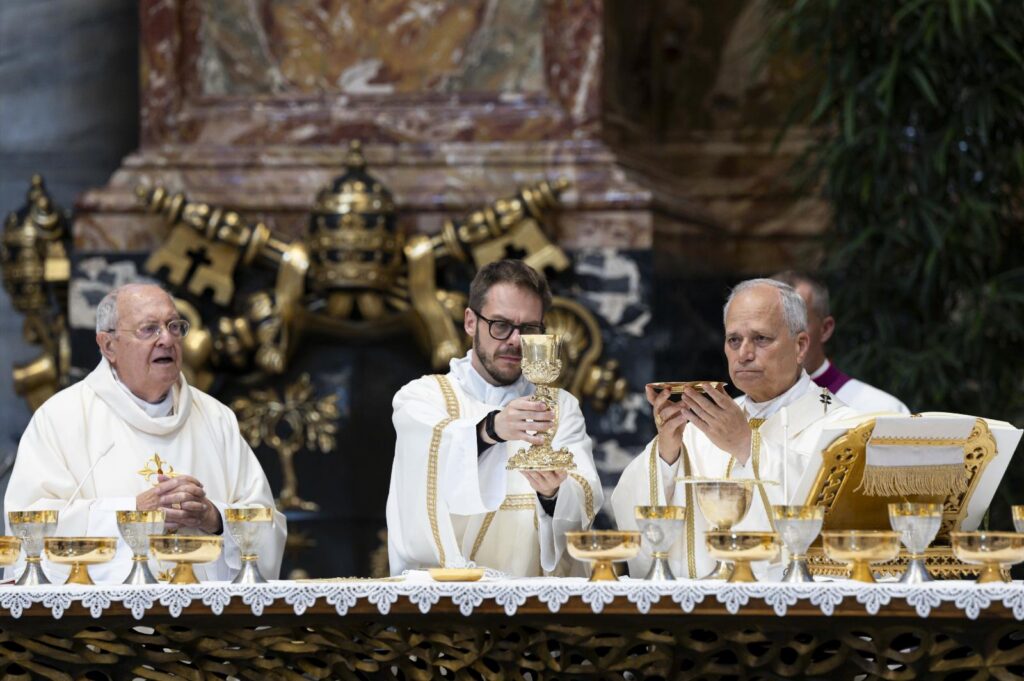
The consistory opened with Mass celebrated by Pope Leo in St. Peter’s Basilica, where he urged cardinals to “ask for the gift of peace in unity.”
Small group discussions
Before the first session of the consistory, the hymn “Veni Creator Spiritus” was intoned in the Paul VI Hall. Cardinals were divided into small discussion groups seated at round tables, a format more similar to that used during the Synod on Synodality than the traditional open-forum structure used during the pontificates of John Paul II and Benedict XVI in which cardinals addressed the entire college with brief interventions.
Eight of the working groups are made up of cardinal electors serving as ordinaries, including nuncios and retired ordinaries, and 10 more groups are made up of cardinals serving in the Roman Curia and nonelectors who are over the age of 80. Cardinal Rueda Aparicio, the Archbishop of Bogotá, Colombia, moderated the first session.
Among those seated together, U.S. Cardinal Raymond Burke could be seen sitting at the same round table as Cardinal Timothy Radcliffe for the morning’s discussion.
‘Style of ecclesial discernment’
Pope Leo acknowledged that this “style of ecclesial discernment” requires “patience and sometimes raises questions,” but encouraged the cardinals to “engage wholeheartedly in the group work.”
“I am well aware that, for many of us, this is not the usual way of conducting a consistory,” he said. “Yet this too is part of the journey along which the Lord is leading us.”
“We too learn synodality by practicing it; we learn together to grow in communion,” he added.
Four sessions, one central question
Over the two days, cardinals will take part in four sessions discussing their view of the world, peace, the common good and synodality. In his opening address, Pope Leo said that all of these four topics “converge on a single question: how can we help our Churches today to proclaim the Gospel with greater fidelity, freedom, and credibility?”
Friday morning’s first session included a biblical meditation by Cardinal Grzegorz Rys of Krakow. Groups were asked to reflect on what sufferings and tensions most deeply affect the communities in their care, and what signs of hope are emerging.
According to the Vatican, cardinals discussed increasing polarization in societies, the lack of religious freedom in many parts of the world, the crisis of the family, migration, individualism and the rise of loneliness, and secularization, among other topics, in the first session.
Pope Leo stayed in the hall until the beginning of the small group discussions and returned to listen to the group presentations and the prayer of the Angelus.
‘Culture of power, civilization of love’
Cardinal Victor Manuel Fernández, prefect of the Dicastery for the Doctrine of the Faith, will introduce the second session in the afternoon, taking up the theme, “The culture of power and the civilization of love,” drawn from the fifth chapter of “Magnifica Humanitas.” Among the issues addressed by Pope Leo in that chapter are the risks posed by technology when used irresponsibly, especially in warfare.
Saturday’s sessions will focus on the Church’s contribution to the common good in a time of fragmentation, as well as the implementation of outcomes from the Synod on Synodality.
“Let us entrust these days to the Holy Spirit, that he may make us docile to his voice and grant us the grace to seek together what best serves the Gospel and the good of the People of God,” Pope Leo told the cardinals.
In his remarks, Pope Leo also clarified how he understands the concept of synodality, explaining that some have interpreted synodality as a diminishment of authority when “in reality, it helps us to understand more deeply the meaning of authority itself, which exists to safeguard communion, to foster the participation of all, and to guide the Church’s common journey.”
‘Synodality points to a way forward’
“In the face of the wounds of the world, the building up of the common good, and the mission of the Church, synodality points to a way forward: listening, discerning, and taking responsibility together for the choices that the Lord entrusts to us,” he said.
Of the 241 cardinals in the Catholic Church, 117 are eligible to vote in a conclave. All cardinals, including those older than 80 and therefore ineligible to take part in a conclave, are invited to participate in an extraordinary consistory — although not all are usually able to attend due to either health or sometimes geopolitical reasons.
“We have gathered around the altar of the Lord, at the tomb of Saint Peter, to begin this Consistory. From every corner of the world, we have come to celebrate this Eucharist,” Pope Leo said in his homily for the consistory’s opening Mass in St. Peter’s Basilica.
“This diversity of emotions and thoughts now comes together and finds its luminous center in Christ, who himself addresses us, saying: “I am the true vine” (Jn 15:1). Through Jesus, grace and truth flow into our lives (cf. Jn 1:17), renewing us from within. These divine gifts are also the life-giving nourishment of the Consistory that we inaugurate today.”
Courtney Mares is Vatican editor for OSV News. Follow her on X @catholicourtney.
