


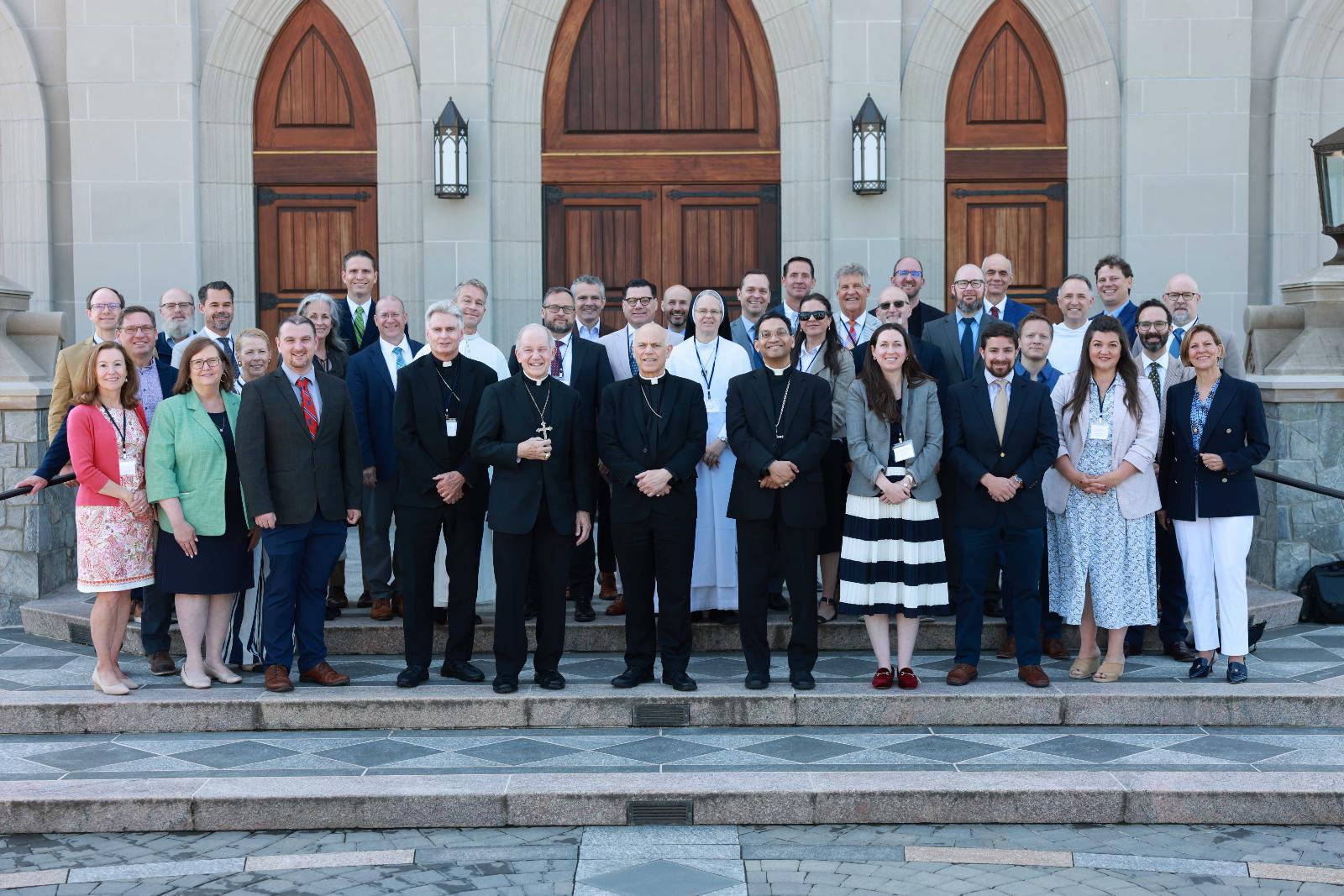
(OSV News) — “The more things change, the more they stay the same” is not a philosophical statement the 45 signers of “The Front Royal Statement: Seven Cardinal Principles of Catholic Elementary and Secondary Education” have any intention of embracing.
Catholic bishops, higher education leaders, scholars, superintendents and educational partners from across the United States convened at Christendom College in Front Royal, Virginia, May 27-28 for a major collaborative effort dedicated to the renewal of Catholic elementary and secondary education.
The fruit of their deliberations, the Front Royal Statement, is a document they describe as articulating “the fundamental principles of authentic Catholic education as the philosophical, theological, pedagogical, and methodological pillars of the renewal of Catholic schools.”
“This is not a kind of document that you write it, you read it, and you put it on a shelf, and say, ‘That was nice,'” Bishop Thomas J. Paprocki of Springfield, Illinois, told OSV News. “It’s meant to guide the conversation about Catholic education for many years to come.”
Catholic education ‘has some real challenges’
“We have some real challenges — and we really want to see Catholic schools continue,” Bishop Paprocki added. “And so this was an effort to lay out some of the principles that will give a good, strong foundation to continuing with Catholic schools in the United States.”
According to the statement, an average of about 100 Catholic schools have closed per year over the past 60 years, or roughly 6,000 schools since the early 1960s. Today — despite a growing Catholic population — they serve fewer than 1.7 million U.S. students.
Bishop Paprocki said the seven principles outlined in the document include the supernatural end of education, given that “Catholic schools exist because our ultimate goal is eternal life with God in heaven”; the dignity of the human person and call to relationships and community, “an important statement in our culture today, which tends to be very individualistic”; and what children deserve, the rights of parents and the duties of state, since “Church teaching says parents are the first teachers of the faith.”
‘Transmission of a living Catholic culture’
Additionally, there is the ecclesial responsibility of bishops and priests, “an important description of the role bishops and priests have with education”; the formation responsibility of teachers and leaders, who must “have the proper formation”; integrity and order of the curriculum, in which subjects apart from theology also play a role “as a way for us to talk about, how does God act in the world”; and finally, the transmission of a living Catholic culture, because “we want our students to graduate to be practicing Catholics.”
The final product of the summit, Bishop Paprocki declared, “is a good reflection of the principles that we need in Catholic education.”
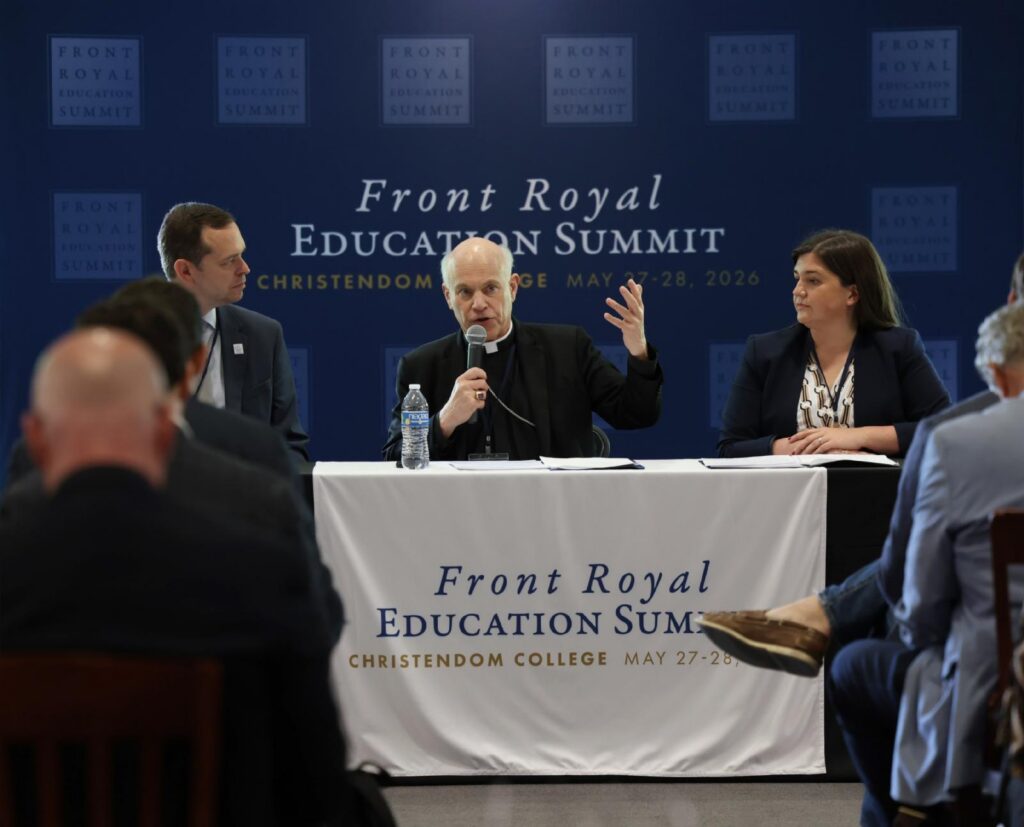
Jon Kirwan, director of Christendom’s Center for Educational Philosophy and Leadership, suggested “the critical moment really begins with a recognition of a crisis. … The number of school closures over the last five decades has been nothing but striking. And to deny a crisis would really be to hinder developing the solutions that we need.”
During the last 60 years, “there’s been kind of a wholesale buy-in to progressive education in mainstream and Catholic schools,” he observed. “And we’ve seen the results.”
Catholic schools have ‘prophetic role’
With that in mind, Kirwan said, “There’s a really prophetic role that our schools must play. … These fundamental principles of the Front Royal Statement really should help us to return to our roots — because this isn’t just one solution among others. Catholic tradition must play an essential role.”
“What this document does,” Kirwan concluded, “is it signifies a coherent set of principles that really any faithful Catholic can agree with. It is attempting to unify those people who recognize the crisis — and who see the problems of adopting secular educational philosophies, wholesale, and the need to come together to renew.”
The Front Royal Statement evokes something of a counterpoint to the Land O’ Lakes Statement, an influential 1967 manifesto published in Land O’ Lakes, Wisconsin, following the Second Vatican Council (1962–1965).
That statement declared, “To perform its teaching and research functions effectively the Catholic university must have a true autonomy and academic freedom in the face of authority of whatever kind, lay or clerical, external to the academic community itself” — an assertion rejected by St. John Paul II in “Ex Corde Ecclesiae” (“From the Heart of the Church”), an apostolic constitution on Catholic universities.
Numerous Church documents have repeatedly stressed the importance of authentic Catholic education, from the 19th century to the present.
Author of section on parental choice
Shawn Peterson — president of Catholic Education Partners, an organization advocating for school choice and access to Catholic education, and the author of the document’s section concerning parental choice — said the Front Royal Statement also draws a line.
“It’s just sort of putting a little stake in the ground,” he explained. “There’s Archbishop Miller’s ‘The Five Essential Marks of a Catholic School‘ — and this is kind of an updated version, or reinforcement, of that.”
In his 2006 book “The Holy See’s Teaching on Catholic Schools,” retired Archbishop J. Michael Miller of Vancouver, British Columbia, outlined said “marks” as “Inspired by a Supernatural Vision”; “Founded on a Christian Anthropology”; “Animated by Communion and Community”; “Imbued with a Catholic Worldview throughout its Curriculum”; and “Sustained by Gospel Witness.”
“We’re using a lot of secular methodology — so it’s time to reassess,” Peterson said. “We have this beautiful 1,000-plus-year-old tradition of what Catholic education should look like. Let’s go back to that,” he suggested. “We’ve been sort of chasing the secular car a little bit too much.”
‘Desire to be more fully, confidently Catholic’
Chris Fisher, superintendent of schools in the Archdiocese of San Francisco, said the statement “reflects what I see in many of our Catholic schools: a desire to be more fully and confidently Catholic.”
It also reflects, he told OSV News, “a movement of renewal happening in Catholic education right now. Across the country, bishops, pastors, superintendents, teachers, parents, and school leaders are asking deeper questions about what makes Catholic education distinctive and how our schools can form children fully in the light of Christ, especially given modern challenges, from social media and AI to the anxiety crisis and social fragmentation.”
Ultimately, Fisher said, he feels the Front Royal Statement articulates “a hopeful vision for Catholic education — a vision marked by a deep integration of the Church’s sacramental and salvific vision into the academic life of the school. That vision is hopeful,” confirmed Fisher, “and I think it is exactly what many families are looking for.”
Kimberley Heatherington is an OSV News correspondent. She writes from Virginia.
