


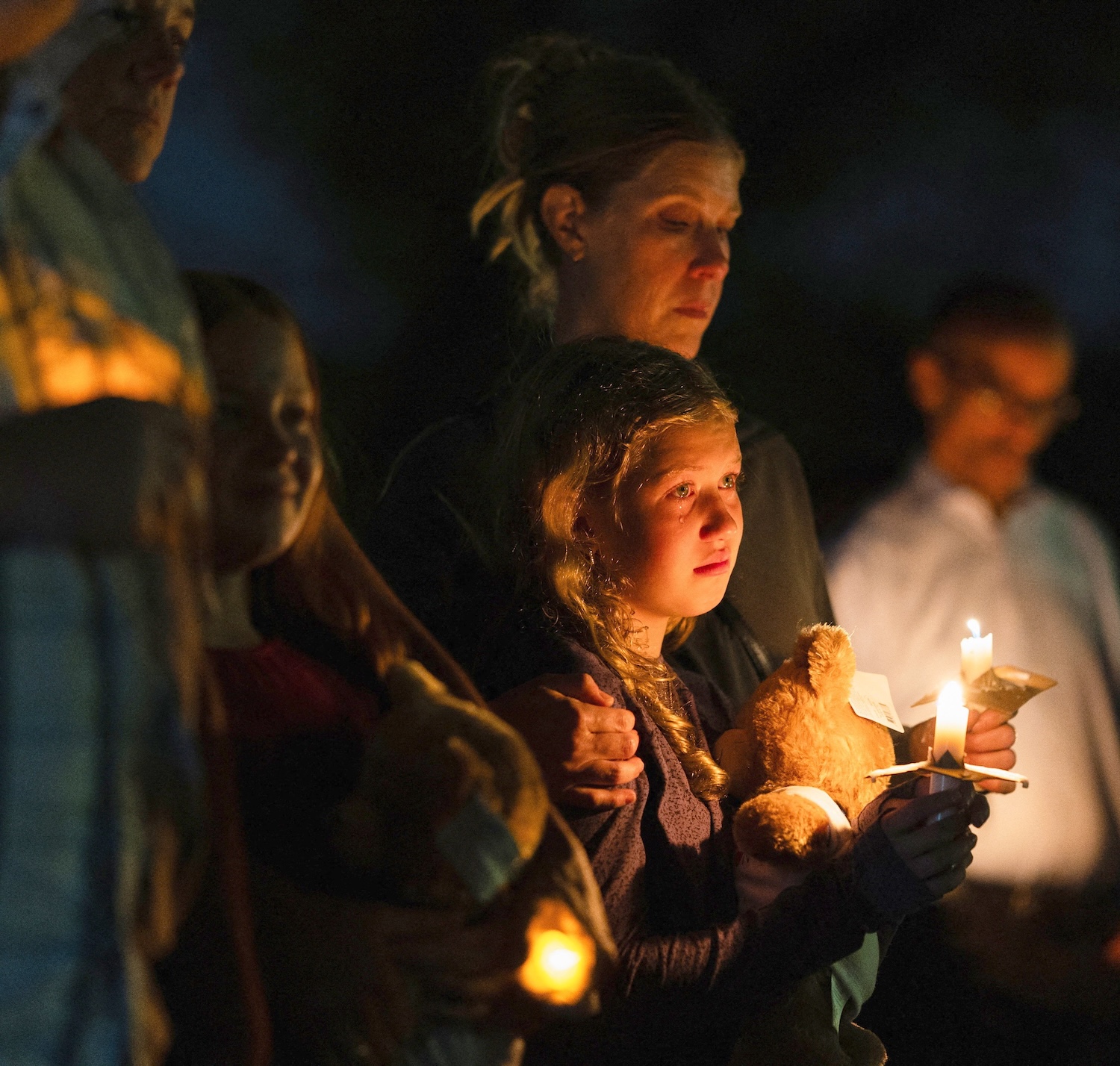
(OSV News) — We are a society in crisis. There is no other way to describe the fact that, in the past month, three young men, aged 16 to 23, have either killed or intended to kill in very public arenas.
That these three perpetrators match the profile of a majority of others responsible for mass shootings in recent years — male and, especially, young — should rouse every citizen to action. All Americans — especially people of faith — should be sounding the alarm and calling for change. And not just in the aftermath of tragedy but continuously, persistently every day. As a society, as a nation, as parents, as a church: We are failing our children. And some of them, in turn, are becoming killers.
Internet addiction
There are many reasons for this, all of them pooling together to create a perfect, chaotic storm for our young people. But primarily, an addiction to the internet — including unfettered access to its darkest corners from the privacy of one’s screen — and a distorted understanding of the truth are causing the brains of our children to be warped before our very eyes.
Since the mid-1990s, when “the Net” first became accessible to the common person, we have been living in an unprecedented and unregulated sociological experiment. The ubiquitous adoption of smartphones a decade later turned Gen Xers and Millennials, in particular, into walking guinea pigs. We gave our data, our faces, our habits, our fingerprints and our credit cards over to Big Tech; we shared our children’s names, faces, likes and dislikes unhesitatingly on social sites. We became addicted to continuous connectivity, and we taught our children that this is normal behavior. This addiction has given way to a social isolation and loneliness that is compounded by a growing dismissal of organized religion, which has meant that fewer people are encountering and coming to know Jesus Christ, the ultimate antidote to this chaotic storm.
Our “terminally online” lives are built on a cracked foundation: the cultural breakdown that has diminished the value of the family; that has allowed “sexual preference” to replace biological fact; that has devalued human life and dignity; and that has glorified violence on the screen, on gaming systems and in the bedroom.
As a result, the mental health of too many of our young people is in tatters. Their minds are confused; they don’t know what’s true. Their lives are empty, and their hearts are turning to stone. In many cases, they have lost even the desire to know where to turn; they have lost their way. And the pervasive availability of weapons in our country is the icing on the cake that allows the violence that has taken root in the mind to be unleashed on reality in a paroxysm of rage, scarring forever countless lives with each touch of the trigger.
Christ-centered living
The answer, though, is simple: to give one’s self completely — mind, heart and will — over to Jesus Christ. But such a decision for Christ must manifest itself in a changed life: replacing screen time with prayer time, and raising our children with the same priorities; getting off of social media and being intentional about belonging to a real community — whether a parish, a youth group or a friend group who share similar values — that can counteract confusion, hatred and violence with the virtues and holiness that comes from a life committed to the Gospel; providing young people with mental health support grounded in the truth of natural law and a desire to care for the entire human person; and working for effective policies that minimize opportunities for gun violence, a task made more urgent by the depth of the mental and spiritual health crises we are in.
We are hopeful that Pope Leo XIV, with his cautions on AI and advancing technologies, will continue to be a voice of prudence for the technology companies that have so much influence on our young people today. And we pray that his continued integration of synodality — which he recently described as “how we can come together and be a community and seek communion as a church” — will help provide avenues that restore right relationships and foster unity. To help our young people through this time of crisis, we need to work together. We cannot simply prescribe a solution — they must see this better way clearly and unequivocally modeled by us.
At the end of his homily at the canonization Mass for Sts. Carlo Acutis and Pier Giorgio Frassati earlier this month, Pope Leo said that the lives of the two new saints “are an invitation to all of us, especially young people, not to squander our lives, but to direct them upwards and make them masterpieces.”
This is the call for each of us — for the sake of our children and for the sake of humanity. May we hear it and respond.
The members of the OSV Editorial Board include Father Patrick Briscoe, OP; Gretchen R. Crowe; Paulina Guzik; Peter Jesserer Smith and Scott P. Richert.
