


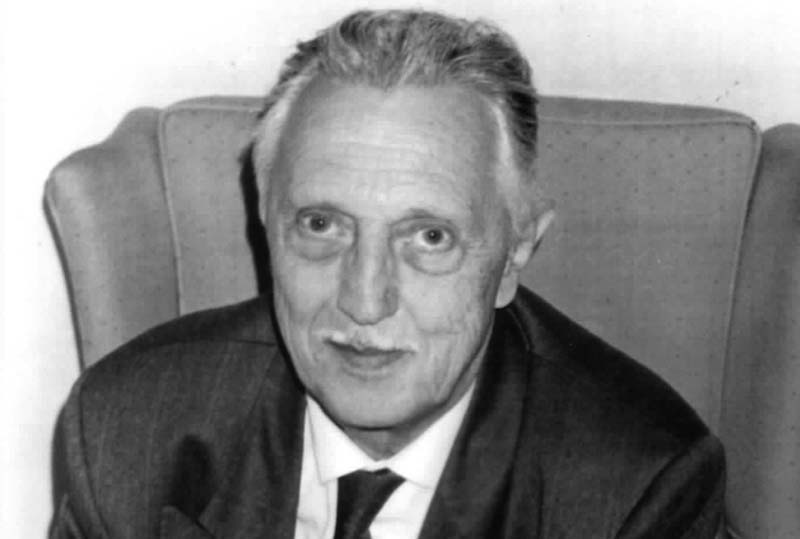
PARIS (OSV News) — A century after his birth, French geneticist Jérôme Lejeune is being remembered for both a landmark scientific discovery and a steadfast commitment to the dignity of human life.
Born June 13, 1926, near Paris, Lejeune identified in 1958 that an extra chromosome 21 causes Down syndrome, a breakthrough that transformed modern genetics. He believed that would help protect and care for vulnerable children. Instead, he lived to see it widely used for prenatal screening that often led to Down syndrome babies’ elimination.
A devout Catholic, he later served in the Pontifical Academy of Sciences and became the first president of the Pontifical Academy for Life, founded by St. John Paul II in 1994.
Lejeune died shortly after being appointed president by John Paul — on April 3, 1994, Easter morning. In August 1997, during his visit to Paris for World Youth Day, the pope traveled to the village of Chalo-Saint-Mars, about 40 miles south of Paris, to pay his respects at the grave of the man he came to consider a friend.
Jérôme Lejeune Foundation founded in 1995
In 1995, a year after her husband’s death, Birthe Lejeune established the Jérôme Lejeune Foundation at her home, in the Latin Quarter of Paris, with her son-in-law, Jean-Marie Le Méné, serving as its president.
Aude Dugast is the executive director of the Association of Friends of Professor Lejeune. She began working for the Jérôme Lejeune Foundation in 1999.
“When Lejeune died, his entire work could have come to a halt,” she told OSV News. “But his family and close friends rallied their energies to continue his work, with great fidelity in three areas: research, care, and advocacy.”
Today, the Lejeune Foundation is a cornerstone of research on Down syndrome and other genetic disorders. “The Jérôme Lejeune Institute is one of the world’s leading medical centers specializing in genetically caused intellectual disabilities,” Dugast noted. “And it helps fund numerous other research programs around the world working on these fields.”
In Paris, it also treats patients suffering from the conditions in which it specializes. “Since 1998, the Institute has provided comprehensive, personalized, and lifelong medical care to more than 13,000 patients from all over France and abroad,” Dugast said.
For Dugast, this care for patients was at the heart of Lejeune’s work.
Lejeune continued to treat his patients
“Even while conducting his research, he continued to treat his patients,” she noted. “He was deeply saddened to see that his discovery would be used to detect Down syndrome before birth and to eliminate those who carried it. His concern was to change society’s negative view of them and to advance research to find ways to treat them.”
Beyond the medical field, Dugast worked for years on the cause for the beatification of Lejeune, whose diocesan process was opened in Paris in 2007. On Jan. 21, 2021 he was declared venerable by Pope Francis. The next step could be the recognition of a miracle so that he may be beatified.
“I receive many testimonies of graces and even healings obtained through his intercession,” Dugast testified. “But the medical conditions and guarantees required to conclude that these are indeed miracles are extremely strict and rigorous.”
Dugast also works as director of the French-speaking section of the Jérôme Lejeune International Chair in Bioethics. It organizes international conferences on bioethics in Rome and develops training programs and university courses for young healthcare professionals and medical students.
‘An approach that respects human life’
“The idea is to foster a culture of life,” she explained. “The goal is to enable younger generations to be trained to address the challenges of modern genetics and bioethics, through an approach that respects human life. It is not easy, but it is very exciting.”

For Dugast, this respect for life remained at the heart of Lejeune’s work and all his scientific discoveries.
“In 1994, he drafted a declaration by the Servants of Life when he drew up the statutes of the Pontifical Academy for Life,” she explained. “It was a commitment for scientists and doctors to respect the human person from conception until natural death. It was, in a way, an adaptation of the Hippocratic oath to the advances of modern medicine.”
According to Dugast, 100 years after Lejeune’s birth, the influence of his research and his life continues to bear fruit.
His legacy inspires new initiatives
Dugast noted that his legacy continues to inspire new initiatives: the recently completed Venerable Jerome Lejeune Hall at Christendom College in Virginia, foundations in Spain, Argentina and the United States, as well as a school in Ottawa, Ontario, and a home for young people with Down syndrome in Italy — all bearing his name and vision.
Finally, for Dugast, the defining characteristic of Lejeune at the heart of all his care, research, actions and public statements was his “great gentleness.”
“He embodied a holiness grounded in intelligence and his entire life was guided by his search for truth,” she said. “His primary concern was to anchor the truth in charity. One cannot understand Jérôme Lejeune without mercy.”
Caroline de Sury writes for OSV News from Paris.
