


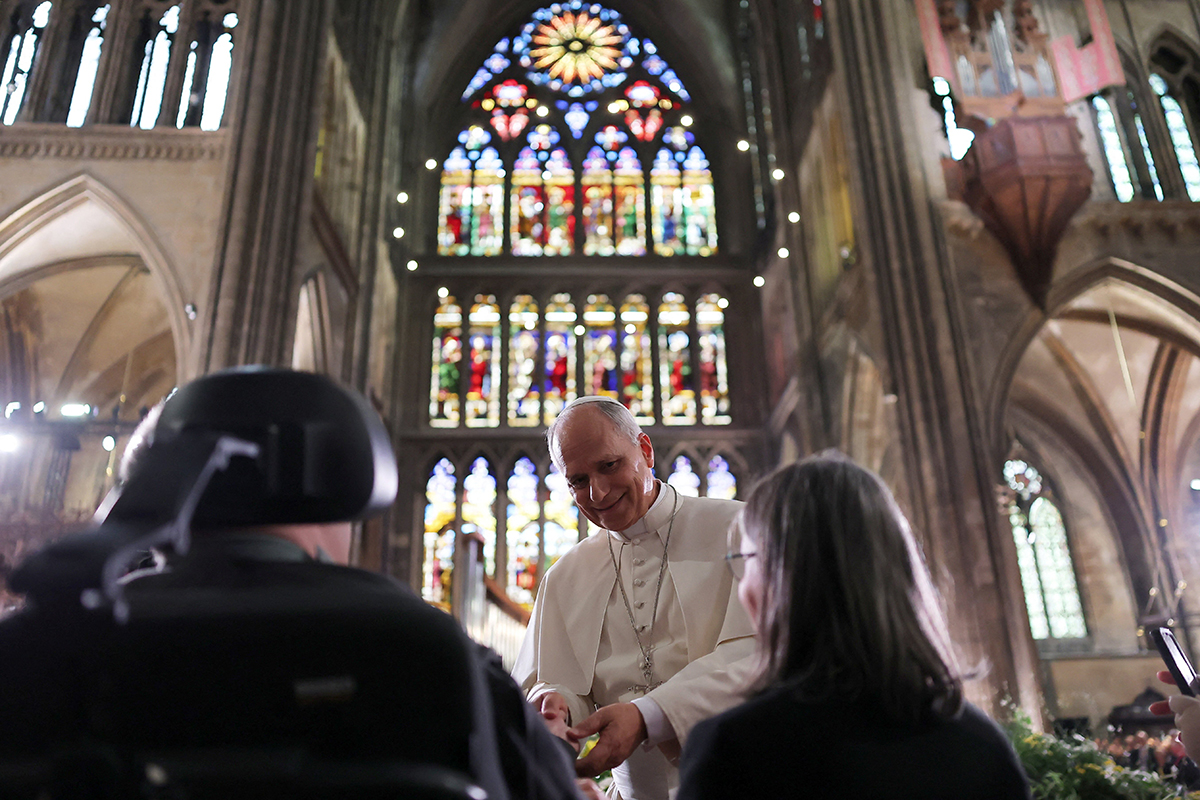
(OSV News) — “That the world may have life.” Few papal journeys have embodied their motto as fully as Pope Leo XIV‘s apostolic journey to France.
From his arrival in Paris on Sept. 25 to his encounters with the sick and disabled in Lourdes, Pope Leo made the dignity of every human life the defining theme of his first visit to the country.
He challenged French lawmakers over their recent approval of assisted dying, condemned abortion and surrogacy, and delivered a message that extended beyond the political debates of the moment: No human life is disposable, and suffering does not diminish a person’s worth.
Pope Leo’s previous visits to other countries this year have highlighted different priorities of his emerging pontificate. In visits to the Canary Islands and Lampedusa, he offered a strong and politically nuanced defence of the rights and dignity of migrants. Throughout his journey to four countries in Africa, the pope cemented his identity as a global voice for peace, refusing to back down from his calls to end war in the face of personal attacks from President Donald Trump.
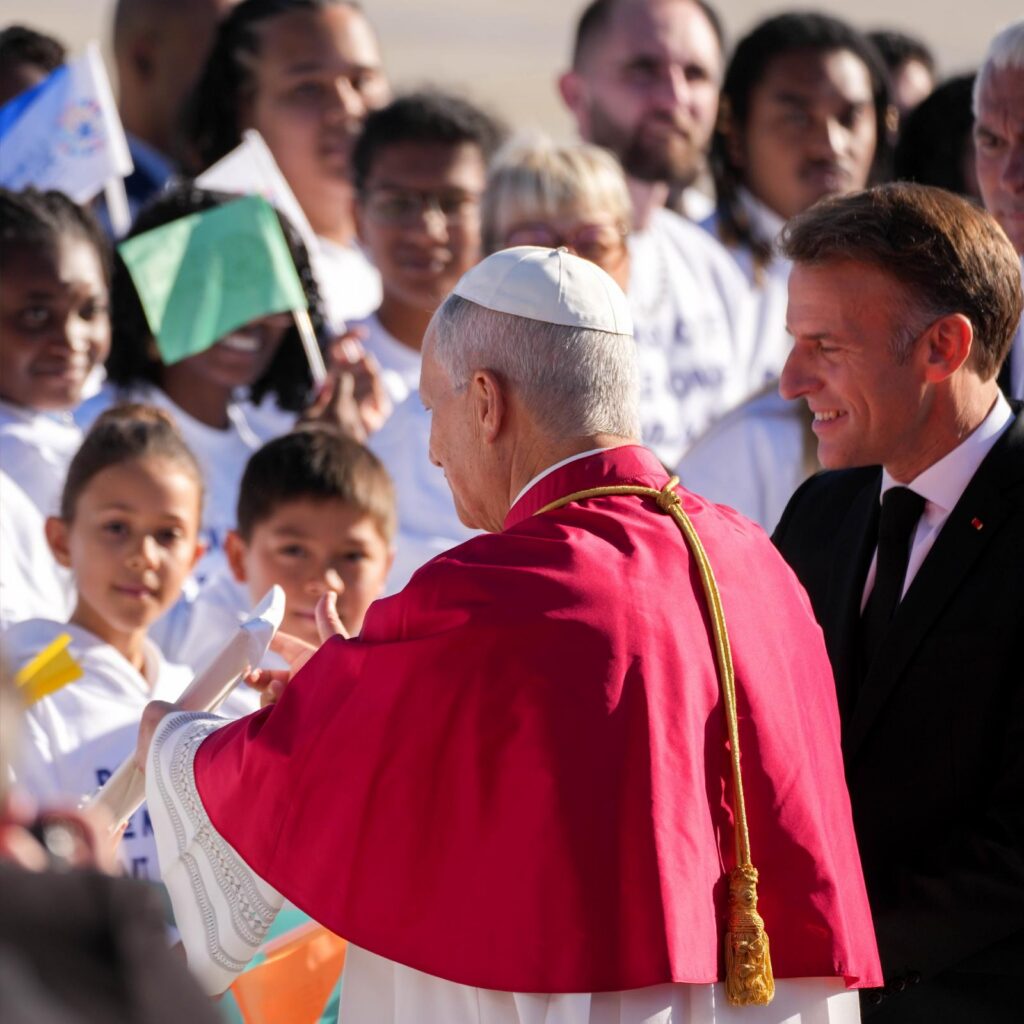
But France was where Pope Leo emerged most visibly on the world stage as the voice for the disabled, the elderly, the unborn, and the most vulnerable in a society that, he warned, risks mistaking death as the answer to human suffering.
Touched on some of Europe’s most contentious social questions
The pope’s defense of life touched on some of Europe’s most contentious social questions, yet with his humble and measured manner, his message hit differently than the “culture wars” of decades past.
Pope Leo was received like a rockstar by hundreds of thousands of people in France, even by those who might disagree with his positions politically. The most visible of which was President Emmanuel Macron, an ardent supporter of the “assisted dying” bill to legalize euthanasia in France earlier this year who also championed the French Parliament in making abortion a constitutional right in 2024.
Yet after Pope Leo came to Macron’s official residence, the Élysée Palace, and proclaimed that “the protection of the right to life constitutes the indispensable foundation of every other human right” in a speech that condemned “assisted dying,” abortion and surrogacy, Macron went out of his way to rearrange his schedule to be able to attend Mass with the pope at Saint-Étienne Cathedral in Metz on Sept. 28, despite criticism that the president’s political opponents who argued that his attendance violated “laïcité” — France’s strict principle of separation between church and state.
Pope Leo also used his visit to the UNESCO headquarters in Paris to deliver a warning about the relationship between technological progress and human dignity. In the speech, widely anticipated to touch on the challenges posed by artificial intelligence, the pope warned diplomats and academics gathered at the U.N. agency that human dignity was being discarded in the name of efficiency and productivity in the era of AI.
More than 800,000 lining the Champs-Élysées
The following day, more than 800,000 turned out for Pope Leo’s Mass in the heart of Paris, lining the Champs-Élysées with all eyes looking toward the papal altar where six of the altar servers with Down syndrome assisted Pope Leo with the Mass, a poignant witness to life in the capital of a country where 68% of prenatal diagnoses of Down syndrome end in abortion, according to a 2020 study published in the European Journal of Human Genetics.
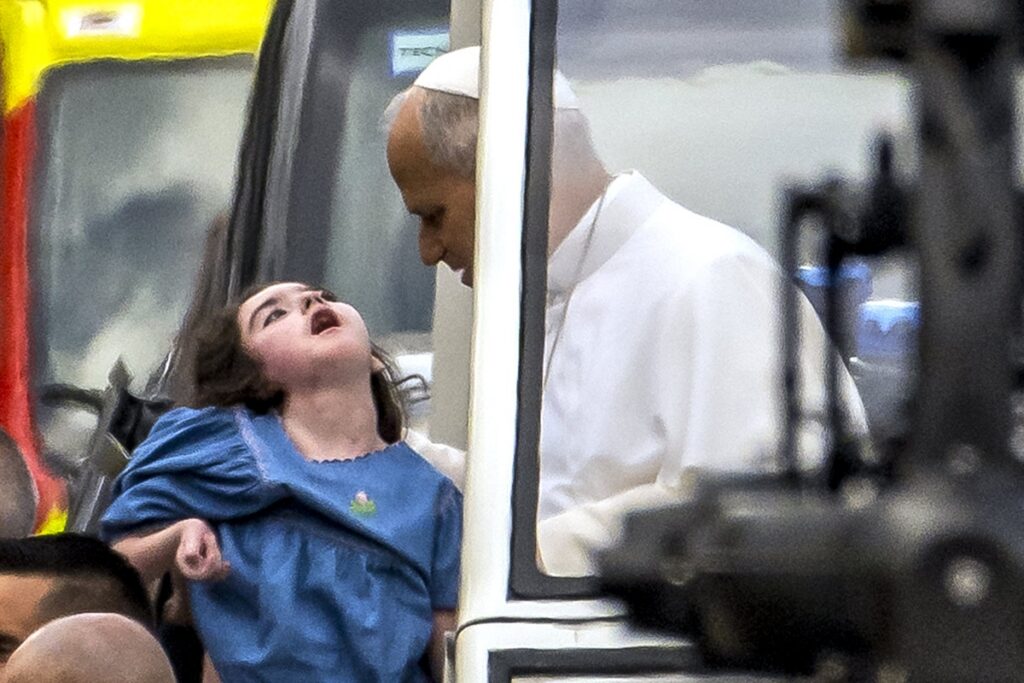
It was just before that Mass that a photograph, described by some as the defining image of Pope Leo’s pontificate so far, was taken and quickly went viral. The image shows the pope blessing Marie-Garance, a 10-year-old girl with multiple disabilities wearing a blue dress. Some observers noted its composition and emotional resonance, comparing it to Michelangelo’s famed “Pietà.”
Speaking to OSV News after the photograph circulated widely, the girl’s adoptive mother, Clotilde Noël, who has adopted four children with disabilities, said she saw the pope’s blessing as extending to Marie-Garance’s biological parents as well.
“I pay tribute to them, because they chose to bring her into the world, despite all her disabilities,” Noël said.
Visit to Lourdes a personal highlight for pontiff
For Pope Leo, one of his personal highlights of the four-day apostolic journey to France was his visit to Lourdes. During the in-flight press conference, he described the experience of accompanying the sick and suffering as especially meaningful.
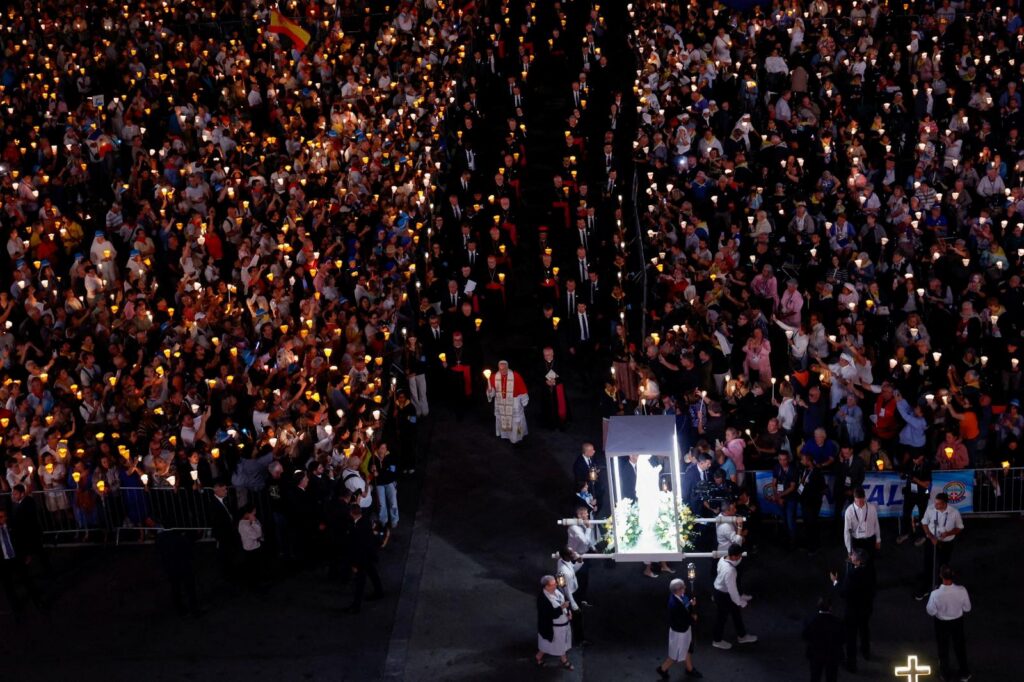
“Walking with, accompanying so many people who are sick and suffering and seeing how the grace of God’s presence manifested in many different ways, touches people’s hearts, transforms their lives, and — to use an expression that I mentioned there — restores dignity to the sick, the elderly, those who in some parts of society are discarded,” he said.
The visit to the Marian shrine in Lourdes, which draws thousands of people with sickness or disabilities each year, was filled with moving encounters between the pope and pilgrims. The pope praised the shrine as being a place where the sick and disabled are not simply accommodated, but are welcomed, honored, and celebrated.
From her wheelchair, Gabriella Panizzardi, 84, from Milan, Italy, described to OSV News why she had returned to Lourdes for her 15th pilgrimage.
“Look at this heavenly sight, something out of the ordinary — it brings such peace. Yes, everyone loves one another and helps those who are sick. It’s beautiful, truly,” she said.
Strongest words of pontificate so far on defending life
It was in a speech outside the Accueil Notre Dame in the Lourdes sanctuary, addressing the sick and suffering and their caregivers directly, that Pope Leo delivered what could be considered some of the strongest words of his pontificate so far in defense of human life.
“No one ever has the right on the basis of laboratory algorithms, to decide the life of a given embryo or elderly person!” the pope declared. “Medicine must never become the servant of programmed death.”
Speaking directly to the sick and disabled, the pope said, “No human law should ever make you lose the certainty of your dignity. On the contrary, it is precisely in the name of this inalienable dignity of the human person that we must reject the temptation to cause death under the guise of false compassion.”
“It is impossible to regard causing death as something normal. What is legal is not necessarily moral,” he added, as his speech was repeatedly interrupted by thunderous applause from people in wheelchairs, medical patients, their families and caregivers.
Reigniting debate over country’s assisted-dying measure
Pope Leo’s forceful defense of human life during his Sept. 25-28 visit to France also reignited debate over the country’s assisted-dying legislation, which lawmakers had largely considered settled following its passage through Parliament in July.
“The pope’s remarks in Lourdes come at just the right time to ensure we do not give up the fight against these deadly laws,” Lucie Pacherie, a lawyer and spokesperson for the Jérôme Lejeune Foundation, told OSV News after the visit.
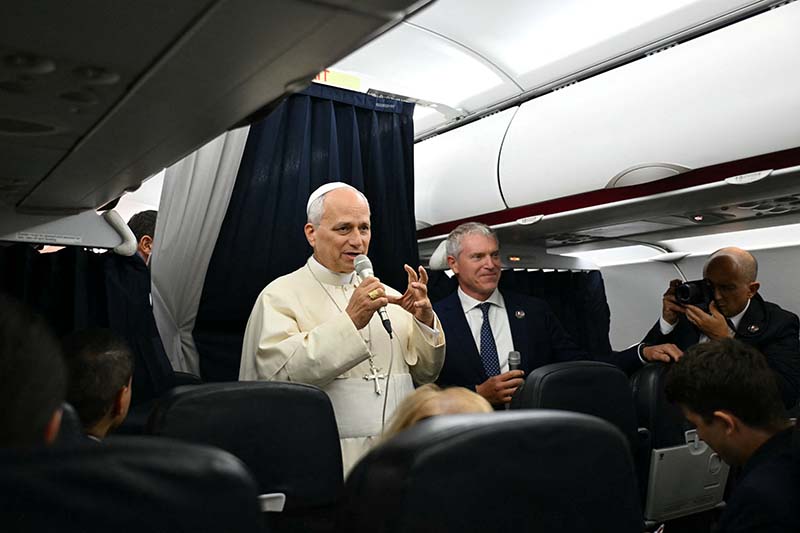
During the in-flight press conference on his return from France, Pope Leo was asked why he had spoken so frequently about euthanasia and end-of-life issues during the trip. He responded that the Church’s defense of life was not an attempt to enter political debates.
“When the Church speaks about defending life, when it speaks about questions of social doctrine, we’re not entering into politics, we’re applying the Gospel to people’s lives,” he said.
Church believes in defense of life ‘very deeply’
“The defense of life is something that as you all know the Church teaches, believes very deeply,” he added, acknowledging that France and other countries in Europe and around the world were debating end-of-life legislation.
But he returned to the experience of Lourdes, where people living with sickness, disability and pain were searching for something deeper: an understanding that their lives still held meaning.
“Being in a place especially like Lourdes where people are searching for something much deeper and understanding that their lives, even in the midst of sickness or disability or pain of different kinds, that their life has meaning,” he said. “The Church, because of Jesus Himself, wants to be close to those people and to affirm the values that life itself I think holds for all of us.”
“So, I would say, if that’s politics, I did that,” he concluded. “But it was not to get involved in French politics. It was to teach what the Church really believes.”
Courtney Mares is Vatican editor for OSV News. Follow her on X @catholicourtney.
