


By Fernando Ceniceros / The Rio Grande Catholic and OSV News
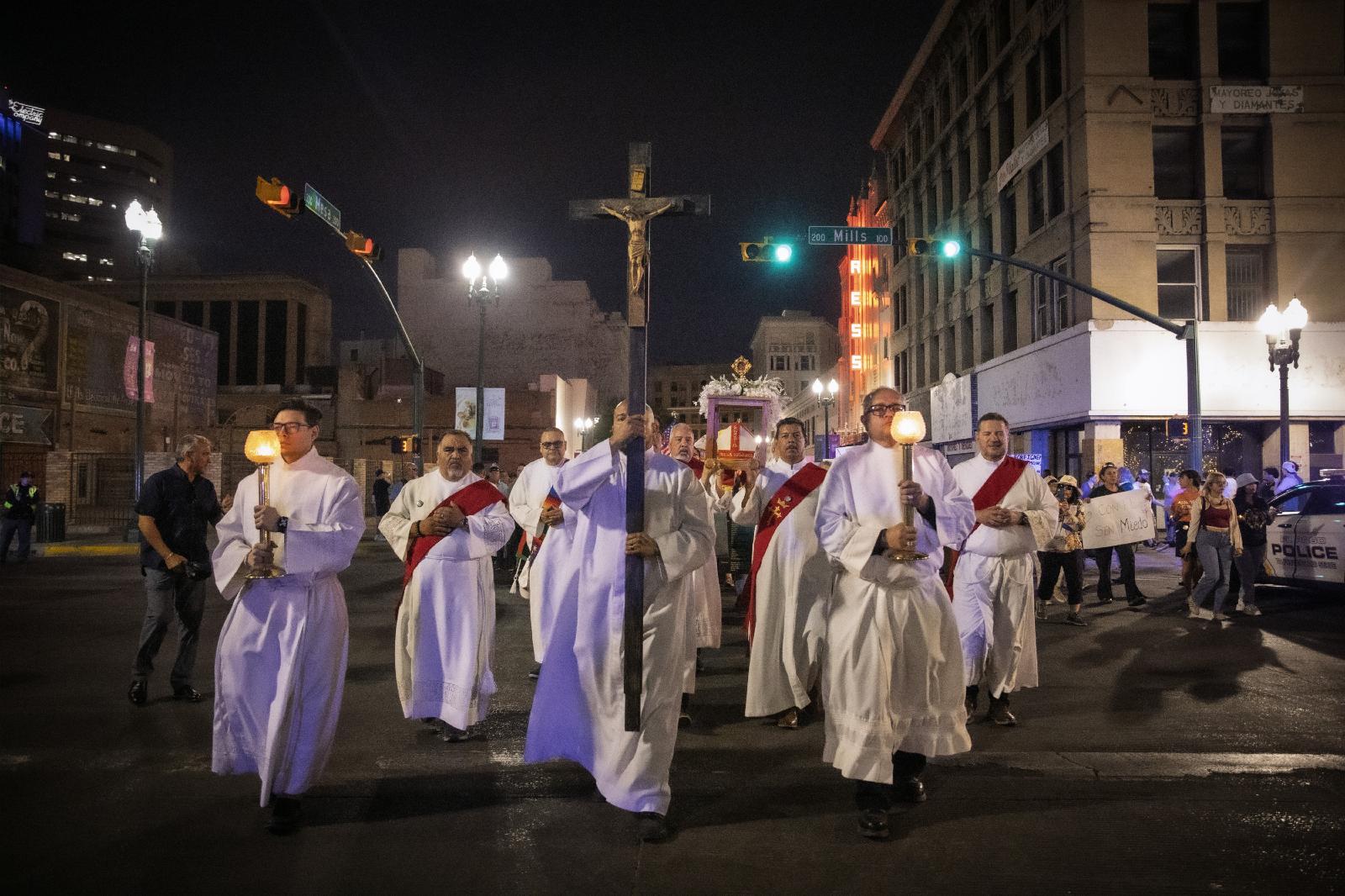
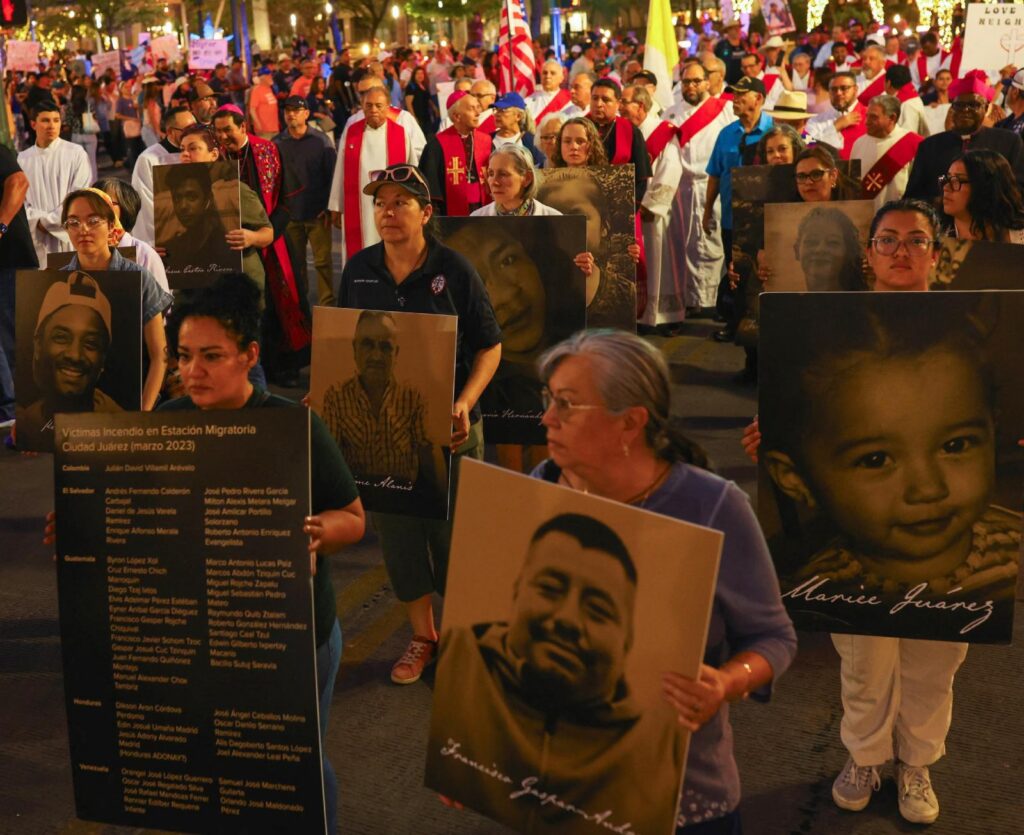
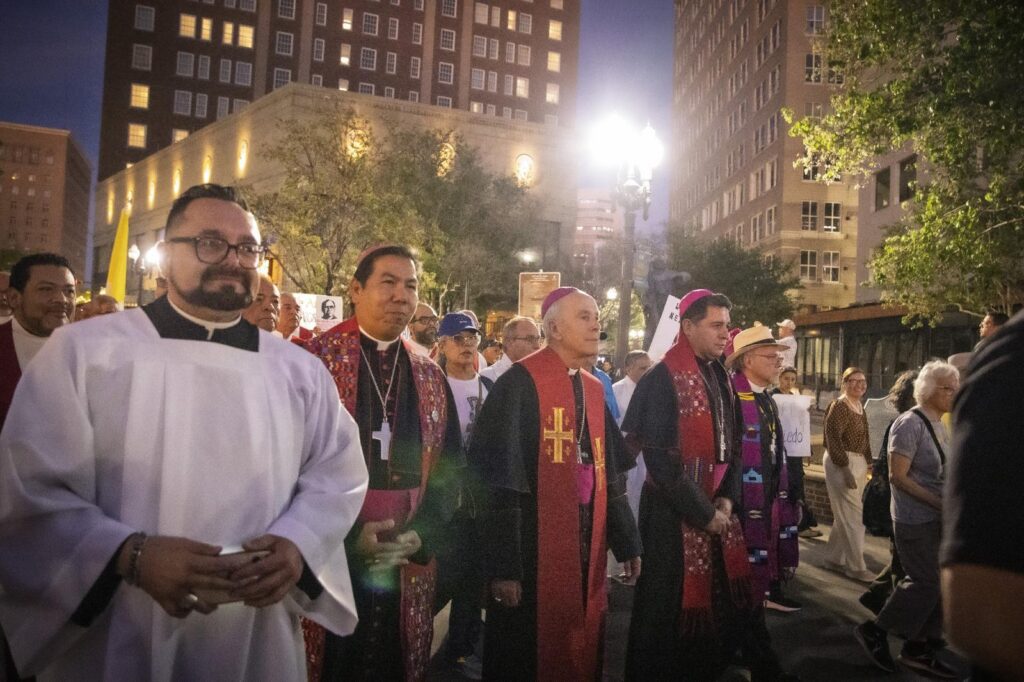
EL PASO, Texas (OSV News) — On March 24, to commemorate the feast day of the martyr St. Óscar Romero, hundreds of people joined in a march and vigil calling for an end to mass deportation and mass detention led by El Paso Bishop Mark J. Seitz and other Catholic bishops, clergy and organizations in downtown El Paso.
El Paso is home to one of the largest mass detention centers in the U.S. Since mid-December, as many as three people accused of immigration-related violations have lost their lives — including one ruled a homicide — at Camp East Montana, located in far east El Paso.
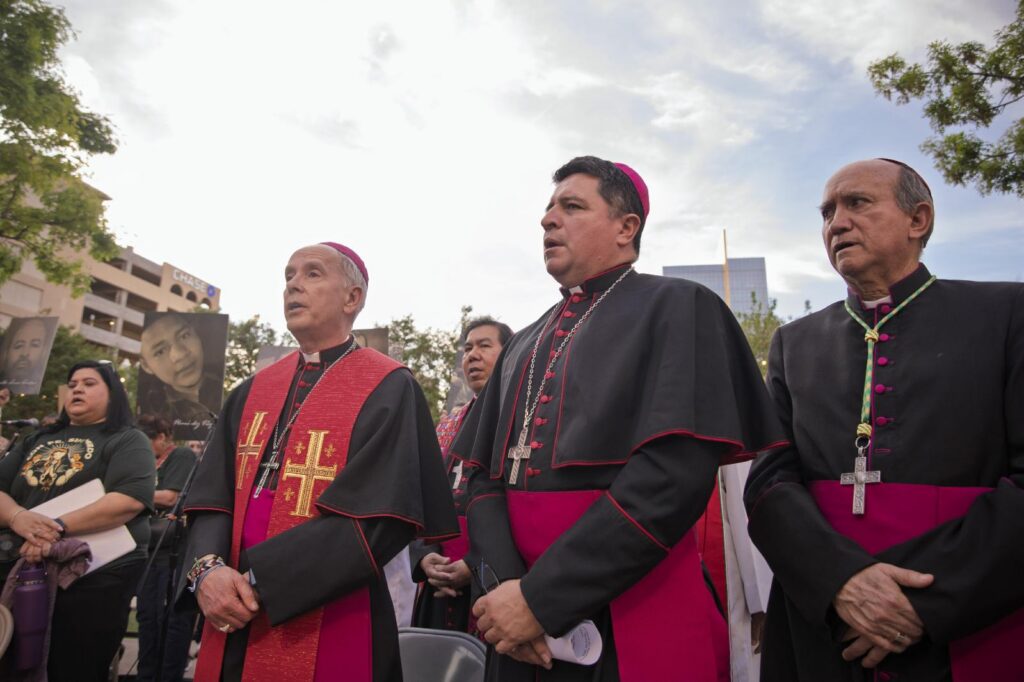
Bishop Seitz, who earlier in March released a pastoral letter on mass deportations and detentions, led the march along with Bishop Anthony C. Celino, auxiliary bishop of El Paso, and fellow visiting Catholic bishops, including Bishop Brendan J. Cahill of Victoria, Texas, chair of the U.S. Conference of Catholic Bishops‘ Committee on Migration, Bishop Guadalupe Torres Campos of Ciudad Juárez, Mexico, and Bishop Evelio Menjivar, auxiliary bishop of Washington.
Hope Border Institute and Estrella del Paso were also involved partners in uniting the local community in El Paso behind the march and vigil.
At the event, Bishop Seitz reiterated his pastoral letter’s call to end mass detention and deportation.
“We are coming together to pray and to show our community’s concern. We hope it moves our leaders to think: ‘Maybe we’ve gone too far,'” he said.
Mass detention ‘a grave injustice’
The bishop pointed to government data showing over 70% of the 68,000 people in immigration detention have no criminal convictions.
“It is a grave injustice to lock up people who did what was necessary to survive and care for their family,” he said. “We do not agree with this process of mass detention.”
The Trump administration’s push for mass detention and deportation of immigrants who have lived and worked in the U.S. without legal authorization for years heavily impacts the Catholic population.
A majority of the people targeted by Immigration and Customs Enforcement for mass detention and eventual deportation are expected to be Catholics in six out of 10 cases, according to a 2025 joint Catholic-Evangelical report published by the USCCB and World Relief. It also found Christians make up 80% of those at risk of President Donald Trump’s mass deportation effort. The report also found nearly one in five Catholics (18%) in the U.S. is either vulnerable to deportation or lives with someone who is.
The Trump administration has also moved aggressively to eliminate temporary legal protections for hundreds of thousands of Venezuelans and Haitians, typically Catholic populations, exposing them to the prospect of mass detention and deportation to dangerous and unstable conditions in their home countries.
Protest means to ‘stir the conscience’
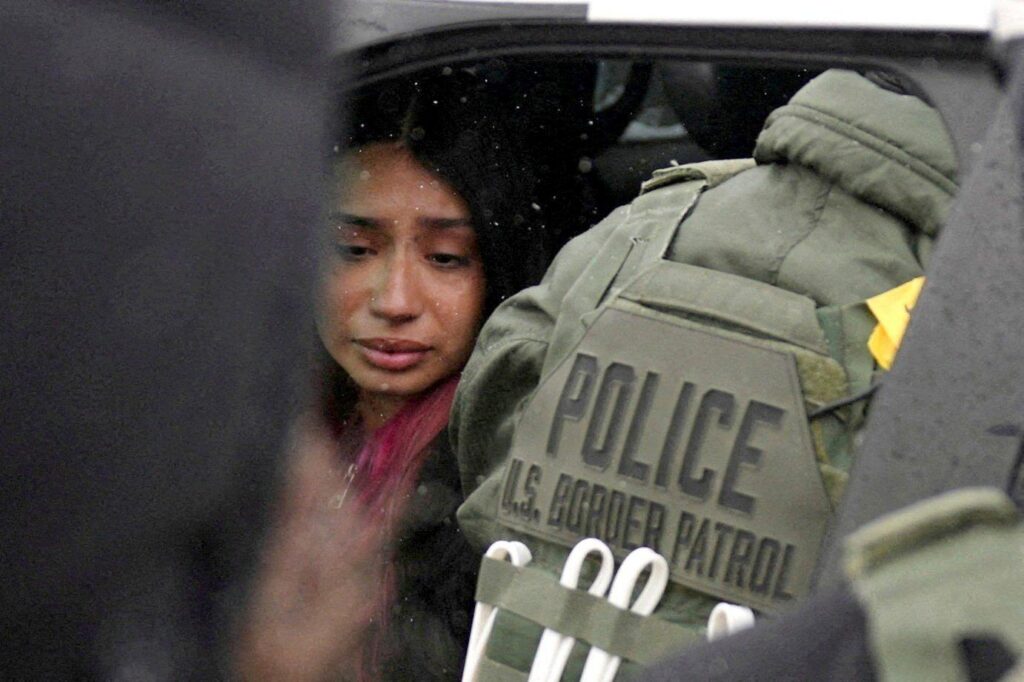
Bishop Seitz offered hope that the actions of civil and peaceful protest would call attention to the injustice of mass detention and deportation.
“We hope actions like this will stir the conscience of people and realize that these people who are threatened right now are their neighbors, and if they are Christians, these people are their brothers and sisters,” he said.
Bishop Menjivar called on all to see the border as a place of encounter with the Lord Jesus Christ.
“The border is a place of encounter and conversion,” he said. “It’s not just a matter of having empathy, but a matter of Christian identity. The United States is a country of immigrants, and when we forget that, we lose a sense of who we are as a people.”
Bishop Menjivar, the first Salvadorian-born bishop in the U.S., made several attempts to migrate to the U.S. as a young man in 1990. He had several jobs before finally entering the seminary in 1999 and being ordained to the priesthood for the Archdiocese of Washington in 2004. He became a U.S. citizen in 2006 after applying for asylum and gaining a work permit.
“If any of you have done anything to help a migrant who is desperate to better their lives in this country, I want to thank you,” he said. “That immigrant could have very easily have been me.”
Inspired by the martyr Romero
Calling attention to the last homily that St. Óscar Romero delivered the day before he was assassinated, Bishop Menjivar, drew parallels between St. Romero’s appeal to his government and their appeal to U.S. government officials now.
“In his last Sunday homily, on the day before he was killed, St. Óscar Romero made a special appeal to government agents: ‘I order you in the name of God: Stop the repression,’ Bishop Menjivar exclaimed. “This is the same as what we demand today. Stop the repression. Enough of injustice, inhumanity but also, enough of so much indifference. It is time to wake up. It is time to unite, to come together, without fear, with strength and with faith.”
El Paso is the current site of Camp East Montana, an ICE facility which can currently house as many as 3,000 people in detention — 70% of whom the El Paso Diocese believes are Catholic and require sacramental and pastoral care — and was contracted to hold up to 5,000. In recent months, the facility has experienced a measles outbreak on the heels of COVID-19 and tuberculosis outbreaks.
Mass deportation and mass detention nexus
During a rally prior to taking to the downtown streets, Melissa Lopez, an attorney and executive director of Estrella del Paso, the diocesan migrant and refugee ministry, called attention to how quickly the issue of mass detention has escalated in the El Paso region.
“When I started this work over 18 years ago, we had 700 detention beds in El Paso,” Lopez said. Now, she said, the region “houses 7,000 detention beds.”
“We have become ICE’s detention capital,” she added. “We do not want to be known as the community where more people are detained — where people do not get basic information about their rights, do not receive the basic legal representation they are entitled to and that they deserve as human beings. We are becoming stronger as a community that is going to continue to oppose mass deportation and mass detention.”
The New York Times, citing internal Department of Homeland Security documents it had obtained, reported Feb. 18 that the administration is seeking to purchase some 20 warehouses for the detentions, with the goal of 92,600 total beds.
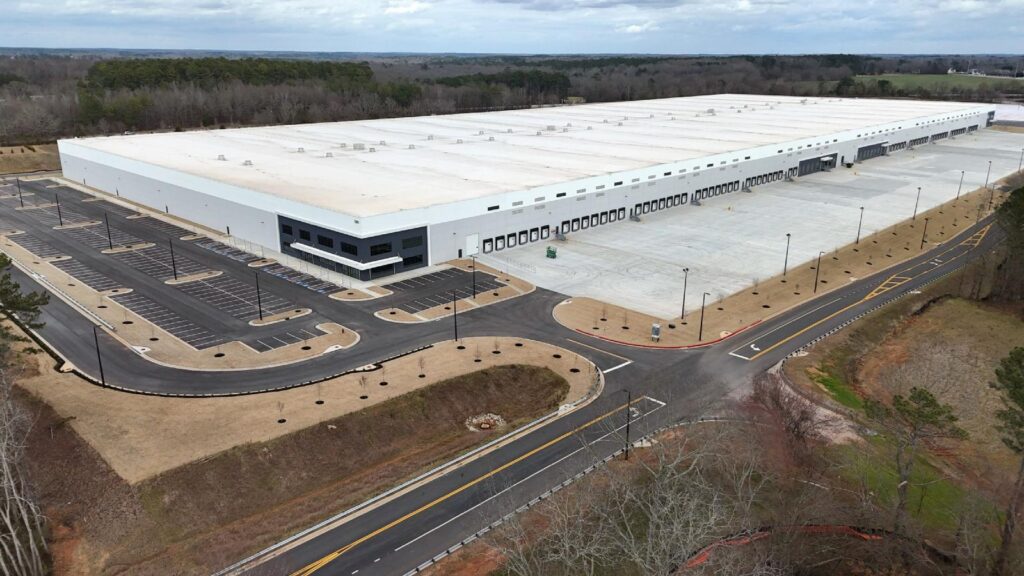
In a Feb. 20 statement released by the USCCB, Bishop Cahill said the government’s plan for “holding thousands of families in massive warehouses should challenge the conscience of every American.”
“Whatever their immigration status, these are human beings created in the image and likeness of God, and this is a moral inflection point for our country,” he said.
Dylan Corbett, executive director of the Hope Border Institute, explained why the march will bring attention to the problem of mass detention and deportation.
“Why do we march? Because when we raise our voices, when we reach out in faith,” Corbett said, “when we march together to that place where God is leading us, on the way to immigration reform, when we march with justice as our compass, and hope as our crown and love as our goal, when we put one foot in front of the other, no one will stop us.”
Relics of Romero join the protest
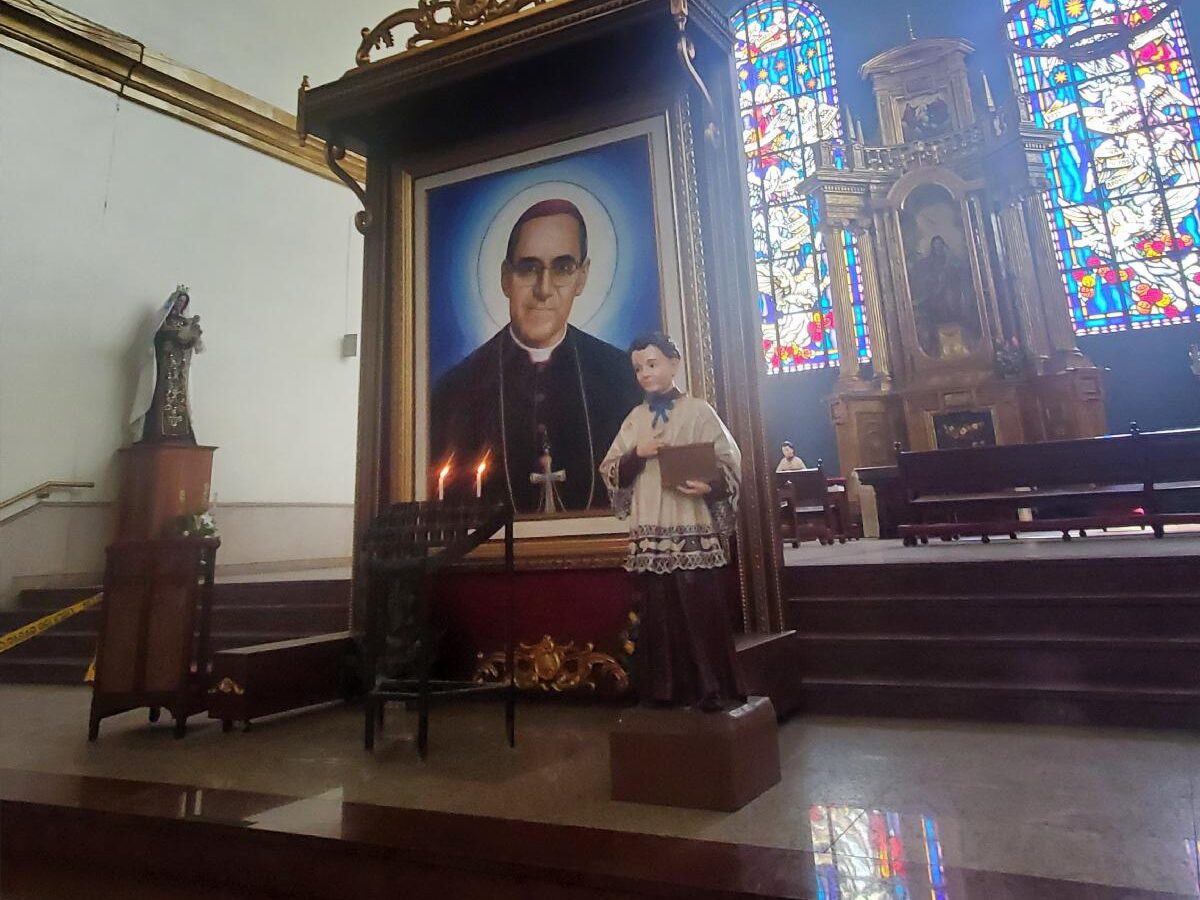
As a part of the commemoration of the feast of St. Óscar Romero, a first class relic of a piece of a blood stained cloth from the martyr’s assassination day was on display during the march.
Msgr. Arturo Bañuelas, an El Paso native and one of the founders of the Hope Border Institute, expressed the significance of this relic.
“It’s a beautiful occasion for us to do two things, to celebrate the inspiration that St. Óscar Romero gives to us, as a bishop of the Church, as well as to unite ourselves with our bishop,” he said. “Bishop Seitz is calling us to do the same thing, to be in solidarity with those who are poor, with the immigrant, and also struggle to survive.”
“There is a beautiful connection of living our faith, sacramentally in the Eucharist, but also to see that as part of our faith, is a commitment to be in solidarity, but also in the daily struggle that immigrants face today,” he added.
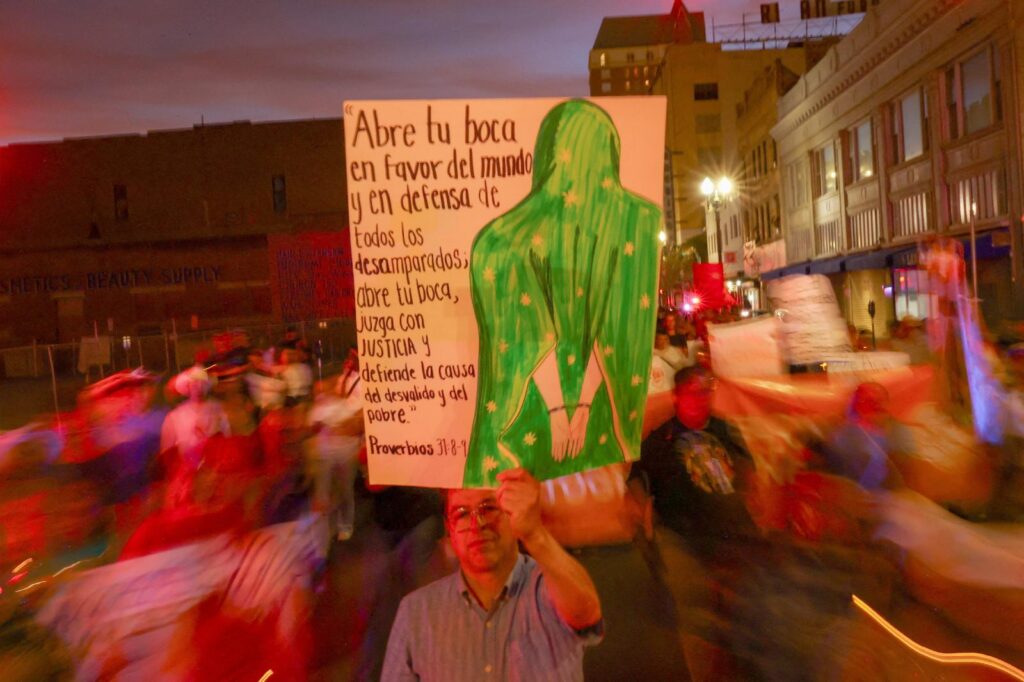
Bishop Seitz’s call to action was centered around the harsh realities of mass detention and deportation that have devastated the migrant population in the United States.
“They came without documents, perhaps, or maybe they stayed here after their documents expired. We as a nation didn’t give them the opportunity to rectify their situation,” he added.
“Sometimes they were in the process of legalizing, and it was just taken away by the actions of this administration. We believe that it’s a great injustice to incarcerate people, who have done things that are in many cases, necessary to preserve their life and the life of their family,” he said.
Catholic teaching and condemnations of deportation
Catholic social teaching on immigration seeks to balance three interrelated principles: the right of persons to migrate in order to sustain themselves and their families; the right of a country to regulate its borders and immigration; and a nation’s duty to conduct that regulation with justice and mercy.
The U.S. Catholic bishops noted in a special message promulgated in November that the Church’s teaching on immigration “rests on the foundational concern for the human person, as created in the image and likeness of God (Genesis 1:27).”
The bishops also condemned “indiscriminate mass deportation,” a position backed by the Church’s magisterial teaching at the highest level. St. John Paul II’s 1993 encyclical “Veritatis Splendor” (“Splendor of Truth”) and 1995 encyclical “Evangelium Vitae” (“The Gospel of Life”) both quote the Second Vatican Council’s teaching in “Gaudium et Spes” condemning “whatever is offensive to human dignity, such as subhuman living conditions, arbitrary imprisonment, deportation” among others. The Council calls them “a disgrace, and so long as they infect human civilization they contaminate those who inflict them more than those who suffer injustice, and they are a negation of the honor due to the Creator.”
Papal teaching in “Veritatis Splendor” reinforced the Council’s moral condemnations, stating these acts are examples of “intrinsic evil” incapable of being ordered to God or the good of the human person.
Raising awareness of mass deportation effects
A ProPublica report published March 23, the day before the El Paso march and vigil, stated that the Trump administration’s mass deportation push has led to the detention of the parents of 11,000 children who are U.S. citizens. It stated that ICE arrests of parents have doubled in the second Trump administration compared to the prior Biden administration, with the Trump administration “deporting about four times as many moms of U.S. citizen children per day as Biden did.”
“We hope to raise the awareness of what really is happening now: the suffering that people are going through, the pain that they are experiencing,” Bishop Seitz said. “We hope that all Christians can encounter Christ in the eyes of the poor and the people that are suffering.”
Fernando Ceniceros is editor of The Rio Grande Catholic, the news outlet of the Diocese of El Paso, Texas. OSV News staff contributed to this report. This article is a collaboration between The Rio Grande Catholic and OSV News and is distributed in partnership with OSV News.
