


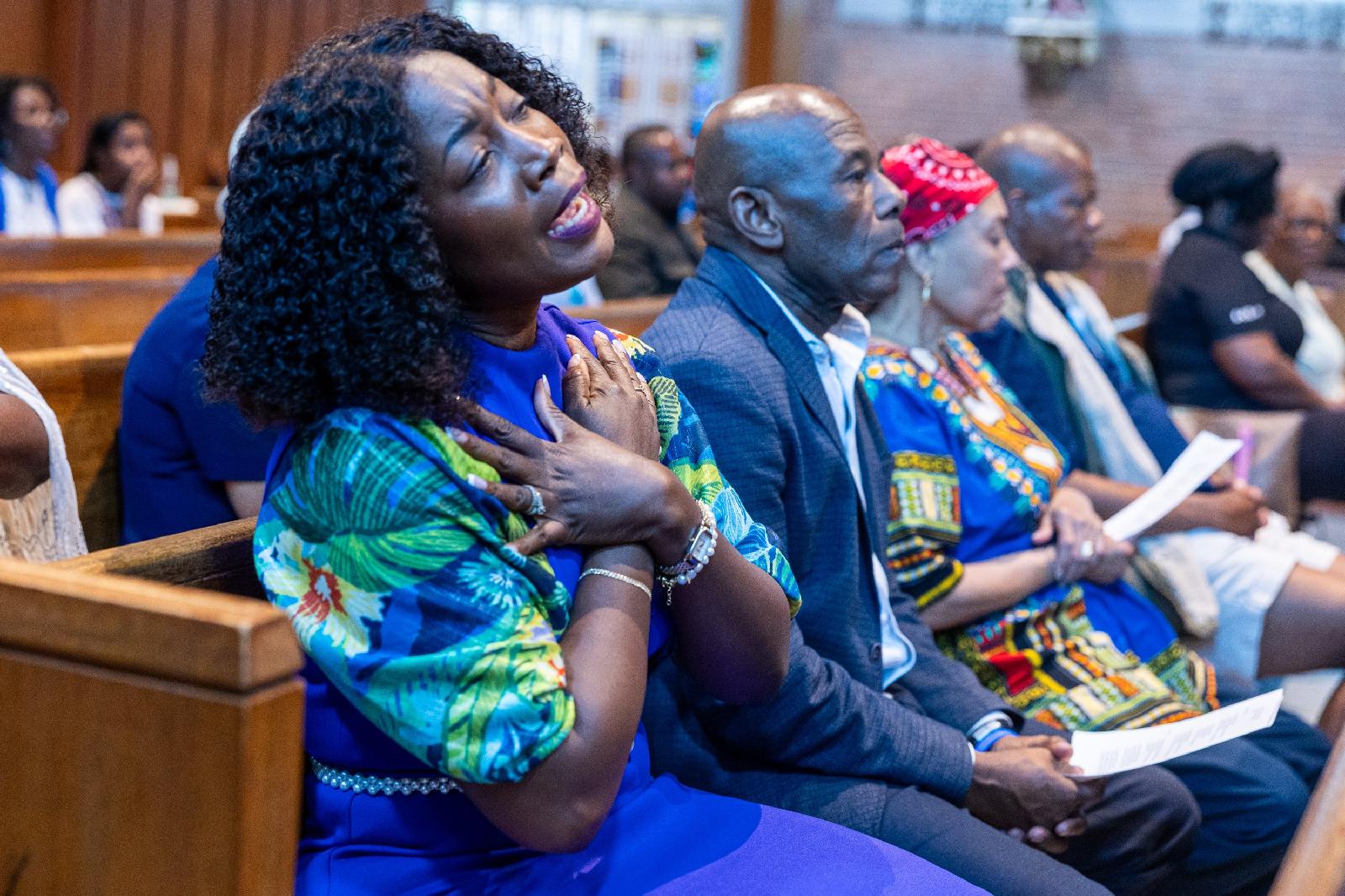
TAKOMA PARK, Md. (OSV News) — Cardinal Chibly Langlois of Les Cayes, Haiti, celebrated a Mass of solidarity July 28 with the Haitian community and those impacted by changes to immigration policy.
As an estimated 350,000 Haitian immigrants to the United States face losing their Temporary Protected Status, or TPS, following the Supreme Court’s June 25 ruling that the Trump administration can end a program temporarily shielding eligible Haitian and Syrian immigrants living in the U.S. from deportation.
Haitians confront the possibility of having to move back to their country, which is plagued by gang violence and political instability.
The concelebrants at the Mass at Our Lady of Sorrows Church in Takoma Park included Archbishop Thomas G. Wenski of Miami; Archbishop Robert G. Casey of Cincinnati; and Bishop Jacques Fabre-Jeune of Charleston, South Carolina.
Haiti priests serving Haitian immigrants in U.S.
Also concelebrating were 10 priests, including priests from Haiti serving Haitian immigrants in the United States, priests whose religious orders serve in Haiti, and priests whose parishes have longstanding outreach programs there.
The Mass was celebrated in French, with the choir singing songs in Haitian Creole, French and Latin.
“Today we gather to bring before God the pain, sorrow, and anxiety of the Haitian community in the United States as they face the consequences of the end of Temporary Protected Status,” Cardinal Langlois said as he opened his homily.
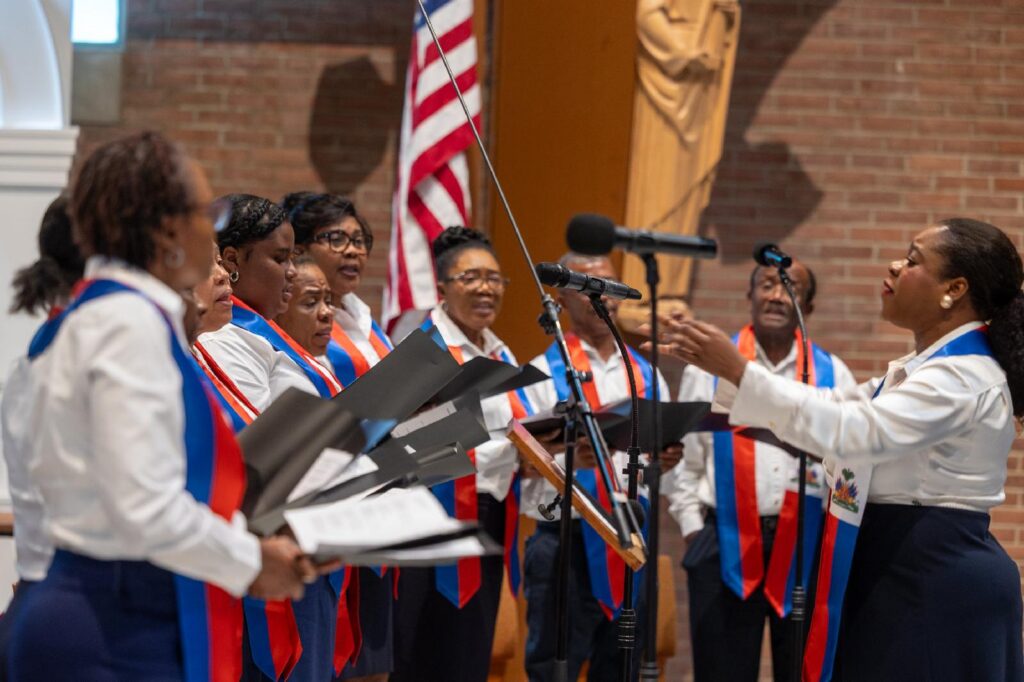
“This celebration is a profound gesture of solidarity by the Church in the United States and the Church in Haiti with more than 350,000 people who now find themselves in this difficult situation,” he said. “We gather not only to pray, but also to remind one another that we are one family in Christ. When one member of the Body of Christ suffers, the whole Body suffers with it.”
‘They lift up their eyes to the Lord’
Referencing the reading at the Mass from the prophet Jeremiah, the cardinal said, “Many families are living with fear and uncertainty. Yet Jeremiah teaches us something important: even when God’s people feel abandoned, they never stop turning to Him. They lift up their eyes to the Lord, asking for healing, mercy, and deliverance. We bring our anxieties before God, but we do not lose hope.”
Cardinal Langlois gave his homily in Haitian Creole, and an English translation of his remarks was shared by the U.S. Conference of Catholic Bishops. The USCCB’s Secretariats of Migration and Cultural Diversity helped coordinate the Mass along with the Archdiocese of Washington’s Secretariat for Evangelization and Synodal Renewal.
Earlier that day, the Haitian cardinal and the three U.S. bishops participated in meetings on Capitol Hill with U.S. senators and their staff, to urge passage of a Senate bill that would extend Haiti’s TPS designation, following the passage of a bipartisan bill in the U.S. House of Representatives in March that would require the secretary of Homeland Security to extend that designation to 2029.
Work permits for Haitians with TPS expired July 24.
TPS protections first granted to Haitians in 2010
TPS protections were first granted to Haitian immigrants in 2010 following a catastrophic earthquake that devastated Haiti, the poorest country in the Western Hemisphere, and then the protections were extended several times over the years.
“God’s people are not governed by fear but by faith. We proclaim our trust in a God who opens a way even when every human door seems closed,” Cardinal Langlois said in his homily,
“Temporary protections may come to an end, but God’s grace never ends. Human decisions may bring uncertainty and suffering, but God’s love and His faithful presence never cease,” he said. “As disciples of Christ, we are called to be signs of that love by standing with those who are vulnerable and by working for justice with hope, charity, and perseverance.”
As he concluded his homily, Cardinal Langlois sought the intercession of Our Lady of Perpetual Help, the patroness of Haiti, and he prayed that God would help Haitians remain steadfast in their faith and comfort families living in fear and uncertainty.
Praying God grants wisdom, compassion to leaders
He also prayed that God would “grant wisdom, compassion, and enlightenment to the leaders of nations, so that they may always protect the dignity of every human person and work for the common good, especially for the Haitian people.”
After Communion, Archbishop Wenski, a member of the USCCB’s Committee on Migration, spoke to the congregation in Creole. He has worked with the Haitian community in the Archdiocese of Miami since 1979, serving as the associate director of the Haitian Apostolate there and then as its director and as the pastor of the Notre Dame d’Haiti Mission in Miami from 1985 to 1998.
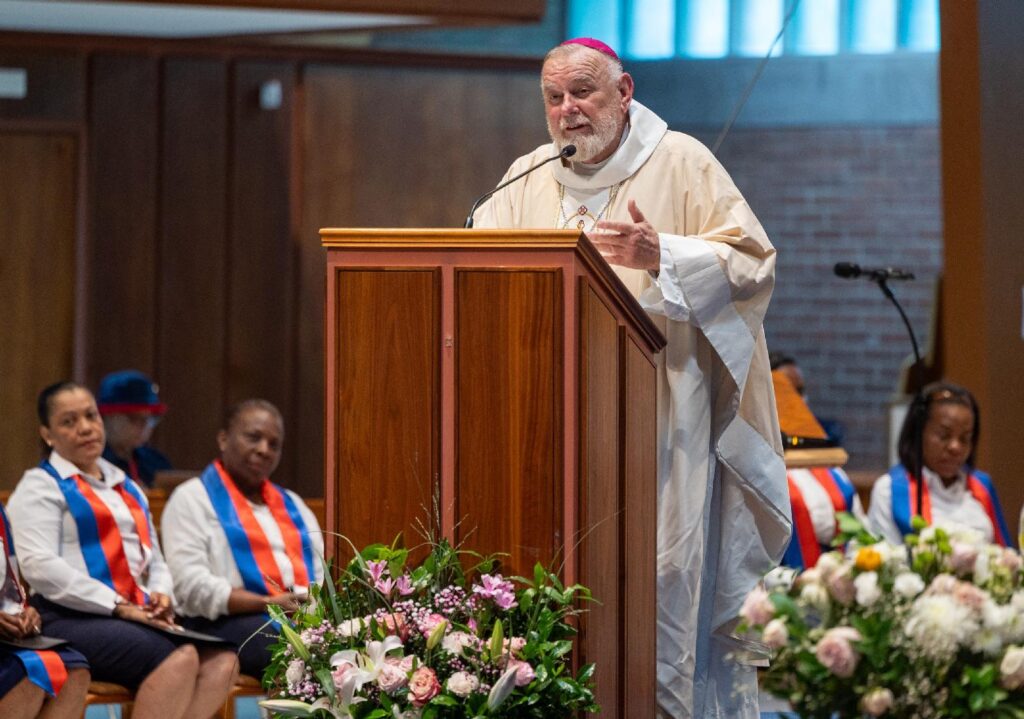
He emphasized that Haitians are a resilient and a deeply religious people. “We have to have hope,” said the archbishop, who led the congregation in singing a song in Creole, with its verses emphasizing that through life’s struggles, don’t be discouraged or give up, but continue to move forward.
In an interview after Mass with the Catholic Standard, Washington’s archdiocesan news outlet, Archbishop Wenski said that ending the TPS status for Haitian immigrants will hurt them and their families back home whom they send money to, including to help children in Haiti go to school, and if they lose their jobs in the United States, it will have an economic impact on the communities where they worked.
‘Crime, terrorism, kidnapping, unrest’
Some of those immigrants, he said, had lived in Haiti’s capital, Port-au-Prince, where many homes were destroyed by the 2010 earthquake and in subsequent years by marauding gangs. The U.S. State Department’s travel advisory for Haiti recommends “do not travel to Haiti due to crime, terrorism, kidnapping, unrest and limited health care.”
If those Haitian immigrants losing their TPS status can’t work in the United States, “they won’t be able to pay their rent, so when they are sent back to Haiti, they’ll go back with nothing, and basically, they’ll have no place to go to,” Miami’s archbishop said.
In another interview after the Mass, Archbishop Casey said the issue hits very close to home for him, because his archdiocese includes Springfield, home to an estimated 12,000 to 15,000 Haitian immigrants. “They’re my flock. So this is important to me,” he said.
“They’re good people. They’re hardworking. They’re family focused. They contribute to the well-being of the city that they now call home,” he said about Haitians in Springfield, which he has visited since becoming Cincinnati’s archbishop last year.
Employers grateful for hardworking Haitians
“For the most part,” Archbishop Casey said, “the employers have been grateful for this influx of hardworking individuals” who have served in a variety of jobs, including in the health care field as aides in hospitals and nursing homes, and in manufacturing and construction jobs.
If those workers from Haiti are forced to leave, Springfield may struggle to find other workers to fill those jobs, he said.
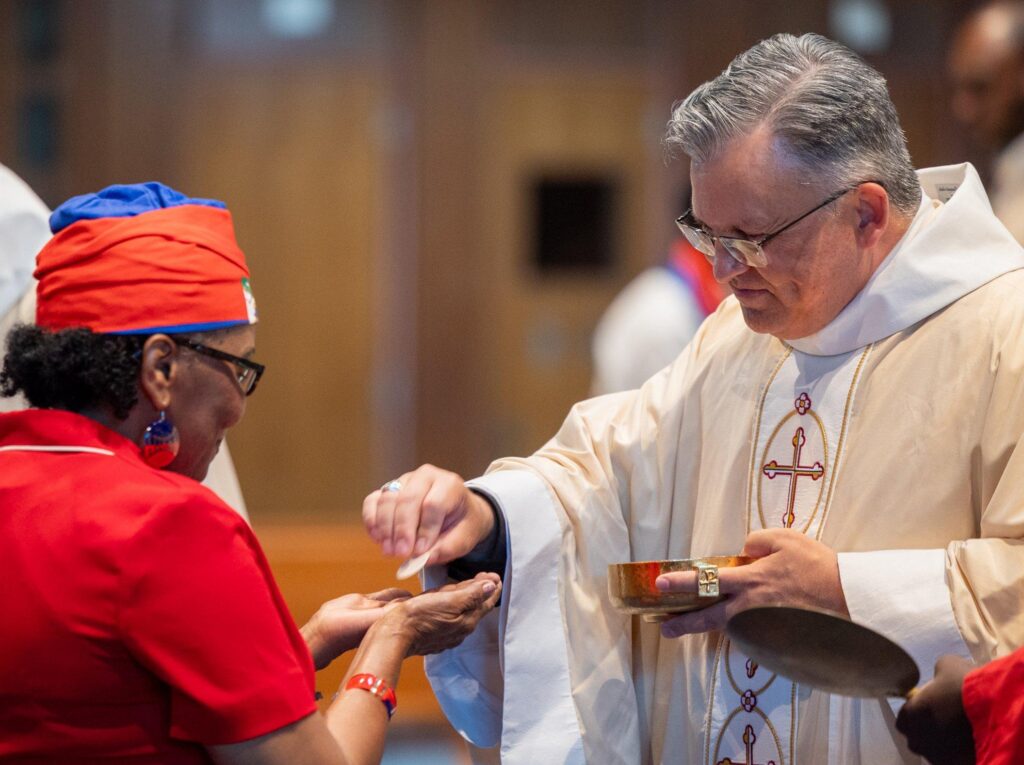
Bishop Fabre-Jeune, who was born in Haiti and is liaison of the Haitian Apostolate in the U.S. and as a bishop consultant on the USCCB’s migration committee, told the Catholic Standard it was fitting that their day of advocacy concluded with prayer. “Everything that we experienced today, we brought to the altar,” he said.
In remarks to the congregation after Communion, he noted that as the bishops visited the Senate offices, at times the effort seemed hopeless, but they came to the realization that “it’s not on us, it’s on the Holy Spirit.” Later in the day, he said, a senator told them, “This is unjust. This is not humane. Count on me (to support the bill).”
Bishops calling for extension of TPS for Haitians
Washington Cardinal Robert W. McElroy, along with Baltimore Archbishop William E. Lori and Bishop William E. Koenig of Wilmington, Delaware, have joined other U.S. bishops urging the Senate to pass the extension of Haiti’s TPS designation.
In a July 30 message to the Haitian and Syrian families impacted by TPS termination, Boston Archbishop Richard G. Henning encouraged them to be as resilient in the face of their challenges ahead.
“The Haitian and Syrian people have proven resilient in the face of natural disaster and civil discord. You have endured much and kept the faith. May that faith now give you strength for the days ahead,” he wrote. In the message he noted House passage of a measure that would continue TPS protection for Haitians, “but the Senate has not yet acted.”
‘A secure and human path forward’
“I therefore renew my appeal to our elected leaders: act swiftly to protect these families and provide them with a secure and humane path forward,” Archbishop Henning said.
On June 29, the USCCB Office of Government Relations sent out an advisory encouraging people to contact and urge the U.S. Senate to pass the legislation extending Haiti’s TPS designation.
In a June 26 statement, Bishop Brendan J. Cahill of Victoria, Texas, chairman of the USCCB’s Committee on Migration, said revoking the legal status of hundreds of thousands of people creates “a moral crisis” when returning home is neither safe nor realistic. He urged the nation to uphold the God-given dignity of every person.
Mark Zimmermann is editor of the Catholic Standard, the news outlet of the Archdiocese of Washington. This story was originally published by the Catholic Standard and distributed through a partnership with OSV News.
