


YAOUNDE, Cameroon (OSV News) — From Algeria to Angola, Church leaders across Africa expressed profound joy and hopes that the upcoming apostolic trip would bring much needed change to regions needing reconciliation and social stability, and dialogue to those who live interreligious relations daily.
In the April 13-23 visit to the African continent — the first since the start of his pontificate — Pope Leo XIV will travel to Algeria, Cameroon, Angola and Equatorial Guinea. The Vatican has highlighted that peace and care for the poor will be central themes of the African journey, which will see him following in the footsteps of St. Augustine.
Algeria: The birthplace of St. Augustine
The birthplace of St. Augustine is “overjoyed” with the fact the pontiff is coming.
In a Feb. 25 statement, Algerian bishops said Pope Leo is “coming to encourage our Church in its mission of fraternal presence among a predominantly Muslim population,” and to “remind us of the blessing of having a common elder brother born in this land in the person of Saint Augustine, whose example can guide our shared journey.”
The bishops said he also comes “as an apostle of peace.”
“Algerians know that popes are not only concerned with their flock, but also with peace, justice and reconciliation for all,” Bishop Michel Guillaud of Constantine-Hippone told OSV News.
“If the Holy Father is coming to Algeria, it is because he believes that everyone has a part to play in building the kingdom of God, including the Muslim Algerian people. The hope of the Church in Algeria is that the Algerian people will grow in the conviction that Christians are not a threat, but that their presence and what inspires them can be good news for everyone,” Bishop Guillaud told OSV News.
Algeria is a country with a small Christian community, but one that is “joyful in living fraternally with all the people of this country, beyond our differences in culture, religion and language,” the bishop told OSV News.
Annaba is home to the Basilica of St. Augustine, built near the ruins of the Basilica Pacis where the theologian died in A.D. 430 as Vandals besieged the city. A statue in the basilica contains a relic of one of Augustine’s arm bones.
Algeria is 99% Sunni Muslim, and the Catholic Church counts just 8,740 members, about 0.019% of the population, out of more than 45 million people, according to the 2025 edition of the Annuario Pontificio, the Vatican’s annual yearbook.
Cameroon: Papal visit “rising sun” of hope
The bishop of Cameroon’s war-torn northwest region has described Pope Leo’s upcoming visit “a rising sun” of hope, “coming up” on the Cameroonian people from God.
The pope will come to Cameroon from Algeria April 15-18 — with Yaoundé, the capital, Bamenda and Douala — the country’s largest city and economic hub, as his stops.
The pope’s upcoming visit is a “source of joy” for Cameroon, a nation grappling with severe social and political crises, according to Archbishop Andrew Nkea Fuanya. In a video message sent to OSV News, Archbishop Nkea, president of the country’s bishops’ conference, said, “The people of Cameroon have gone through a lot, and hearing that the Holy Father is coming to visit us in moments of difficulty is very big news for us.”
Cameroon’s two English-speaking regions have been gripped by separatist violence since 2017, when the government took a hard line following strikes by Anglophone teachers and lawyers. The Anglophone crisis has killed at least 6,500 people over the last decade.
The country has been the object of increasing international criticism as a result of gross human rights violations. According to Amnesty International, people critical of the regime face persecution and are threatened with restrictions on their right to freedom of movement. Journalists are intimidated by security forces.
The country’s image was further dented by the Oct. 12, 2025, presidential election. President Paul Biya, in power for 43 years, was declared the winner, extending his rule by another seven years. The main opposition leader, Issa Tchiroma, rejected the results and has since continued to claim that he is the duly elected president.
Adolf Lele L’Afrique, a member of the Catholic Men Association and governor of the North West region, told journalists he believes the pope’s coming “will be a gathering for us to pray for long-lasting peace in our beloved country.” He appealed to all people in the region “to mobilize” to welcome the pope “warmly.”
Archbishop Nkea told OSV News that the Christian community was thankful that the Holy Father had chosen Bamenda as one of the stops in his Cameroon visit.
“It’s a very big moment of joy for our local Church, for all people of goodwill, and for our country in general,” Archbishop Nkea added.
Bishop Michael Bibi of Buéa hoped the visit “will help us to continue to work to see that there is justice, there is peace in our society,” helping to promote “work for the common good,” and solidarity.
Angola: A cry for reconciliation
In the third leg of the African trip, Pope Leo will head to Angola’s capital, Luanda, and the cities of Muxima and Saurimo April 18-21.
The government formed a special commission to prepare for the pontiff’s visit. The bishops’ conference of Angola and São Tome is also working full steam to welcome the pope in April, expecting the Holy Father to deliver a message of hope, especially for young people, local Church sources told OSV News.
Three-fourths of Angola’s 34 million people are under age 30, according to the country’s National Institute of Statistics, and 27.9% of those younger than 24 are not employed, according to the World Bank.
In addition, Angola is still reeling from decades of war — a wound Brother Cativa said is still “in our hearts, minds and thoughts.” So for him, a hope for Pope Leo’s visit is that he will bring a message of reconciliation and forgiveness.
Equatorial Guinea: Four decades since the papal visit
Pope Leo will end his four-nation Africa tour in Malabo, Mongomo and Bata in Equatorial Guinea April 21-23.
The visit of the pontiff comes 44 years after St. John Paul II visited and bears a special symbolism: It coincides with the celebration of 170 years of evangelization in the country.
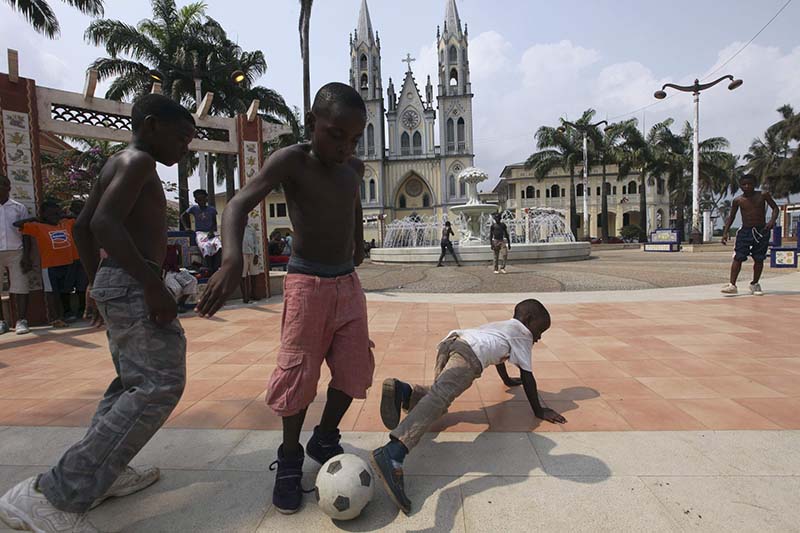
Sister Francine Hien of the Missionary Sisters of Mary Immaculate told OSV News the Christian-majority country was awaiting the pope’s arrival with “enthusiasm, expectations, zeal and joy.”
About 81.58% of the country’s 1.37 million population is Catholic, according to the most recent Vatican statistics, making it one of the most Catholic nations in sub-Saharan Africa by percentage and the only Spanish-speaking country on the continent.
Sister Francine said she expects Pope Leo to come with a “message of love, peace and unity” in what she describes as “a very active Church.”
The pope’s first stop in Equatorial Guinea will be in the city of Mongomo where he will meet with all priests and catechists from all the dioceses of the country. He will then travel to Bata to meet with teachers and students and then will end his three-day visit in Malabo, where final Mass will be held, the program announced on the visit’s website said.
Ngala Killian Chimtom writes for OSV News from Yaounde, Cameroon. Courtney Mares, Vatican editor for OSV News, contributed to this report.
