


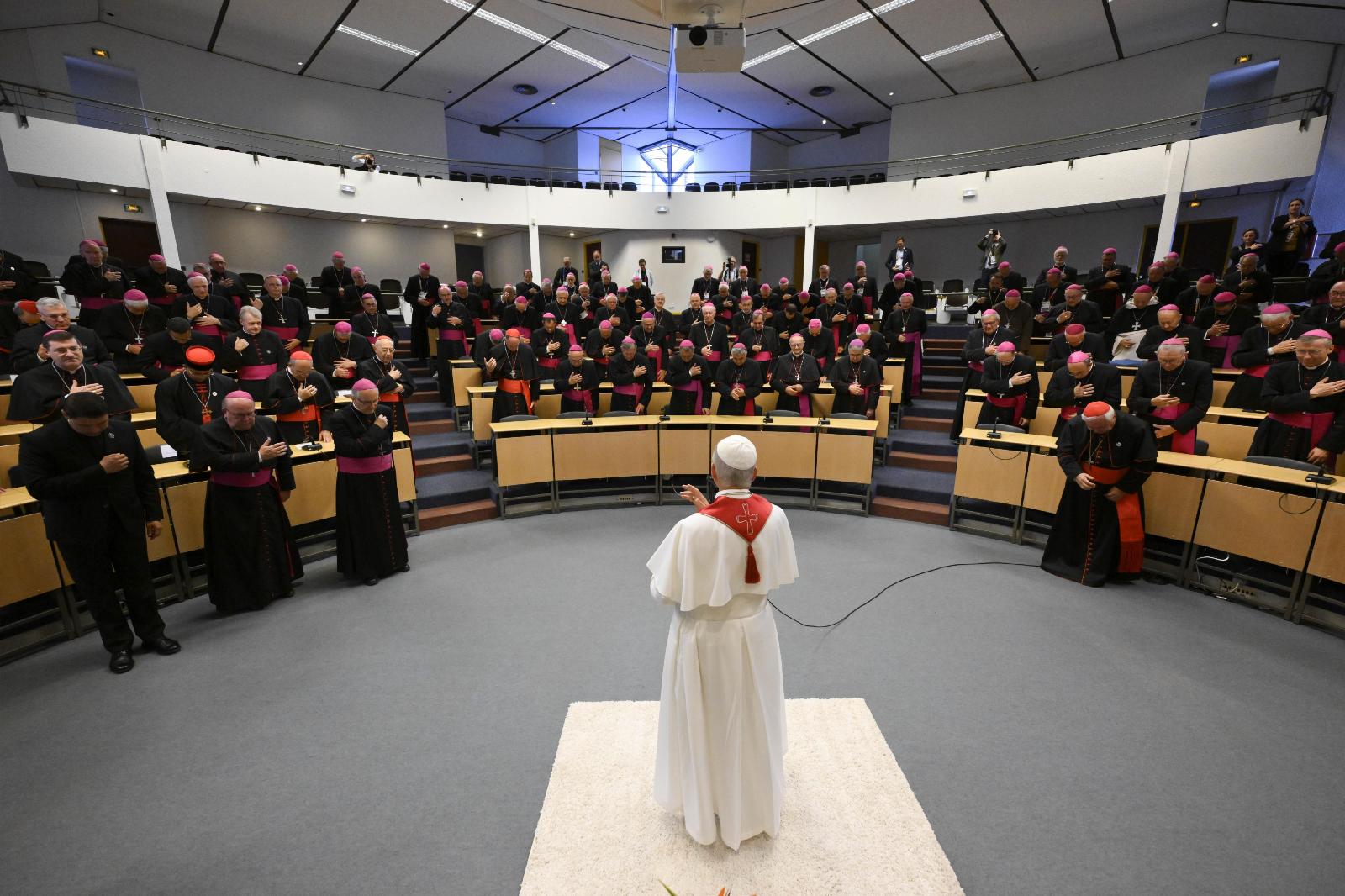
(OSV News) — France’s bishops used their Nov. 3-5 plenary assembly in Lourdes to confront the country’s deepening education crisis, as strikes, school blockades and political battles over funding have pushed the issue to the forefront of public debate.
Church leaders said concerns about young people’s anxiety and uncertainty prompted a major Catholic education initiative launched in 2025 and continuing through 2028.
“We knew that the younger generations were uncertain and anxious,” Bishop Benoît Bertrand of Pontoise, one of two vice presidents of the bishops’ conference, emphasized during a press briefing in Lourdes. “But when we launched this initiative a year ago, we did not expect this issue to become so urgent or to take on the scale we are seeing today.”
The 80 diocesan directors of Catholic education were present in Lourdes along with the bishop conference’s secretary general of Catholic education, layman Guillaume Prévost, who was appointed in 2025.
Catholic schools in France educate over 2 million students in over 7,200 schools, about 17% of the nation’s total student population.
Lawmakers fail to end government funding for teachers in Catholic schools
The assembly came days after French lawmakers debated a proposal to end government funding for teachers in Catholic schools. The measure was ultimately rejected, averting what Catholic education leaders warned could have triggered widespread school closures and added pressure to an already strained public system.
“We want relationships based on mutual respect among all those involved in education,” said Prévost, secretary general of Catholic education. “We believe that the Catholic education system is an asset for the entire country, but we try as much as possible to reach out to everyone, including those who criticize it.”
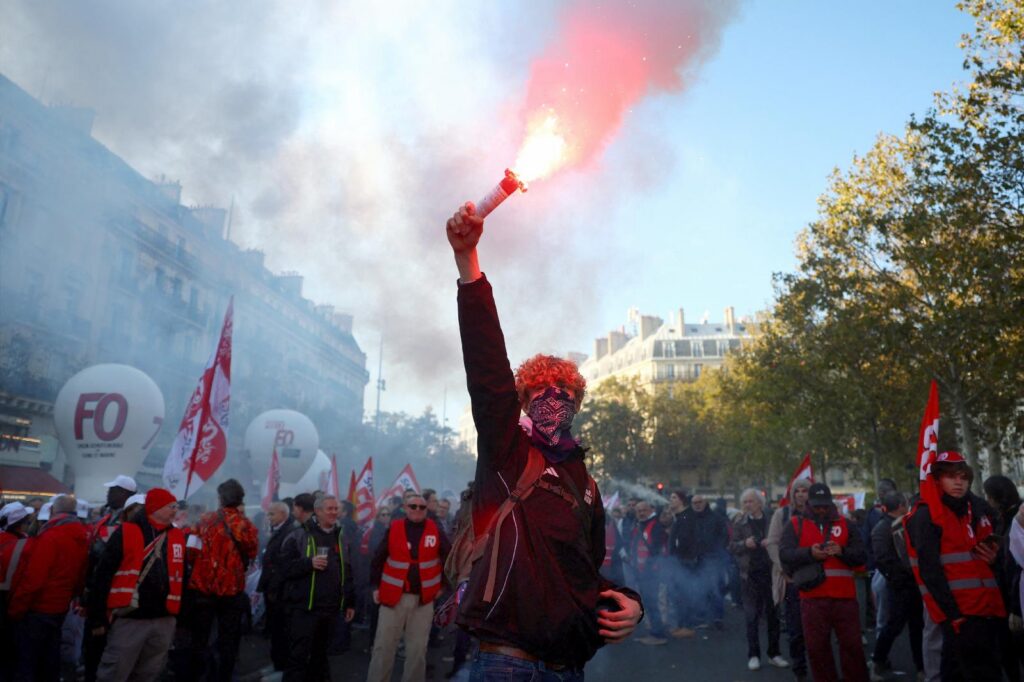
Bishop Matthieu Rougé of Nanterre, president of the bishops’ Council for Catholic Education, called for attention to the “search for meaning” expressed by the protests in high schools that rocked France in recent weeks.
“Our country is going through turbulent times, and we are clearly dealing with a deeply wounded society,” he said. “There is a great thirst for meaning among our contemporaries, young and old alike, for whom, at times, the inability to find it leads to violent protests.”
Standing in ‘full solidarity’ with teachers “voicing their difficulties”
“We stand in full solidarity with the teachers who are voicing their difficulties today,” Prévost added. “We must take care of the adults who take care of the children.”
For Prévost, one of the reasons for the crisis in education is “the rise in tensions between school staff and families.”
“In this regard, Catholic education is facing fewer difficulties than public education,” he noted. “There is a strong tradition and culture of supporting children in Catholic schools that relies on collaboration with families. That is one of their strengths.”
But Prévost also highlighted the fragility of families themselves. “It is no coincidence that schools are struggling,” he said. “The family is the institution that has been most disrupted in recent times. Inevitably, the weakening of families due to conflicts has repercussions at school. And this is not just about single-parent families, disadvantaged families, or families with an immigrant background. A majority of children today experience their parents’ separation. We cannot continue to pretend that this is not the case.”
Beyond education, the bishops addressed the upcoming presidential election, scheduled spring of 2027, which is expected to be highly tense and polarized. The latest polls suggested that the second round would pit Marine Le Pen’s far-right party, the Rassemblement National, against Jean-Luc Mélenchon’s far-left party, France Insoumise. Mélenchon clearly implied that if Marine Le Pen wins — as all polls predict for now — riots could destabilize the country.
Analysis of the outlook for presidential election
In Lourdes on Nov. 5, the bishops heard Jérôme Fourquet‘s analysis of the outlook for the presidential election. As director of the opinions and strategies’ department at the prestigious French Institute of Public Opinion, or IFOP, he pointed out that the violent strikes of recent weeks reflect “a culture of rioting” that has become “structural,” involving a “total disregard for the rules” in which anger is expressed impulsively and without restraint, against the backdrop of a weakening of state institutions.
In this context, the bishops hope to offer “guidance on discernment” in the coming months.
“Our goal is to ensure that votes are not cast solely on impulse or emotion,” Archbishop Vincent Jordy of Tours, also vice president of the bishops’ conference, explained.
“We want to contribute to the electoral debate with constructive proposals, rather than stoking the feelings of fear and anger that currently prevail,” said Bishop Bruno Valentin of Carcassonne and Narbonne and a member of the bishops’ working group on the presidential election. “It is about using words to build, not to fuel a climate of civil war.”
Caroline de Sury writes for OSV News from Paris.
