


OSV News) — In “Beyond the Devil’s Road,” my biography of Spanish Franciscan friar and explorer Francisco Garcés, I argued that Father Garcés’ epic 1775-1776 entrada was unparalleled in the annals of American exploration.
I would now amend that claim to make an exception for the travels of Father Pierre-Jean De Smet, who roamed even further than did Garcés without benefit of European companionship or arms — and under equally dangerous conditions.
Father De Smet was born in Belgium in 1801. Like Garcés, as a young man he was stirred to serve in the New World missions by the zealous appeals of a recruiter, this one working on behalf of the Jesuits. In 1821 he left, against the wishes of his family, for America.
Founding schools for Indian children
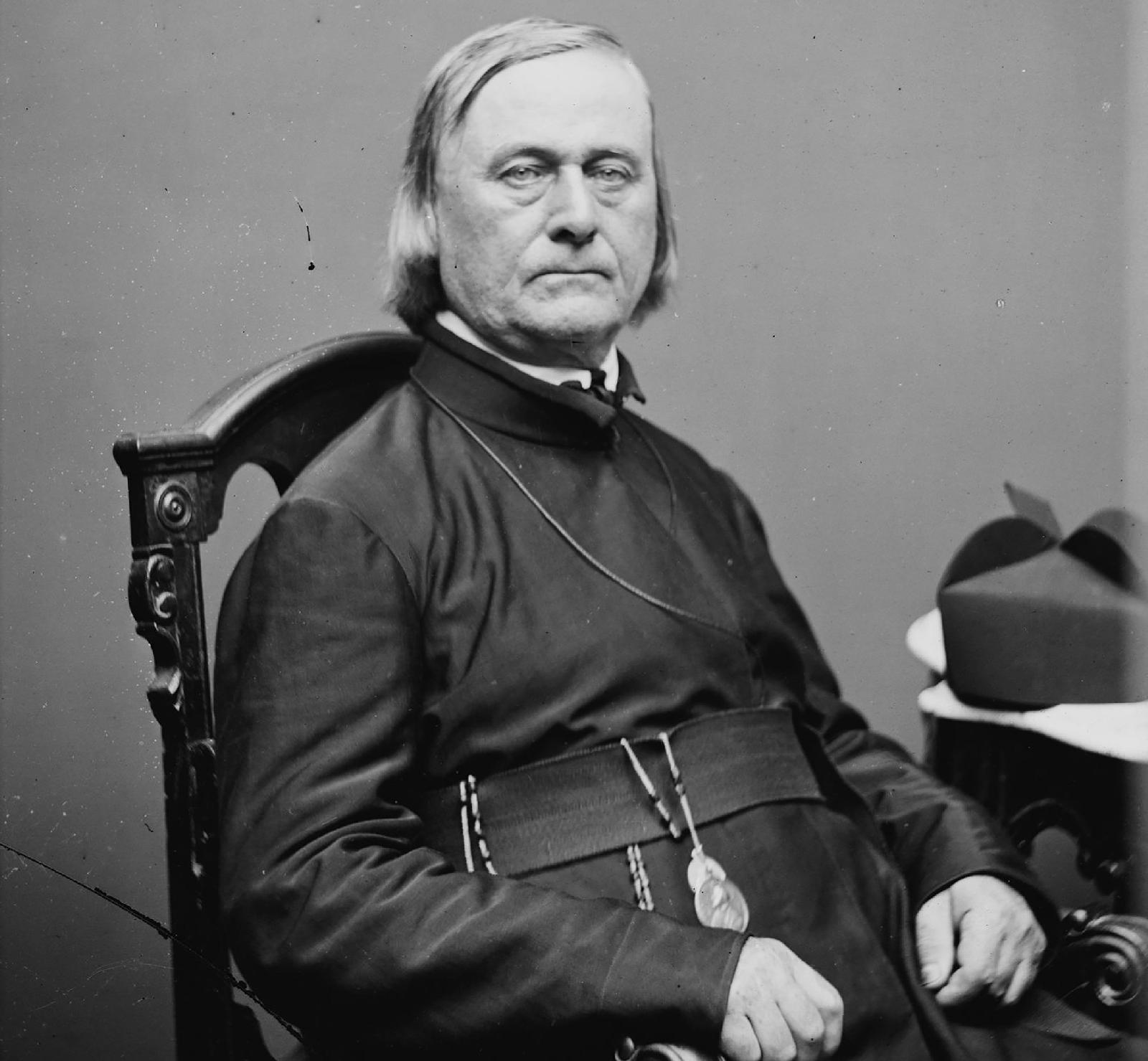
Unlike Fathers Garcés and Jacques Marquette, priest-explorers whose likenesses were never portrayed by those who knew them, we know what De Smet looked like: fair, round-faced, athletically stout, uncommonly strong. We also know much more about De Smet’s activities and thoughts, for, also unlike Marquette and Garcés, his extant writing about his explorations and other topics fills multiple thick volumes. Although they can be difficult to find, they make for entertaining reading.
De Smet arrived at St. Louis, then the far edge of Anglo-American civilization, in 1823. There — or rather some 15 miles north in the town of Florissant, where St. Rose Philippine Duchesne and her Sisters of the Sacred Heart were based — he and his fellow Jesuits founded the order’s second novitiate in the United States.
Eventually their labors would also include the founding of St. Louis University, but initially one of the group’s main purposes was to found schools for Indian children. This turned out to be more difficult than the fathers had imagined. The real work of evangelization would have to take place further west.
Thus, from 1838 to 1868, Father De Smet crisscrossed the northern plains, the northern Rockies and Pacific Northwest to the tune of some tens of thousands of miles. His purpose was the usual one of a missionary: to preach, teach, succor and serve. He established his first mission among the Flatheads (or Salish) of the Bitterroot Valley in Montana.
Life among the Flatheads
For decades, these extraordinary Indians had been pleading for Jesuit missionaries; the faith seems to have been introduced to them by some devout Iroquois from the East. (Much had changed since the days of priest-martyrs Sts. Jean de Brèbeuf and Isaac Jogues.) So much did the Flatheads wish to receive more instruction that four times they sent delegations to St. Louis to request a priest.
On one of these journeys, they were traveling with some white men when the party was intercepted by a group of Sioux. The Sioux decided to execute the Flatheads and let the others go, including an Iroquois named Old Ignace whom, because of his dress, they mistook for a European.
Ignace, who had done more than anyone to evangelize the Flatheads, would not have it. He stepped forward, revealed his identity, and was slain along with his four native companions. A good book could be written about the unshakeable faith of native Christians like Ignace, for they seem to pop up in every missionary’s story.
Justice advocate
De Smet would have happily spent the rest of his life among the Flatheads, but he was too talented and too passionate not to become involved in defending the region’s natives from the rapacity of American traders and settlers and the cruelty and incompetence of the American government.
Time and again he wrote letters and treatises exposing the unjust treatment of his Indian friends. Time and again he was prevailed upon by the United States authorities to act as a mediator between government officials and Indian leaders. To make matters worse, time and again he was removed from the frontier by his Jesuit superiors so that he could go on fundraising tours throughout America and Europe. Talent always exacts a price.
One of Father De Smet’s last official acts was to persuade Sitting Bull and his desperate Sioux followers to lay down arms and negotiate the Treaty of Fort Laramie in 1868. Five years later, he died in St. Louis. He had baptized thousands but, like his idealistic missionary predecessors, he believed he had failed to create the space necessary for distinctively Native American Catholic communities to emerge and flourish.
Enduring legacy
The numbers tell a different story. It is rarely noticed, but today approximately 20% of U.S. residents who identify as Native American call themselves Catholic — the same as among the general population. On some reservations the proportion of Catholics is much higher. Among the Tohono O’odham of southern Arizona, where Garcés labored, it is 80%.
There is a strong devotion to the Mohawk-Algonquin St. Kateri Tekakwitha — received into the Church by French Jesuits one year after Marquette’s death — in Indian communities across the country. And the canonization cause for the badly misunderstood Nicholas Black Elk, an Oglala Lakota who knew Sitting Bull well and is now a Servant of God, seems to have momentum.
It is unthinkable that any of that would be the case without the witness and influence of missionaries like Fathers Marquette, Garcés and De Smet. As much as they contributed to American geographical and ethnographical knowledge, they ought also to be credited for shaping, much for the better, America’s spiritual landscape. American Catholics can take pride in their legacies of witness.
Jeremy Beer is the author of “Beyond the Devil’s Road: Francisco Garcés and the Spanish Encounter with the American Southwest” (University of Oklahoma Press).
