
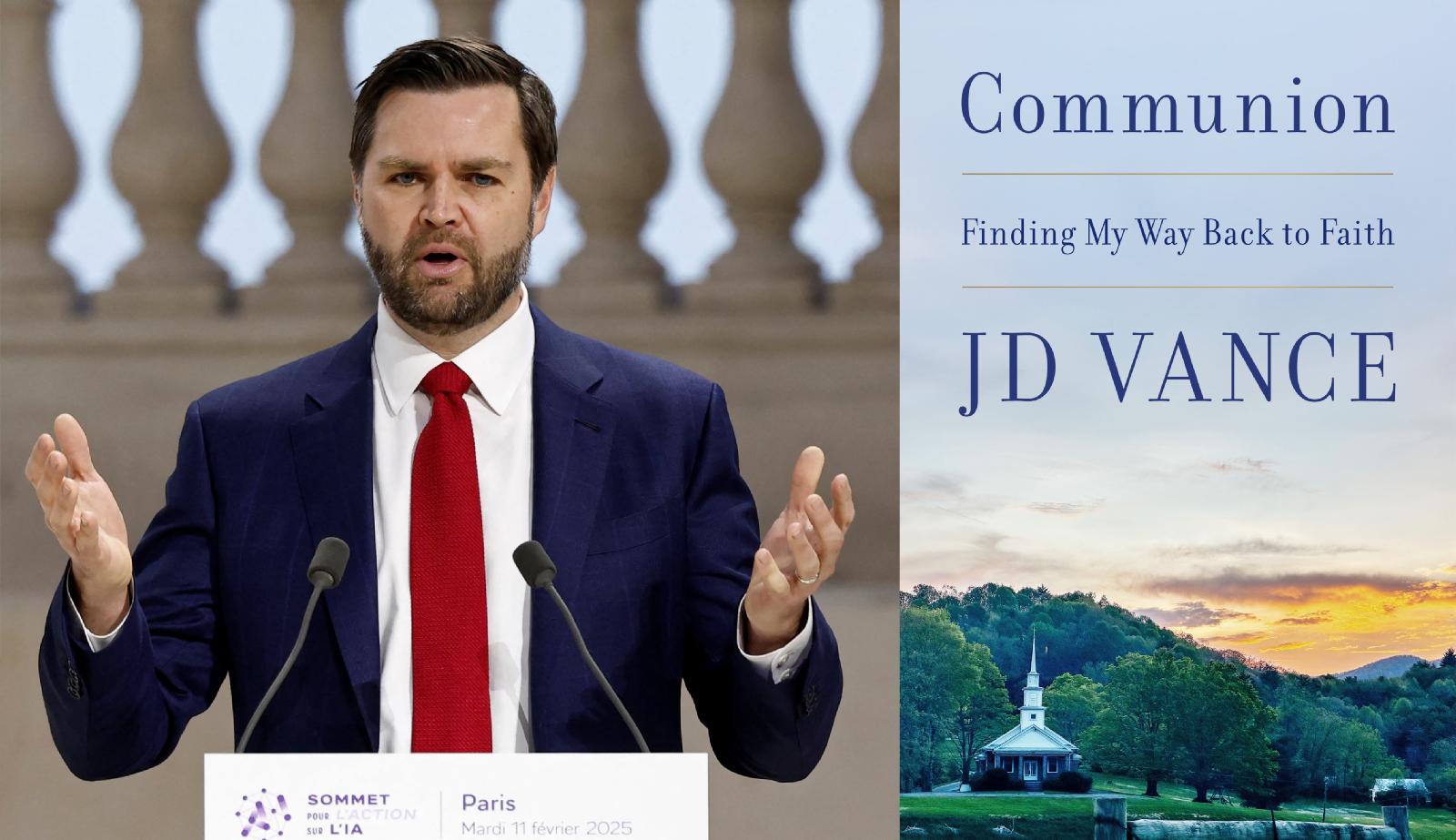
(OSV News) — On June 16, Vice President JD Vance will release his second book, “Communion: Finding My Way Back to Faith” (HarperCollins). As a presumed 2028 U.S. presidential candidate, the timing couldn’t be more critical for Vance, who joined the Catholic Church in 2019.
OSV News recently spoke with acclaimed presidential historian Douglas Brinkley, co-author of the bestseller “Parish Priest: Father Michael McGivney and American Catholicism,” and the Katherine Tsanoff Brown Chair in Humanities and Professor of History at Rice University in Houston.
Brinkley, who holds advanced degrees from Georgetown University in Washington and describes himself as “raised in the bosom of Catholicism,” had not yet read Vance’s “Communion,” but provided both historical context and analysis on the current political climate. The interview has been edited for length and clarity.
OSV News: Memoirs aren’t unusual in an election cycle, but this book focuses solely on JD Vance’s faith — while he’s the sitting vice president. What are the implications of a prospective presidential candidate writing so publicly about his faith?
Douglas Brinkley: In 1975, nobody could project who would be the Democratic nominee for president. Jimmy Carter was a one-term governor from Georgia who made the cover of TIME Magazine because of the stance he took about segregation.
But he was basically an unknown — and he couldn’t get anybody to publish his book, “Why Not the Best?” Eventually, a Christian press called Broadman printed it.
Everywhere Carter went, he’d hand out “Why Not the Best?” People would look at it — and he’d talk about faith in a very deep way while he was running for president. That book sold a million copies — and it worked; he became president.
So JD Vance is pulling a Jimmy Carter “Why Not the Best?”: Put faith as your calling card, right out of the gate.
It worked beautifully for Carter. Whether Vance can ride a wave on this book is yet to be seen, but it may be an answer to getting himself in front of the pack for 2028.
OSV News: So the book could be a sort of public relations offensive that Vance hopes might sway voters of faith?
Brinkley: Yes — and introduce himself to people. His opponent could be Marco Rubio, a Cuban-American who’s also Catholic.
It allows Vance to talk about the importance of faith in America –and to not have to just answer “Do you agree with what President Trump said?” every second.
He’s going to be asked an awful lot “Pope Leo said this about immigrants — do you agree with that?” He’s going to be peppered by any journalist with questions, when he’s promoting his newfound Catholic faith.
He might do talks at Catholic colleges, or congregations or even to secular audiences. ?And then hope there’s a spillover effect of that to the very large Protestant evangelical community — on which Vance might have an edge over Rubio.
From a political point of view, American Catholics are in transition. ?As voters, for a long time now — certainly 20 years — the Catholic Church’s opposition to Roe v. Wade and abortion has dominated. But the big issue that’s snowballing for 2028 is immigration. ICE overreach on immigration is going to be a hotly debated issue.
The Democrats are going to be courting American Catholics, and the Republicans can’t afford — whether the Republican candidate is Rubio, or Vance or someone else — to lose the momentum they’ve built over the last 20 years with American Catholic voters. And so there’s kind of a fight for the soul of today’s American Catholic communities going on right now.
OSV News: How has the political atmosphere changed from the era when John F. Kennedy faced a nation uneasy with the idea of a Catholic president, leading him to downplay his faith?
Brinkley: When John F. Kennedy won the Democratic nomination in 1960, it was a massive thing. He spoke to the Greater Houston Ministerial Association and said, “Look — I don’t work for the Vatican. I’ll be an American president, first and foremost.”
Since then, things have improved for the American Catholic community — although John Kerry and Joe Biden kind of crossed swords with the Catholic Church on the abortion issue.
God was invoked constantly in American history up until the mid-1960s — then the secular movement kicked in more, and that division of church and state became starker.
But there’s been kind of a paradigm swing. This is going to be a different election cycle in 2028 — and it may flip to the immigration issue, which could create problems for Rubio and Vance with some voters.
I think the question is, how large is Pope Leo’s megaphone — and will it resonate with American Catholics? If you’re an American Catholic, how important is your Catholicism to you, in the voting booth? Two percent of American Catholic voters could swing an election.
Kimberley Heatherington is an OSV News correspondent. She writes from Virginia.
