


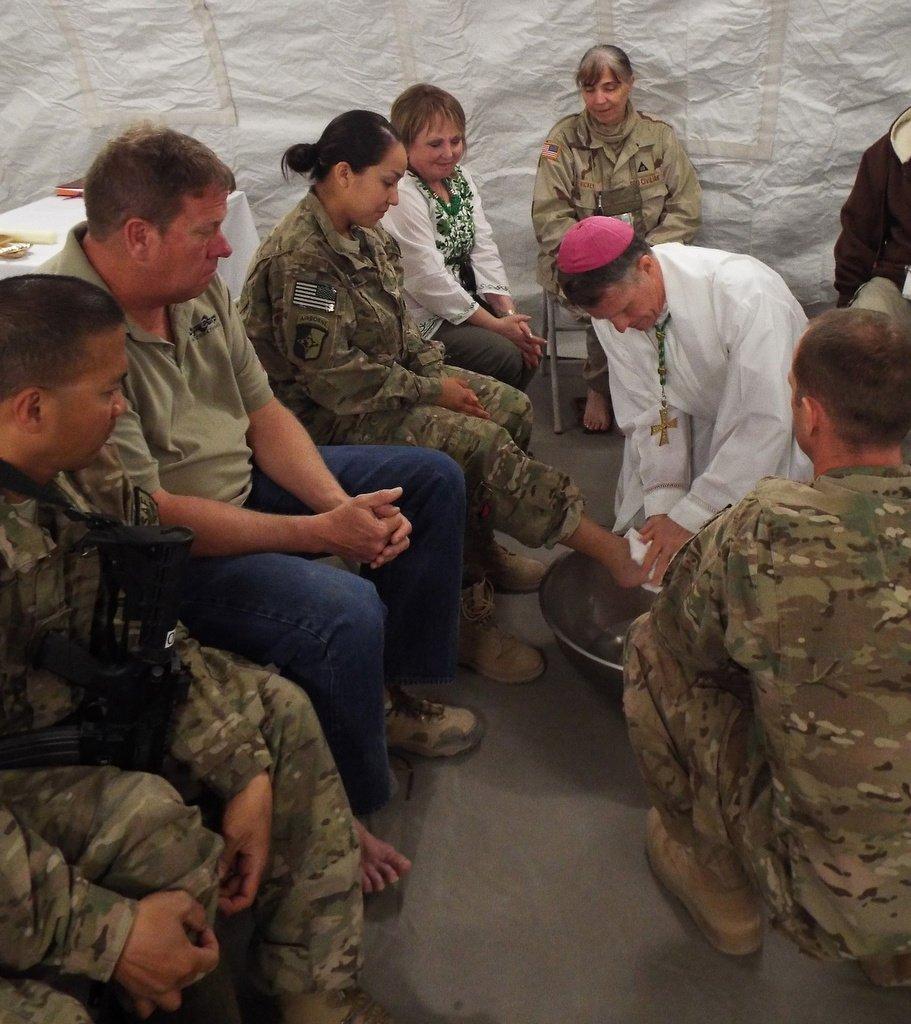
CHANTILLY, Va. (OSV News) — The inaugural Catholic Military Conference sponsored by the U.S. Archdiocese for the Military Services Nov. 9-11 was an intimate affair, as conferences go, with 280 attendees representing all branches of the armed services for three days of lectures, workshops and prayer.
The impetus for the conference originated with laypeople, “and I jumped on it,” Archbishop Timothy P. Broglio, who heads the military archdiocese, told OSV News.
The initial planning only began in February before the conference was announced in May. Considering that such events usually are planned over the course of a year, “it’s a lot less painful than I thought it would be,” the archbishop said.
Teaching and support
Logistics were a special challenge, Archbishop Broglio said, since the archdiocese has no geographical boundaries. It covers the entire world to serve the spiritual needs of an estimated 1.8 million Catholics stationed at U.S. bases.
The archbishop thinks the conference may not become an annual affair, but rather every two years.
With the theme of “Living and Serving Justly,” it was designed to stay above the political fray, he added. “I generally make a considerable effort to keep my intentions on the social doctrine of the church and church teachings, and avoid partisan politics.”
He saw the conference as a way “to teach Catholics to live their faith” and “to know they are supported in their faith.” Also, “to deepen our understanding of just war to really view security as protection of the human person,” he added.
Day 2 of the conference was devoted mostly to an examination of “Magnifica Humanitas” (“Magnificent Humanity”), Pope Leo XIV’s first encyclical, released in May.
Just war
In the encyclical, the pope looks at the consequences of the digital revolution in the 21st-century and how best to safeguard “the human person in the time of artificial intelligence.” In the document — addressed universally to all people of good will across every nation — he also declared centuries-old “just war” frameworks are now outdated.
“Today, more than ever, without prejudice to the right to self-defense in the strictest sense, it is important to reaffirm that the ‘just war’ theory, which has all too often been used to justify any kind of war, is now outdated,” the pope states. “Humanity possesses far more effective and capable tools for promoting human life and resolving conflicts, such as dialogue, diplomacy and forgiveness. The use of force, violence and weapons reflects a relational poverty that always has disastrous consequences for civilian populations.”
The Nov. 10 plenary sessions covered everything from St. Augustine to 19th-century Prussian officer and military theorist Carl von Clausewitz, who famously wrote, “War is the continuation of politics by other means.”
Matthew Bunson, vice president and editorial director of EWTN News, said the encyclical opens a “new chapter” in explaining what conflicts are to be fought as well as when and why.
“The traditional foundation of just war theory has become inadequate,” he said, so the document deserves a “central place in Catholic moral reflection” in order “to think beyond inherited assumptions.”
He praised the encyclical’s assertion about the “culture of power” that is “taking advantage of the crisis of multilateralism and fueling a false realism that insists that there is no alternative.” Pope Leo, he said, “is certainly a realist without being a pragmatist. … This is not a utopian dream.”
The late Pope Francis as well as Pope Leo “are consistent with the tradition of looking at wars skeptically,” said Joe Capizzi, the McGrath-Cavadini director of the McGrath Institute for Church Life at the University of Notre Dame and a frequent lecturer on just war.
“All of us,” he said, “are invited morally to evaluate the wars in which we fight,” and “vengeance is not a good political end.” Wars, he added, “must be justice-seeking.”
“The coin of war is life itself — the life that only God gives,” said retired Army general and author James Dubik. “War … damages lives and changes living, sometimes forever. This is why wars should only be fought sparingly.”
He also called war “the abnormal that becomes the normal.”
Affirmation of a unique calling
During a question-and-answer session, Archbishop Broglio observed that on his visits to military bases, he is often approached by chaplains of other denominations “thanking me for statements” on the role of military chaplains.
He said he was told, “‘We don’t have anyone speaking for us,’ so they turn to what the Catholic Church has to say.”
Other sessions at the conference dealt with incarnational ministry, which requires personal interactions, in the age of artificial intelligence; the stresses of military marriages; and how to extend missionary discipleship.
The archdiocese has a perpetual shortage of priests to serve as military chaplains. There are fewer than 500, and of those, fewer than 250 serve as active-duty chaplains as commissioned officers, with many on loan from their home diocese.
Archbishop Broglio has to put constant effort into recruiting chaplains. In Baltimore, he recently hosted 33 prospective chaplains for a three-day fall discernment retreat. After ordination, new priests are required to spend three years in civilian pastoral service to their home dioceses before joining the military.
There are two important elements to attract priests to military service, Archbishop Broglio told OSV News.
The first comes from a military environment, which he called “a call within a call.” And while “it does take a certain physical condition to meet to be in the military,” he said, it also requires “the ability to serve far away from home, outside of your community.”
Kurt Jensen writes for OSV News from Washington.
