


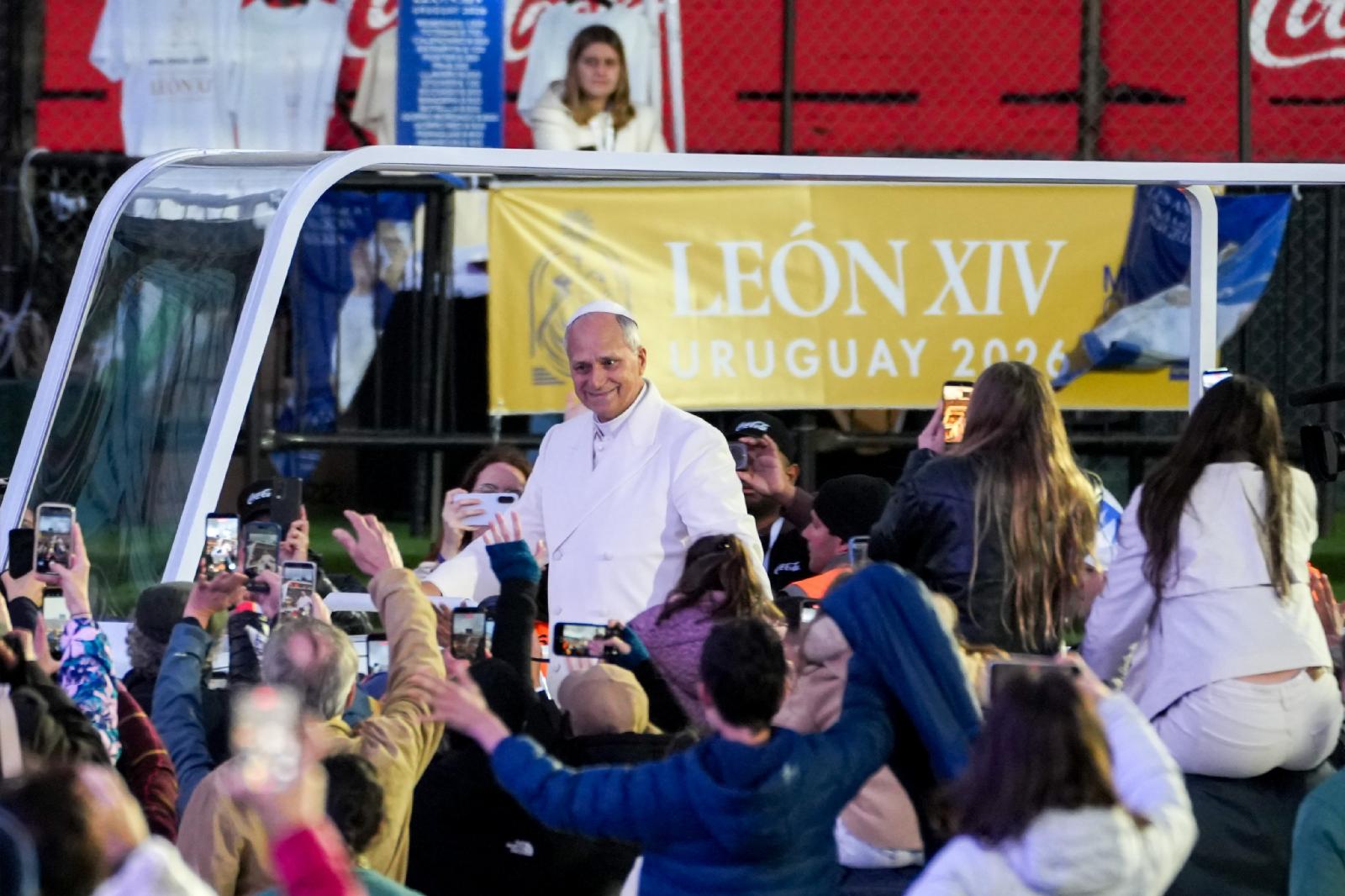
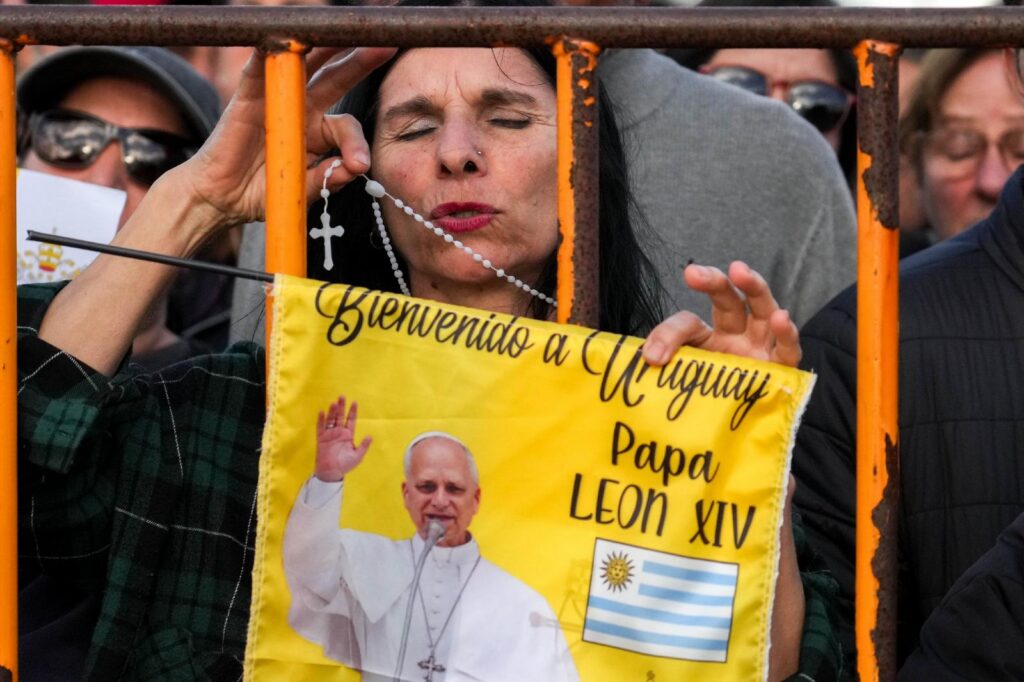
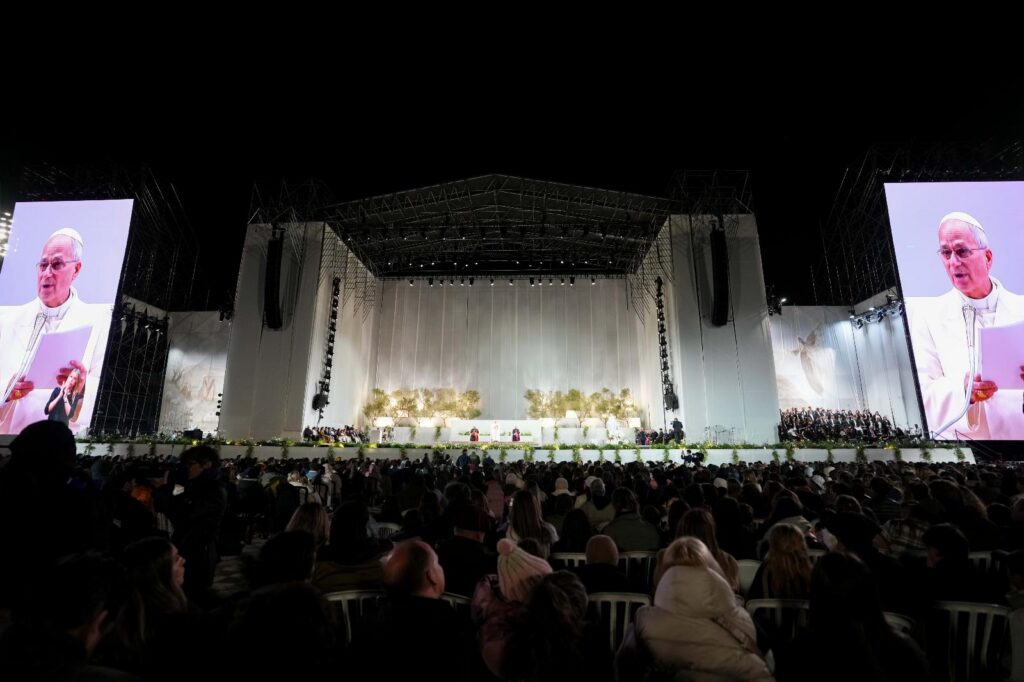
MONTEVIDEO, Uruguay (CNS) — In Latin America’s most secular country, Pope Leo XIV received a welcome that surprised even longtime Vatican observers: Tens of thousands of people were eager to see the pope, as tickets for a prayer vigil at the country’s largest stadium were snapped up within hours of going online.
The roughly 70,000 free tickets for the Nov. 7 vigil at Montevideo’s Centenary Stadium were quickly claimed in less than three hours, mirroring an unexpected display of enthusiasm in a country where only about 35% of the population identifies as Catholic and more than 50% declare having no religious affiliation at all, in a 2024 survey by Latinobarómetro.
Local media outlets reported that this demand broke records.
“I have never seen it in this country!” said Guzmán Carriquiry Lecour, a former secretary of the Pontifical Commission for Latin America and former Uruguayan ambassador to the Holy See, speaking to journalists Nov. 3, detailing that he said he had never witnessed the city’s public spaces so filled with welcoming posters and demonstrations.
Enthusiastic reception meets deeply-embedded secular culture
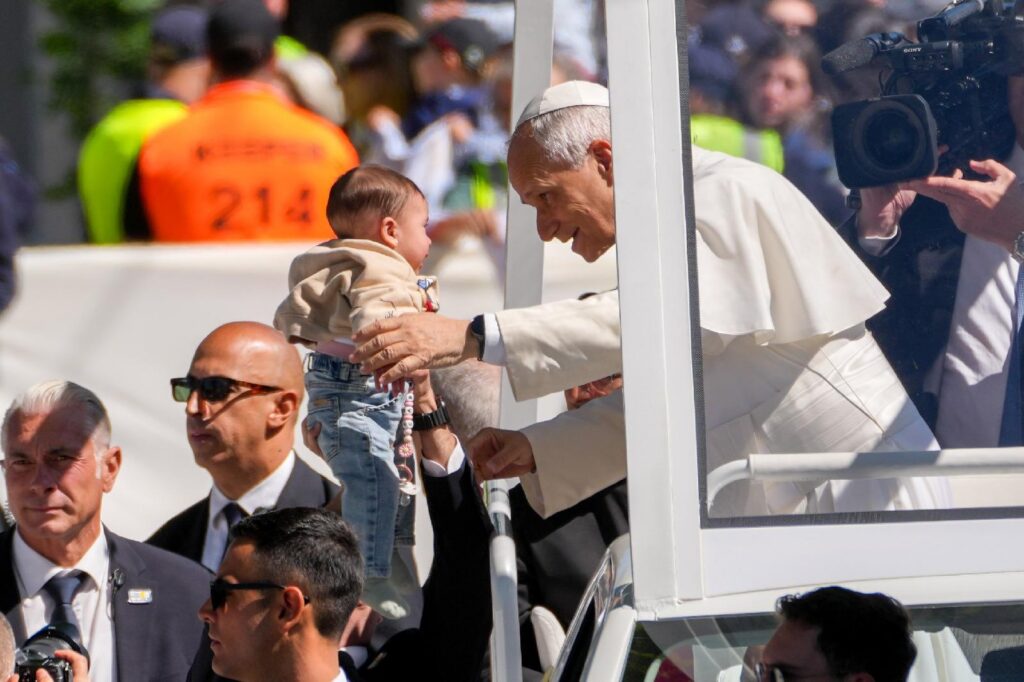
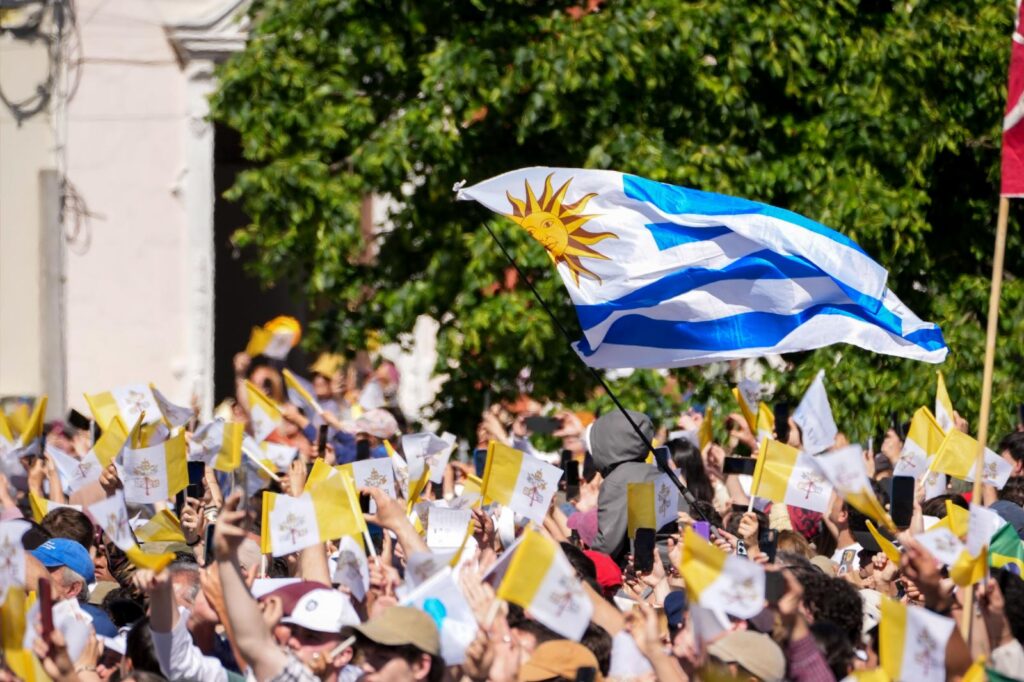
But the enthusiastic reception at the stadium stands in contrast to the rest of the pope’s time in Uruguay, where secularism has been a defining feature of national identity for more than a century and most of Pope Leo’s events were not brimming with attendees as in his recent trips to France, Spain and Africa.
Throughout his visit, Pope Leo addressed the Church’s declining influence in Uruguay, urging Catholics to find strength in their status as a religious minority and demonstrate the relevance of their faith through their lives, rather than their numbers.
Uruguay’s separation of church and state has roots in the late 19th century, when the government began reducing the Catholic Church’s influence over public institutions. The separation was formally established in a new constitution that took effect in 1918.
The country’s secular identity became so deeply embedded in public life that Christian holidays were renamed. Christmas officially became “Family Day,” while Holy Week became “Tourism Week.” Religious names of some towns and streets were changed, crucifixes were removed from public spaces and religious instruction was eliminated from public schools.
In more recent decades, Uruguay has also adopted legislation legalizing same-sex marriage, abortion and euthanasia, reflecting a society where Catholic moral teachings have limited influence over public policy.
Uruguay more ‘secularist’ than secular
For some within the Church, including Carriquiry Lecour, the country’s history of secularization has included what he described as “aggressive, anti-clerical attacks.”
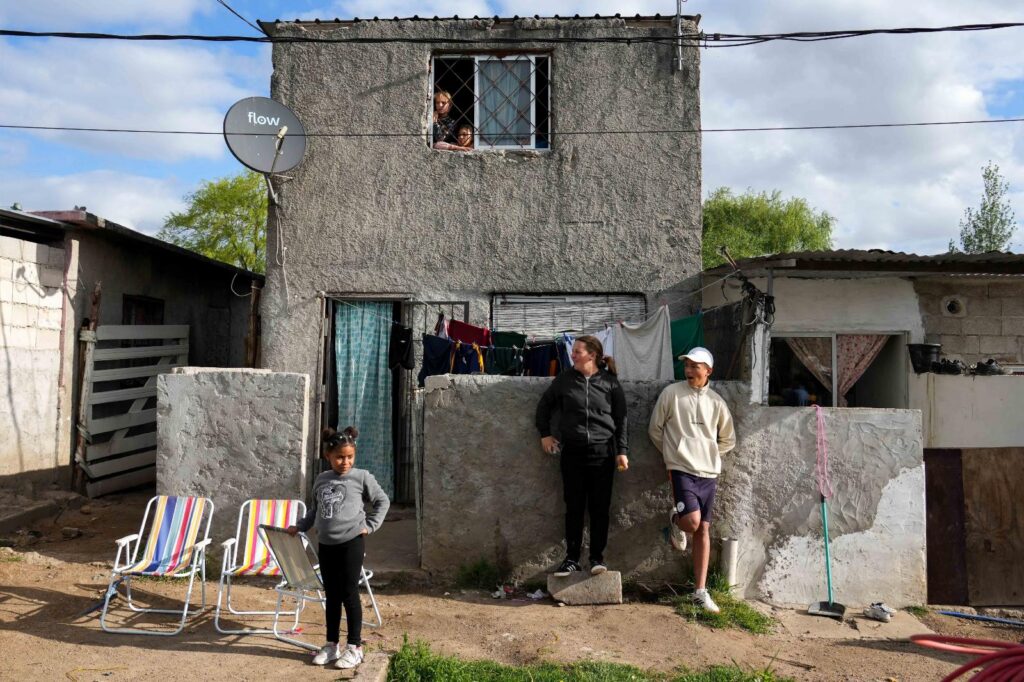
For Manuela Rodríguez, a Catholic who came to see the pope during his visit to Casavalle, where Papal Foundation funds helped support the construction of new homes, Uruguay’s secularism has gone beyond separating church and state.
“Uruguay isn’t just secular, it’s secularist,” she said Nov. 7 to Catholic News Service. “One thing is separation between the government and the Catholic Church, which is understandable and fine. But another thing is that many times we Catholics have to hide ourselves or conceal our crosses or our beliefs because we’re treated badly.”
She pointed to the legalization of abortion and euthanasia, saying Catholics who publicly oppose those measures can face insults and hostility.
“We’re strong because we resist attacks on Catholics, whether in our workplaces, at universities or everywhere,” she said.
Pope addresses religious freedom in secular society
But Gustavo Yuane, another Catholic who came to welcome the pope at the Parish of Our Lady of Guadalupe in Casavalle, had a different perspective.
“I think it’s good. It strengthens freedom and democracy in every sense. We must respect all religions,” he said Nov. 7 of Uruguay’s secular system.
Asked whether Yuane had ever felt persecuted or attacked for being Catholic in Uruguay, he responded: “No, not at all. Not in Uruguay.”
Pope Leo addressed the relationship between religious freedom and secular government during his Nov. 6 speech to Uruguayan authorities and the diplomatic corps.
Addressing Uruguayan President Yamandú Orsi, civil authorities and the diplomatic corps Nov. 6 at Independence Square, Pope Leo acknowledged the country’s secular traditions while emphasizing that religious freedom includes the right to practice faith publicly.
He said secularism has an “obligation to ensure that there is room for believers and non-believers to live together in freedom and respect.”
“This neutrality does not require that the religious dimension be confined to the private sphere,” the pope said.
Challenges for Uruguay Catholics
Quoting the Second Vatican Council’s teaching on freedom of conscience, the pope said religious liberty allows people of different beliefs to participate in society without compromising the independence of civil institutions.
“On the basis of this freedom, individuals and religious communities can contribute to the common good while respecting the autonomy of civil institutions,” he said.
But the challenge facing Uruguay’s Catholics extends beyond the separation of church and state.
During the celebration of vespers with bishops, priests, deacons and religious at Montevideo’s Metropolitan Cathedral Nov. 6, Pope Leo described a country “where many of our contemporaries barely know Jesus Christ and so many young people have grown up far from the life of the Church.”
He encouraged young people to consider religious vocations, noting that Uruguay’s inter-diocesan seminary received no new candidates in 2024.
The decline in vocations reflects broader changes in the country’s Catholic population.
Pope Leo encourages Catholics to live the Gospel publicly
In 1980, the country had approximately one priest for every 4,940 residents, compared with one for every 9,700 in 2024, according to Vatican statistics.
During the same period, the number of marriages celebrated in the Church fell from 8,673 to 1,649, while First Communions declined from 15,449 in 1990 to 4,087 in 2024.
Throughout his visit, Pope Leo repeatedly urged Catholics to respond to this decline not by withdrawing from society, but by living their faith in ways that encourage others to seek a relationship with God.
Celebrating Mass at París Londres Park in Paysandú Nov. 7, he called on the faithful to sow the seeds of the Gospel throughout their communities by educating children and young people in the faith, supporting the elderly and carrying out works of charity.
During a meeting with students, professors and staff at the Catholic University of Uruguay later that day, he said their mission was to “hear, see, taste, touch and smell the Good News,” becoming living witnesses to Christ through their actions.
The university had previously welcomed St. John Paul II, the last pope to visit Uruguay, in 1988.
Call for greater cooperation between Church and society
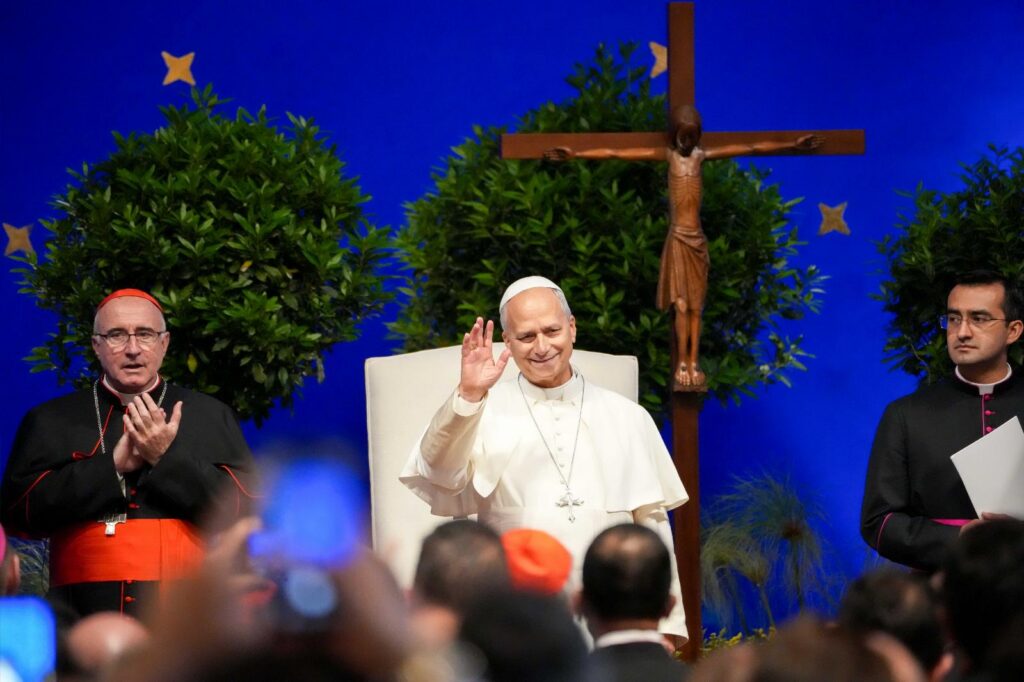
Pope Leo also emphasized that the Church’s contribution to Uruguayan society extends beyond its religious institutions.
Meeting with residents of the Casavalle neighborhood in Montevideo at the Parish of Our Lady of Guadalupe, he called for greater cooperation between the Church, civil society and the government to address poverty, insecurity and inequality.
“In a country as rich in resources as this, children should never have to go to bed hungry or be denied the chance of a decent education and a dignified future because of the insecurity that reigns in the streets,” he said Nov. 7.
“We must work together: the Church, civil society, and the state. We need to shake off our apathy and advocate for the common good,” he said.
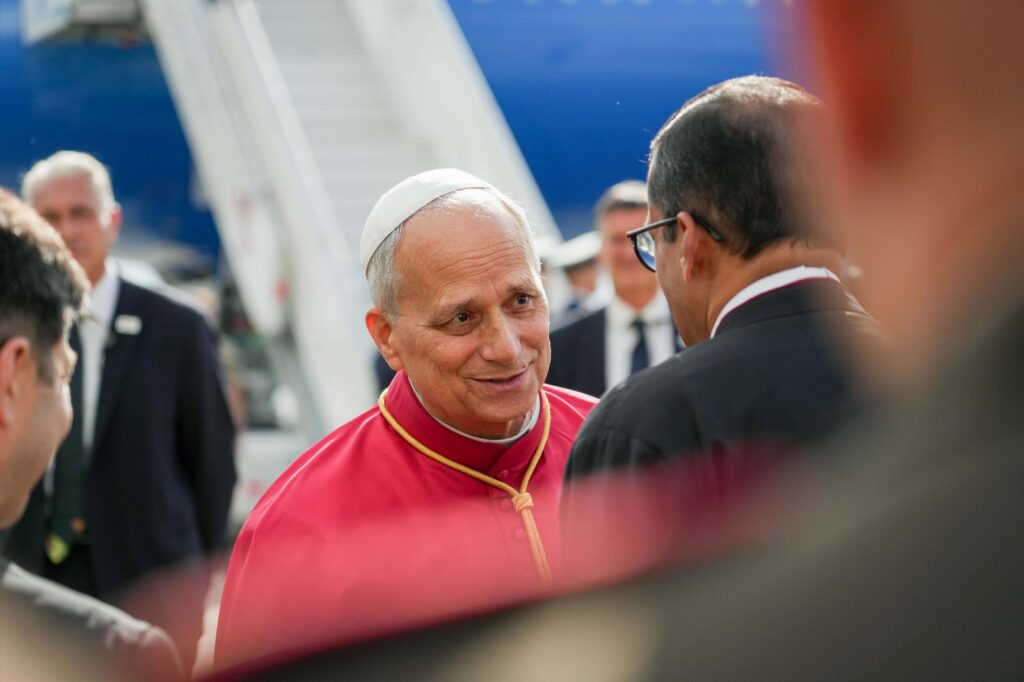
‘Feels like an awakening’ for many in Uruguay
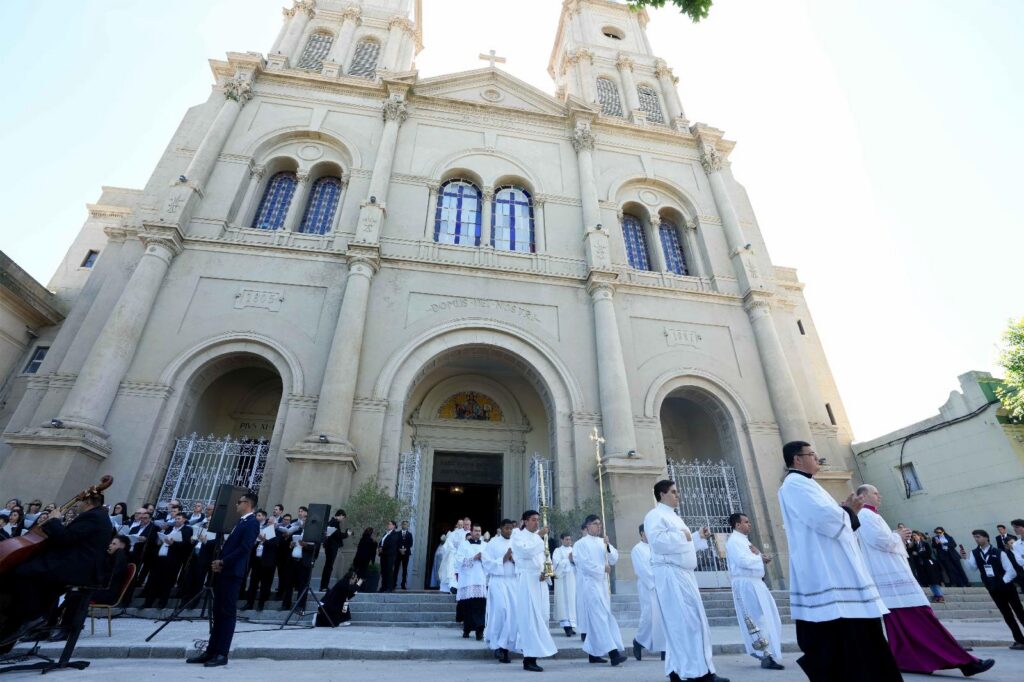
In Uruguay’s final papal Mass Nov. 8, hundreds queued with signs, flags and cups of mate — a hot tea made from the native yerba plant.
While speaking to CNS in the square of the Cathedral Basilica of Florida, Mariano Fontana got emotional about his faith, saying he converted after several family members passed away. Despite the country’s secular nature, Fontana said some had been waiting outside for the pope since 2 a.m.
“The fact that he’s here today, and that we’re all experiencing this, feels like an awakening for many of us. It’s something that will continue to draw us, maybe not necessarily to the Church itself, but at least toward faith and toward the Lord,” he said Nov. 8. “When the moment comes, even if, perhaps, we were atheists at some point, we all eventually turn toward faith.”
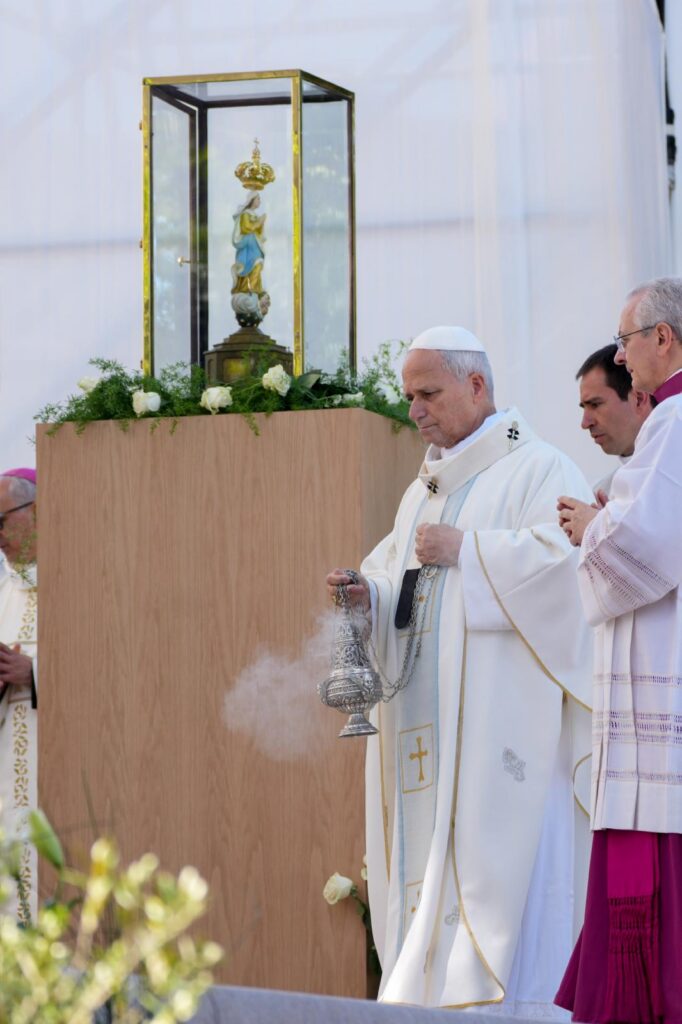
At a prayer vigil at Centenary Stadium Nov. 7, Pope Leo offered his clearest explanation of what it means for Catholics to live as a religious minority.
Drawing a parallel to Bethlehem, the small town where Christ was born in a manger, the pope cautioned Catholics against measuring the Church’s significance by its numbers or social influence, echoing a hallmark position of Pope Benedict XVI.
“God chose Bethlehem, and that choice alone is enough to prevent us from equating smallness with insignificance,” he said.
Pope Leo: Live in a way that awakens the desire for God in others
Pope Leo said that like in Bethlehem, where the inn was too full for Christ, society can sometimes see God as unnecessary.
“When we try to build a world without God, we run the risk of leaving humanity without a place as well,” he said. “If we want others to find Christ, we need to know the way to Bethlehem ourselves first.”
Even those who have not entered a church in years or are unsure whether they believe in God might be drawn to faith through the example of Christians, he said. To people who never would have opened a Bible on their own or set foot in a church, the pope said the faithful should live in a way that awakens the desire for God in them.
“To shed much light, we do not need to be many, but rather to reflect the Lord’s light,” he said.
For Yuane, the pope’s visit was important. He said the visit has given the people hope, peace and has renewed their faith.
“We are small in the region, and the fact that he chose us is a privilege, something we will be grateful for all our lives,” he said.
Josephine Peterson writes for Catholic News Service – Rome.
