


ST. CATHERINES ISLAND, Ga. (OSV News) — When a group of bishops, priests, Franciscans and other pilgrims traveled to St. Catherines Island in Georgia Oct. 29, they weren’t there to see the private island’s lemurs — although it does boast the only free-ranging population outside of Madagascar.
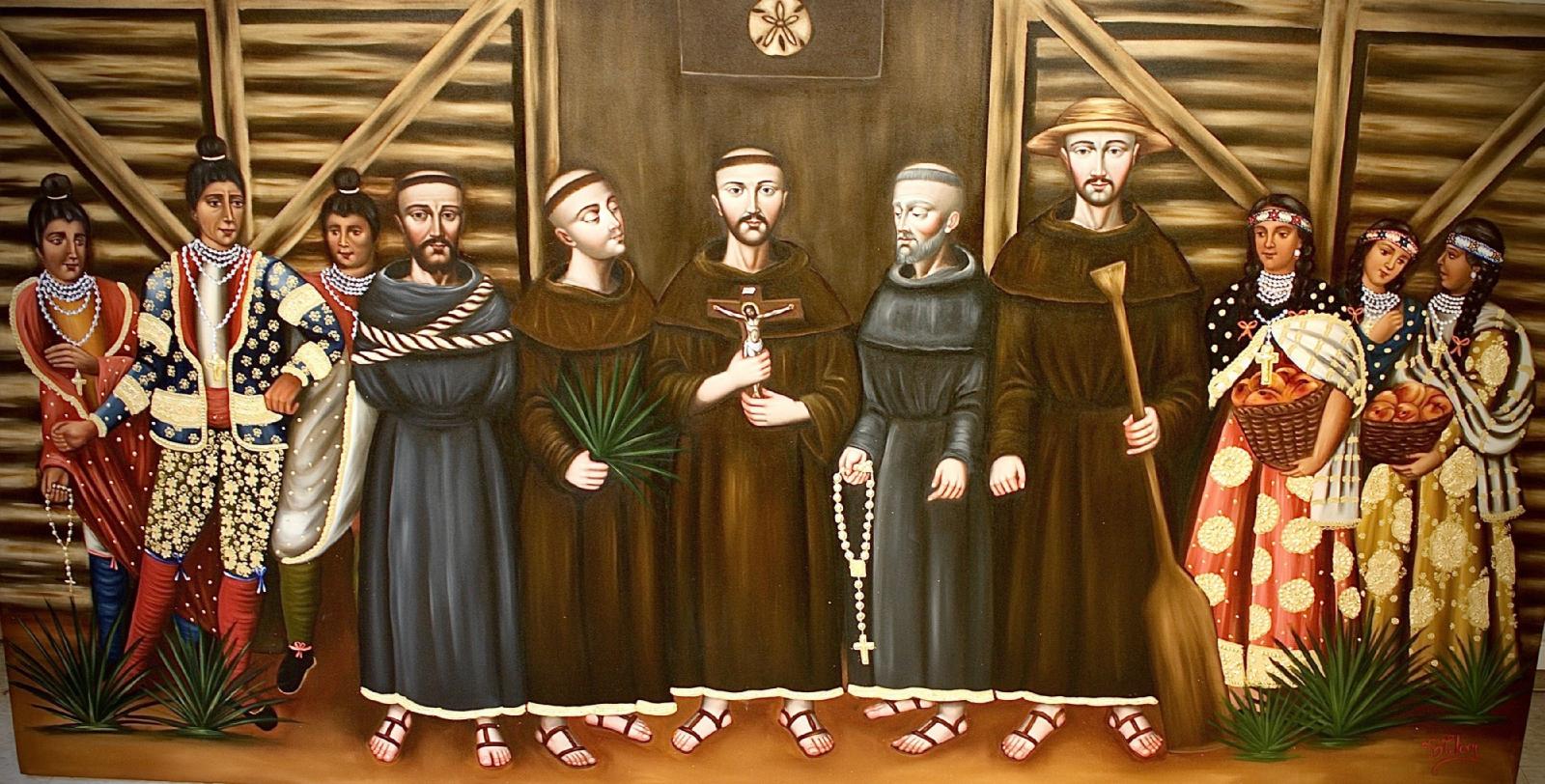
They took the long boat ride and journey along dirt roads because of the island’s unique link to Georgia’s Catholic history as the site where five Franciscan missionaries, who will be beatified Oct. 31, gave their lives for the faith over 400 years ago.
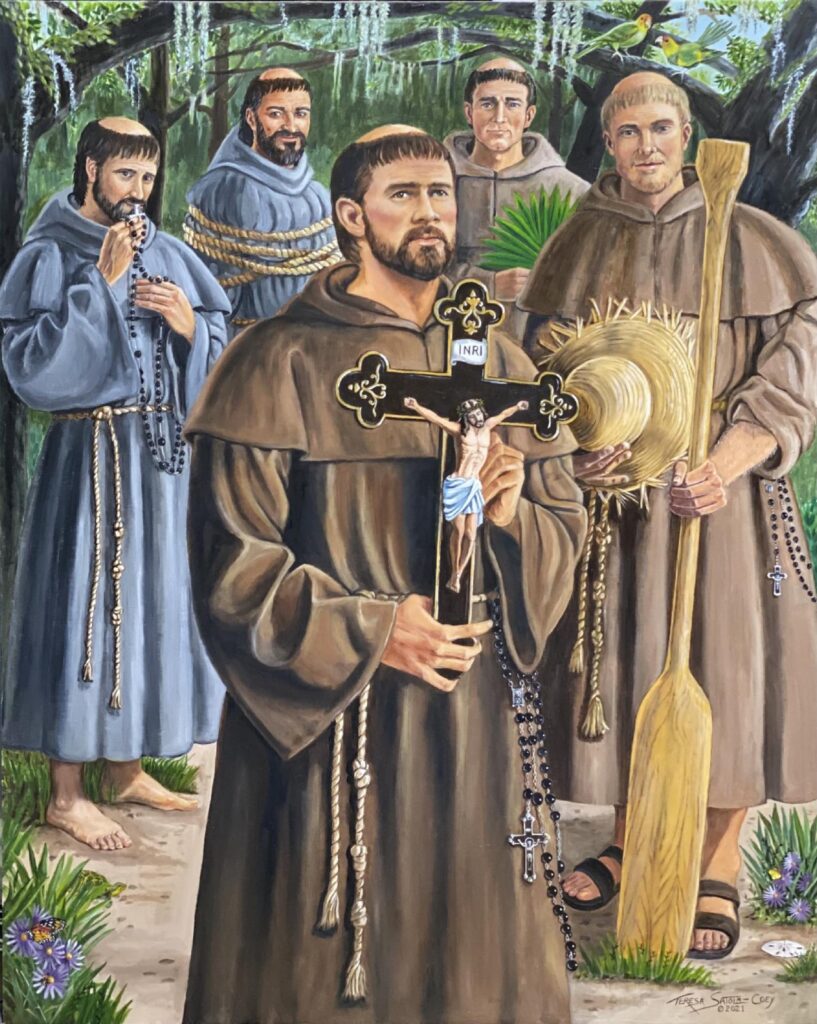
Friars Pedro de Corpa, Blas Rodríguez, Miguel de Añon, Antonio de Badajóz and Francisco de Veráscola, known together as the Georgia Martyrs, all came from Spain as missionaries to the Guale people in coastal Georgia, unaccompanied by soldiers, with Friars Antonio and Miguel serving on the Mission Santa Catalina de Guale, St. Catherines Island.
The friars were all killed within days of each other in 1597 by the order of the soon-to-be chief Juanillo after Father Pedro de Corpa stood by the Church’s teaching on marriage when Juanillo wanted to take a second wife.
After the Spanish left Santa Catalina for good in 1680, the mission on the island was lost for centuries until it was rediscovered in the 1980s by archaeologist David Hurst Thomas, senior curator in residence at the American Museum of Natural History in New York City.
Modern science helped rediscover lost mission of Georgia Martyrs
Spurred by the desire to find the lost mission after he was sent there by the museum to evaluate archaeological material on the island, he found it with the help of the then-innovative technique of proton magnetometry.
Thomas told OSV News during the visit to the island, that using the detection technique, they “found three hotspots in the mission area, and we narrowed it down by that point to a couple of football fields.” Luckily, their first three test pits turned out to be the mission’s well, kitchen and church.
Eventually, that discovery led to the discovery of the graves of Friars Antonio de Badajoz and Miguel de Añon. The late Franciscan Father Conrad Harkins, who was vice postulator for the cause of Georgia Martyrs before his death, heard that the mission church had been located and showed up to dig and find more information about the Georgia Martyrs.
“He turned out to be a great crew member,” Thomas recalled. “He ran marathons. He was in good shape. He was a good digger, and so we trained him on the archaeology, and he trained us on what Franciscans know.”
“As we were excavating around the exterior of the church, we came across these two pits that were clearly dug after the church had burned the first time,” he said.
Partnership between archaeologists and Church
This lined up with what was known about Friars Miguel and Antonio who were “martyred at the church, and then the whole place was burned and abandoned. So when the Spanish officials came up to investigate what had happened, they found the bodies and buried them right outside the church, and then, something like a year or two later, they sent a much more formal group up as they were starting to reestablish and thought they should be buried in the main church in St. Augustine, and so they were disinterred and taken down there.”
“That’s a very distinctive thing that archaeologists ought to be able to see, and we could, so Father Conrad recognized it right away too,” he said. “He worked with us on that, and that’s the only two known graves from Georgia Martyrs.”
Thomas values the unique relationship between archaeologists and the Church that developed in his work on the island.
“If it were not for the interest in the cause, then Father Conrad would not have come to join us in the early ’80s, and we would have missed out a lot on the Franciscan side of things,” he reflected, adding, “It established a relationship that is just remarkable to see how it’s affected so many people and so many lives.” He was struck by the thousands projected to be in attendance at the Oct. 31 beatification.
More than 400 Guale Catholics buried at martyrs’ mission
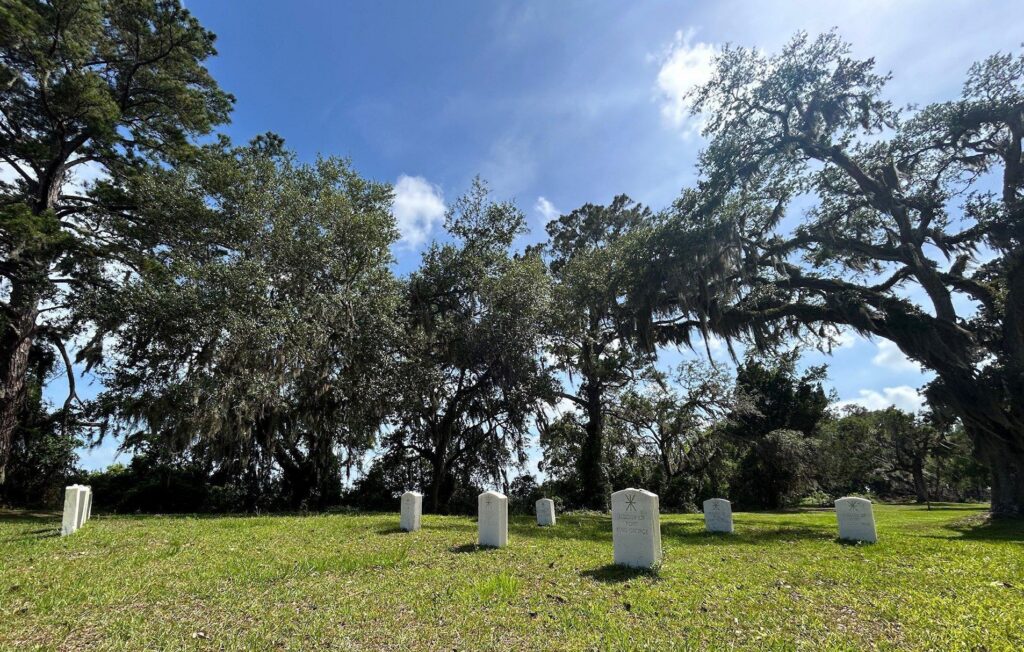
The remains of the mission church, where 432 Guale Catholics are buried, is marked by palm trees planted at every major support of the original structure, turning it into what Thomas called a “living church” where four bishops have now said Mass over the years.
Thanks to the discovery of the mission church, Bishop Stephen D. Parkes of Savannah, Georgia, was able to lead seven visiting bishops, including Bishop Erik T. Pohlmeier of St. Augustine, Florida, as well as Friar Gianni Califano, the postulator of the cause of the martyrs who traveled from Rome; 12th-generation collateral descendents of the martyr Friar Francisco who traveled to the diocese from Spain; and other pilgrims in a group of over 40 people who gathered for Mass on the island in the place where Friars Antonio and Miguel lost their lives just days before the Church confers the title of “blessed” on the martyred friars.
Friars Antonio and Miguel were killed on the island after celebrating Mass at the mission. They were warned of the impending attack, but chose to remain with the Guale people and spent their final hours in prayer.
For some of those gathered, the Mass on the location where two of the martyrs lost their lives was an inspiration and a challenge.
A ‘very sacred’ moment on ‘holy ground’
Franciscan Brother Henry Fulmer of the Province of Our Lady of Guadalupe said he found the Mass to be a moment of quiet and saw the location “as a place of holy ground” that was “very sacred,” especially because of its connection to that piece of history.
Francsican Brother Peter Boegel told OSV News it was “incredibly humbling to have Mass on the site where the two Franciscans were martyred and buried.”
He added that it was also humbling to think about how “they left their homeland, they traveled across the ocean back in those days and then they became one with the people, they learned the language, they learned the customs, they were living with the people and they brought them the faith.”
He said their sacrifices, and their ultimate sacrifice, made him consider the ease of his own life and how he should embrace a willingness to make sacrifices to “promote the kingdom of God.”
On Oct. 30, just ahead of the beatification, the Diocese of Savannah will also lead visiting bishops, Franciscans and pilgrims on a trip to Fort King George in Darien, Georgia, where Friar Francisco de Veráscola is believed to have served.
Lauretta Brown is culture editor for OSV News. Follow her on X @LaurettaBrown6.
