


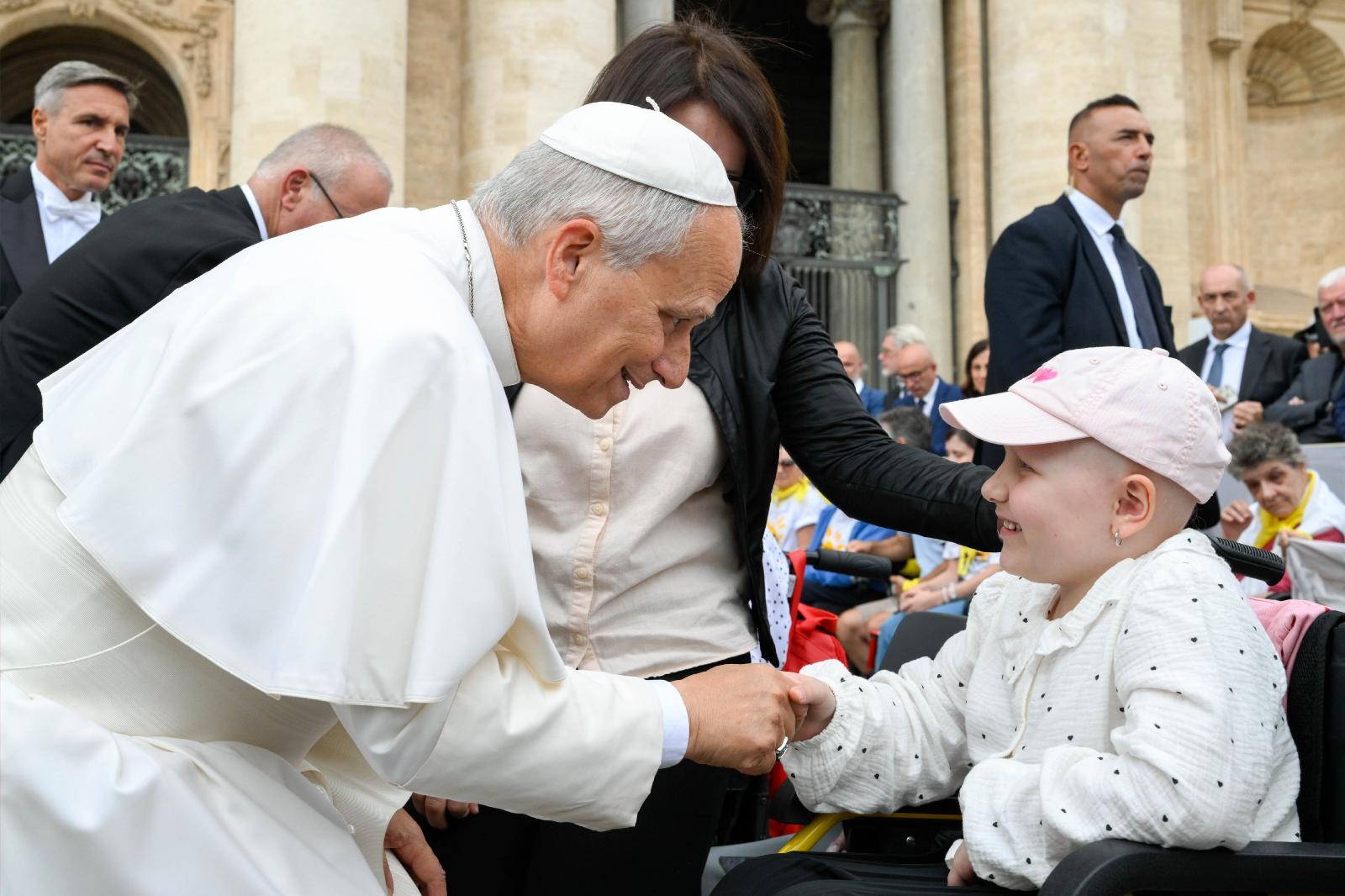
VATICAN CITY (CNS) — Christians “cannot accept the oppression of the weak and the poor, nor the unjust structures that perpetuate conditions of dependence and injustice,” Pope Leo XIV said at his weekly general audience.
By worshipping Christ, “the Righteous One who died for the unrighteous,” the faithful are called to work for justice, peace and fraternity, the pope said Oct. 7 in St. Peter’s Square.
“The Church, therefore, ‘has no fiercer desire than that in pursuit of the welfare of all she may be able to develop herself freely under any kind of government which grants recognition to the basic rights of person and family, to the demands of the common good,'” he said, quoting from the conciliar constitution, “Gaudium et Spes,” as he continued his series of talks on documents from the Second Vatican Council.
Sign of the Incarnation
Just as Christ was incarnated to reconcile the world with God, the Church exists within the world as a “sign of the incarnation of God, in order to manifest His plan to make us all His children in one great human family,” Pope Leo said.
Journeying through history alongside different peoples and cultures helps the Church understand more clearly the scope of its mission, he said. That mission begins with helping people “be attentive to the profound questions of life: those concerning our origin and our destiny, as well as those concerning the meaning of love and suffering.”
“The logic of profit at all costs and the manipulation of information risk exerting undue pressure on people to conform to a lifestyle centered on the consumption of material goods, but our hearts are made to look upwards,” Pope Leo said.
The Church’s mission also includes contributing to building the “earthly city,” he said, although its methods and aims are not primarily political. Rather, the Church bears witness to “faith and charity, together with commitment for justice, peace, and fraternity.”
Living the Gospel
To live the Gospel fully, Catholics must cooperate with the grace of the Holy Spirit so that their professed faith is reflected in their daily lives, the pope said, continuing his reflections on the constitution “Gaudium et Spes.”
The discrepancy between professed faith and daily life, the council wrote, “deserves to be counted among the more serious errors of our age.”
Living the faith in contemporary society also requires pastors, theologians and the faithful to discern what in modern cultures is worthy of consideration without “watering down” Christianity to make it more attractive, Pope Leo said.
“This requires a balanced mind, free from cultural trends, capable of viewing the world in a positive light whilst remaining steadfast in preserving and presenting the Gospel message in its entirety,” he said.
The Church is not “above” or “beside” the world, but rather “grafted into it,” Pope Leo said, and its ultimate purpose is that God’s kingdom may come and “the salvation of the whole human race may come to pass.”
“She strives towards this end above all through personal holiness and fraternal love,” he said.
