


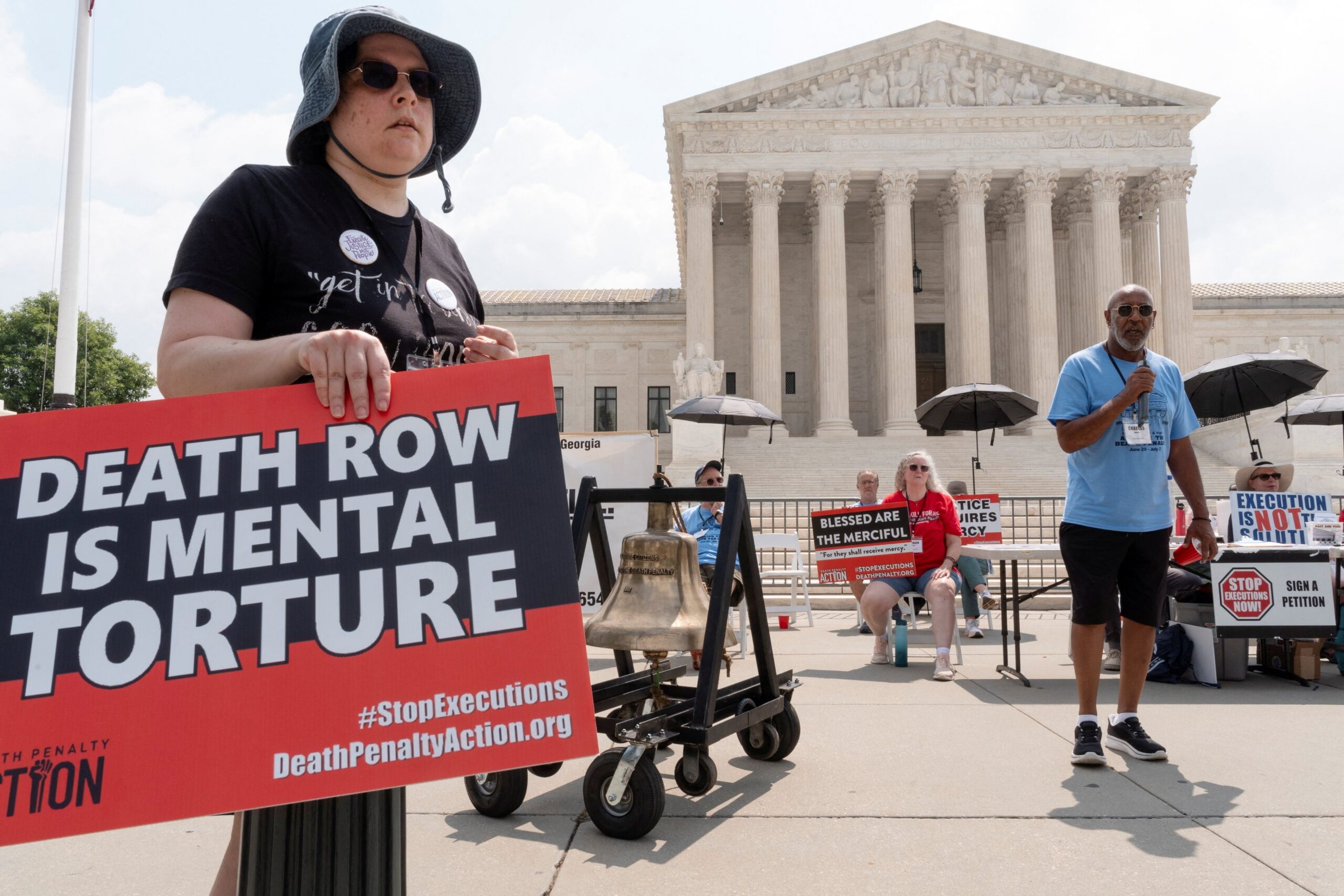
During Nebraska’s long struggle to end the death penalty, a weekly protest was held outside the governor’s mansion.
Norma was an elderly woman who had long opposed the death penalty. As she grew frail, she still went faithfully, rain or shine, to the corner where protestors gathered. No longer able to stand up for long periods, Norma protested from a chair.
When interviewed by local news, Norma humorously made a comment I’ll never forget: “I sit down for what I stand up for.”
Standing against the death penalty
October is pro-life month, and for Catholics, it’s time to stand up.
Polls show that a small majority of Americans, and even Catholics, support taking life in this way. We are one of only a handful of countries who engage in this barbaric practice. We join places like China and Iran, while European countries (with the exception of Russia and Belarus) and most democracies have long abolished execution.
I had already written this column when I awoke October 1 to the news that the execution of Christa Pike had been severely botched.
Pike, who had been abused sexually and physically from the age of two, and had been convicted of a murder she committed when she was only 18, was sent to the hospital after surviving two doses of a lethal injection drug in Tennessee. As I write this, we know little of her condition.
Isn’t it time to stop this brutal practice?
The truth is, we know today society can be kept safe from violent criminals without killing them.
Death penalty statistics
Twenty-three states do not have a death penalty. Some other states rarely use it. The U.S. carried out 47 executions in 2025, and 19 of them were in Florida.
America’s death penalty is often a racist system. One example: Today, although about half of all U.S. homicide victims are black, three-quarters of death sentences involve white victims.
According to the Death Penalty Information Center, since 1973, at least 203 people who were sentenced to death have been exonerated. This begs the question: How many innocent people have we put to death?
All recent popes have spoken out against the death penalty. The Catechism of the Catholic Church teaches that “the death penalty is inadmissible because it is an attack on the inviolability and dignity of the person.”
One hopeful sign is that polls show younger Americans are increasingly opposing execution. Fewer juries are recommending death. The tide is turning.
As Catholics, we care about all life, from the unborn child to those struggling from famine and war. But why, you ask, should I care about a person convicted of a heinous crime?
Forgiveness and justice
For me, the short answer is that God cares. Jesus told us to forgive not just seven times, but 77 times. Jesus held up the prodigal’s father as an image of God. This does not mean we don’t imprison criminals and that we don’t support the families who have been impacted by horrific crimes. But killing to prove killing is wrong makes no sense.
Consider the recent execution of Jeffrey Lee in Alabama. Mr. Lee, a Black man, spent 25 years on death row, even though the jury that convicted him recommended life imprisonment without parole. A law in effect at that time gave the judge the ability to impose his own sentence.
Questions hung over the trial. The prosecutor used all his 21 peremptory strikes to eliminate Black jurors. The court-appointed defense counsel had never worked a capital case and did little to prepare.
Meanwhile, what of Mr. Lee? Over the years, he became a Christian, a Kairos ministry leader, an assistant chaplain and a mentor to fellow inmates.
Isn’t this what we want from a prison system: not to be a place of vengeance, but of restorative justice? If we as Catholics don’t hold open the possibility of transformation, what good is our faith?
The Catholic Mobilizing Network works to educate on justice issues and will send alerts about upcoming executions so that we can take action.
Sometimes, when I sit writing yet another plea for a commutation of death, I think of Norma. I’m sitting here, Norma, I’m sitting here standing up for what I believe in.
Effie Caldarola is a wife, mom and grandmother who received her master’s degree in pastoral studies from Seattle University.
