


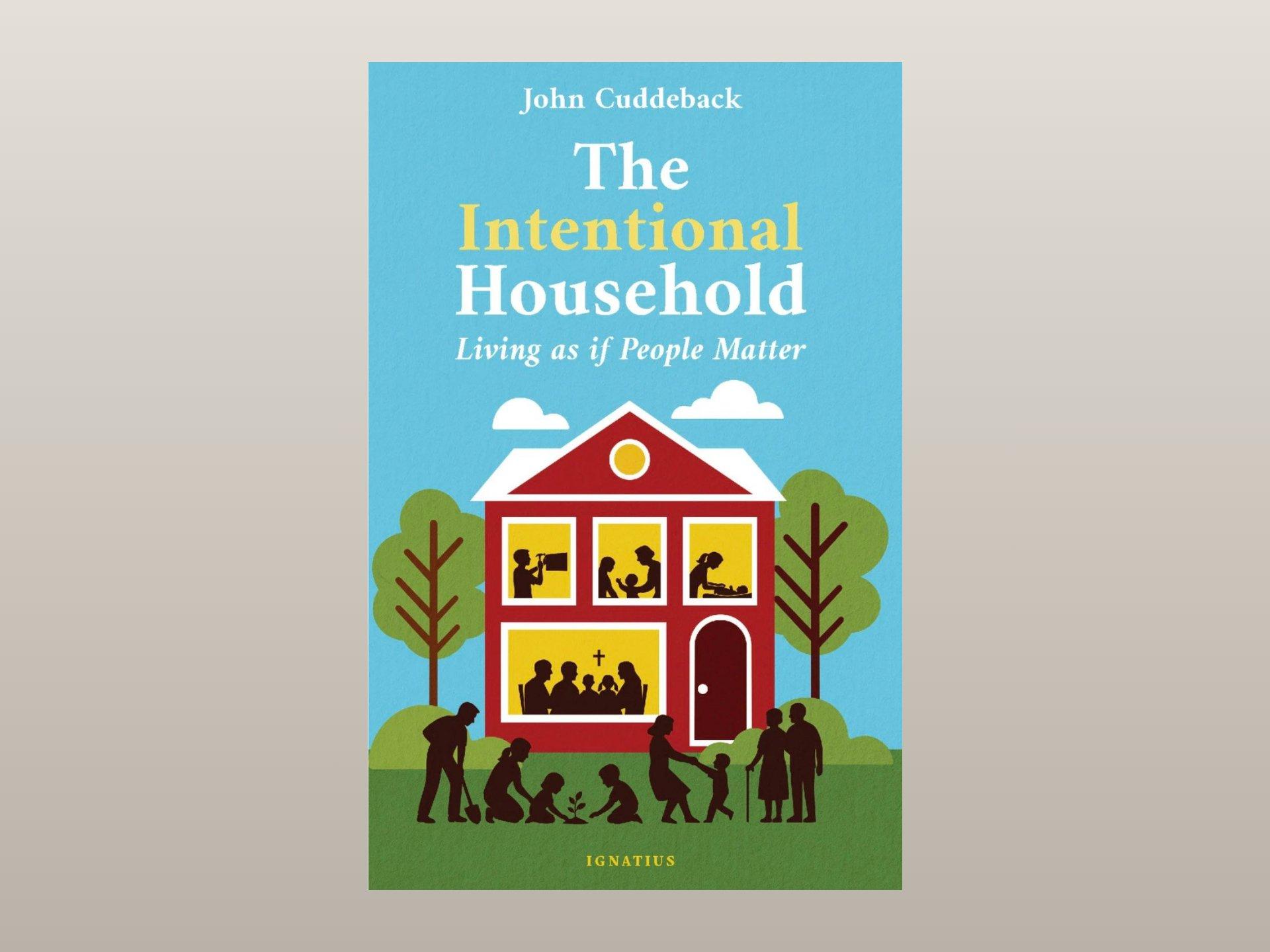
(OSV News) — A new book promises to help readers craft better lives by reclaiming the household as the center of daily life.
“We’ve greatly reduced how much of life itself goes on there,” John Cuddeback, the Catholic author of “The Intentional Household: Living as if People Matter” and a professor of philosophy at Christendom College in Virginia, said of the home. “To see that is to begin to understand we have abandoned the place that by God’s design should be more the center of life.”
Cuddeback’s latest book, published in April by Ignatius Press, presents eight principles for reclaiming the household as a place where people and relationships flourish by sharing work, practicing leisure and embracing family.
In the nearly 170-page book, he approaches marriage, children, elderly parents and even technology in light of the household, while sharing from his own personal life.
Along the way, he draws from ancient and modern thinkers — including Aristotle, St. Thomas Aquinas and Wendell Berry — and presents them in an accessible way.
An intentional home life
While speaking with OSV News, Cuddeback defined the intentional household as “one in which those responsible have a clear understanding of the rich life they are trying to craft and are willing to do what is needed in order best to bring it about.”
To help people to pursue this way of life, he provides practical framing and questions for readers to ask themselves in order to discern an intentional household. He addresses people of all walks of life, including those who are single, married, divorced and separated. He acknowledges those with and without children, as well as single parents, widowers, empty nesters and grandparents. He writes not only for people who want to create intentional households but also for people who have not realized that desire.
“I wanted to write the book in such a way that it would appeal to the hearts of everyone — to speak to something very deep in them that often is not spoken to so much anymore,” he said. “To kind of connect with that deep interior voice that God has put in all of us, that longing for home.”
Cuddeback brings a wealth of knowledge and experience to his new book. It complements his podcast of the same name, which he co-hosts with his wife, Sofia. He also runs LifeCraft, a community project that explores the household, true friendship, good work and natural stewardship.
An inspiration
Cuddeback said two main things inspired his book. He first pointed to today’s difficulties in living out God’s plan for family and household.
“There are many challenges, particularly in the way that many common customs, influences, common ways of thinking, practices in our culture (and) in our society push us away from the home — push us away from the ordinary traditional ways of living in the home,” he said. “It certainly is one of the most challenging times for families simply to live according to God’s plan in the home.”
At the same time, he noticed a renewal in people who want to pursue God’s plan. These people recognize today’s challenges and are searching for something more: a rich and fulfilling life in the home.
“It’s those two things together that made me realize that this book is very much needed today to address that need: to give direction, to give encouragement, to give inspiration, especially by giving principles,” he said.
The need for one another
Multiple principles address the relationship of children and the aging to the household. Throughout his book, Cuddeback emphasizes that caring for elderly parents and children is essential to being human.
“It’s rooted in who God is, and that God is Trinity and that life is living in relationship,” he said of the Father, Son and Holy Spirit.
He recognized the relationships of parents to children and of parents to aging parents as “kind of the primordial human relationships.” One of the most beautiful ways God brings people together is by their needs, he added.
“It’s part of this plan where we just say, ‘Thank you, Lord, for giving us children who need us and giving us the aging who need us as a natural prompt to recognize life is about loving and being loved.'”
Technology use
Another principle focuses on channeling “technology to the real good of the household.” His book complements Pope Leo XIV’s new encyclical on safeguarding the human person in the time of artificial intelligence by encouraging people to ask whether particular technologies serve people where they live.
People’s use of technology should be intentional, Cuddeback told OSV News.
“We have to have a clear understanding of the kind of life that we want to protect, that we want to cultivate, that we want to build, that we want to craft in our home,” he said. “Keeping that firmly in mind, we ask the very important question: Does this technology, do these technologies, serve that well or not?”
Advice for today
Cuddeback shared his advice for families who want to do one thing today to start living better in their homes.
“Rethink how they do meals and prioritize it,” Cuddeback recommended. “Reprioritize dinner, everyone being there — that already is in itself something huge.”
He also shared how he hopes his book helps people build more intentional households in today’s world.
“I hope that it gives people a sense that rediscovering what should be ordinary and what can be ordinary again will make all the difference,” he said. “That living according to ordinary human ways of living in the home is actually extraordinarily beautiful, extraordinarily powerful.”
Because of this, he said, he shares in his book examples such as porch time, working together in the yard or reading stories aloud.
“These things were once ordinary,” he said. “They should be ordinary, and they are in our power.”
Katie Yoder is an OSV News correspondent. She writes from Maryland.
