


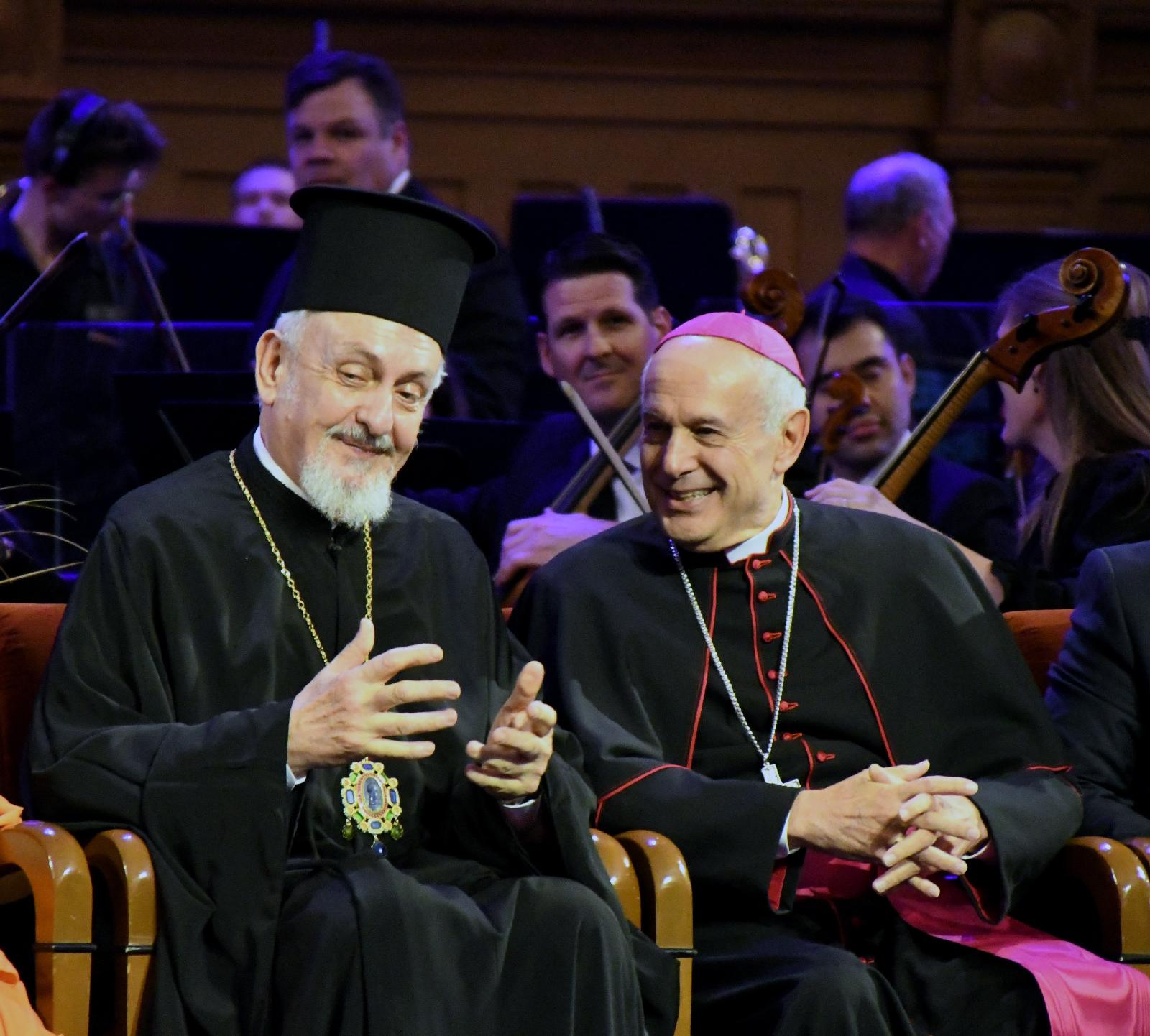
Marie Mischel / Intermountain Catholic
SALT LAKE CITY (OSV News) — “Resilient Hope, Shared Future,” the theme of the G20 Interfaith Forum in Salt Lake City, “raises a question which is becoming more urgent for all of us: What kind of human future are we building together?” the papal nuncio to the United States asked Oct. 15.
When the leaders of the G20 meet in Miami in December, “among the principal questions before them will be economic growth, energy security and the rapid development of new technologies, especially artificial intelligence,” Archbishop Gabriele G. Caccia said.
Although these may appear to be very different subjects, they are related by one fundamental question: “Whether the progress we seek will truly serve the human person,” the archbishop said, addressing what was the largest faith gathering ever held in Utah.
The Oct. 15-17 forum opened with a ceremony at the Salt Lake City Tabernacle, with President Dallin H. Oaks of The Church of Jesus Christ of Latter-day Saints and Archbishop Caccia among the speakers.
The G20 Interfaith Forum, or IF20, “unites scholars, faith leaders, and policymakers to turn faith-informed insights and lived experience into real solutions for today’s most urgent global challenges,” according to its website.
4 primary themes for forum sessions
Forum sessions addressed four primary themes: economic growth for the common good; energy security for a sustainable future; AI and the human future; and interfaith engagement and the United Nations’ sustainable development.
IF20 “represents an important opportunity to ensure that faith perspectives contribute meaningfully to global policy discussions,” Imam Mohamed Magid said in a welcoming message to the forum. He is the executive imam of the Virginia-based ADAMS Center, co-president of Religions for Peace and a member of the IF20 Advisory Council.
The G20, which addresses issues such as global growth and economics, is composed of 19 individual countries as well as the European Union and the African Union, bringing the total number of members to 21.
The IF20 operates in parallel to the G20, linking religious institutions, leaders and scholars directly to the formal G20 process.
In his address, Archbishop Cacia referenced Pope Leo XIV‘s encyclical, “Magnifica Humanitas,” saying that at the center of it is the question of whether the progress “we seek will truly serve the human person.”
Each generation must be open to ‘more fraternal future’
In the document, he said, the pope “reminds us that each generation bears responsibility for shaping … in its time in a very way which is worthy of the human person and open to a more fraternal future. This becomes especially important in the age of artificial intelligence.”
“The Holy Father warns us against imagining that everything, even the mystery of the person, can be reduced to data and performance,” he explained.
Technology offers extraordinary possibilities, Archbishop Caccia continued, “but innovation alone does not tell us what is good. We still need the kind of judgment that asks whom progress is serving and whether it is serving them well, and perhaps this is where religious communities have something particular to offer.”
Those attending the conference came “because our tradition keeps alive the deeper question of what it means to recognize every person as our neighbor and to shape our common life accordingly,” he said. “Authentic interreligious dialogue does not ask us to become less rooted in our own faith. On the contrary, if we know who we are and what we believe, we can meet others more honestly.”
Archbishop Caccia closed his remarks by reading a greeting to those attending the IF20 from Pope Leo, who as of Oct. 16 remained hospitalized recovering from surgery Oct. 13. The pope’s message to the gathering was sent by Cardinal Pietro Parolin, Vatican secretary of state.
‘Shining example of the solidarity of the human family’
“As you discuss the theme ‘Resilient Hope, Shared Future,’ His Holiness prays that your fraternal gathering may be a shining example of the solidarity of the human family,” the message said in part, “and thus promote a deeper commitment among nations to the universal principles of human dignity, religious freedom and common good.”
“In a particular way,” it said, “Pope Leo XIV prays that your deliberation, conducted with gentleness and respect, may inspire believers to find ever more compelling answers to those who ask a reason for our hope, and so help more people to draw closer with confidence to the Creator.”
Ahead of Archbishop Caccia, Sheikh Mohammed bin Abdulkarim al-Issa, secretary general of the Muslim World League, spoke on the theme of hope, “the decision taken by people of living consciousness and hard work for a better tomorrow,” he said.
“Every religion represented by its followers in this hall carries this decision and its teachings,” he said. “In Islam, despair of God’s mercy is considered a departure from the domain of faith.”
Hope is a faith-based beauty and sustainable endeavor, the sheikh said, adding that natural differences “should not be a threat, nor an incitement to clash and conflict. Rather, it’s a part of the diversity that God intended for humanity through his universal predestined wisdom.”
Impact ‘religious diplomacy’ can have on world
“Religious diplomacy” will have a beautiful impact, he said, although that “will not be achieved except through sincerity, devotion, solidarity, sustainable, sustainable work, and the analysis and measure of results.”
It would be wonderful if these efforts helped form “a generation that enjoys its shared human values, acts from a firm faith in them, and deals with them spontaneously,” he added.
Oaks, who followed Archbishop Caccia on the podium, expressed his support “for the praiseworthy goals that bring such a distinguished group together.”
He noted that “faith-inspired insights and initiatives can contribute to a meaningful and scalable worldwide solution,” and added that the IF20’s “approach is broader than what individual religious perspectives are already doing to address humanity’s deepest needs. Your approach — apolitical, nondenominational and nonpartisan — is the effective way to address concerns for human dignity and care for the world’s most vulnerable.”
At the core of peacemaking is “a desire to understand and help one another without demanding a compromise of distinctive commitments,” Oaks said, adding, “We want to be part of your efforts, and invoke the Lord’s blessings on all of us as we go forward.”
The opening ceremony for the IF20 included entertainment provided by the Tabernacle Choir and Orchestra at Temple Square. Among those attending were Father John Evans, vicar general of the Diocese of Salt Lake City, who was representing Bishop Oscar A. Solis.
Other clergy of the diocese also attended, including Father Christopher Gray, rector of the Cathedral of the Madeleine, host of the IF20’s closing ceremony Oct. 17.
Marie Mischel is editor of the Intermountain Catholic, the news outlet for the Diocese of Salt Lake City. This story was originally published by the Intermountain Catholic and is distributed in partnership with OSV News.
