


How does one go from serving time in prison to a closer relationship with God? Robert Ehnow, director for the Office for Life, Peace and Justice for the Roman Catholic Diocese of San Diego, is uniquely poised to answer that question, as he went from prison to being ordained a deacon in 2025 and working in prison ministry. He recently spoke to OSV News’ Charles Camosy about that journey and what Catholics should know about the prison system.
Camosy: Can I ask a bit about your story and how it led you to write a book titled “All Things New: a Journey from Brokenness to Restoration?”
Ehnow: My story really begins after I retired from the Marine Corps in 2008; I had a successful 20-year career as a Marine Corps Officer. My wife and I purchased a business when I retired from the Corps, and the business did very well for three years.
I was making more money than I could imagine, and my focus was to make even more money. I guess you could say that my moral compass was not pointing true north at this time in my life.
In January 2011, my home and business were raided by 25 federal agents, and I was informed that I was a target of a federal investigation.
In an instant, my life completely changed. In the next decade, I endured an indictment, federal trial, incarceration, corporate bankruptcy, personal bankruptcy and multiple civil lawsuits. The “valley” that my wife and I were living in at this time, was remarkably the time when God was calling us to not only move closer to him, but to equip us with the capacity to serve him and his Church. Both Colette and I were “broken” and humiliated, and through God’s graces we were able to move beyond our own suffering and pain to become something new, hence the title of the book, “All Things New.”
When I started working for the Diocese of San Diego in 2018, I began to tell my story of my own experience with the criminal and civil legal systems. Many listeners encouraged me to consider writing a book, but I was not ready because my story was not yet complete. Colette and I did not leave our “valley” until 2020, and then the COVID pandemic provided a different kind of “valley” for all humanity.
It was during this COVID period that God called me to consider becoming a deacon in the Church, and I entered diaconate formation in the summer of 2020. The formation process to become a deacon is five years, and if the truth be told, I had very serious doubts about my worthiness and my commitment to become a deacon. It was my Colette, my pastor and others that encouraged me to take one year at a time.
When I was ordained in May 2025, my story from brokenness to restoration was complete, and it was the time I was also completing the draft for “All Things New.” It was not my timing, but God’s timing that enabled me to complete the book after my ordination.
Camosy: I’m going to speak with you about your story and book on an Aug. 10 webinar, which is also the feast of St. Maximilian Kolbe. What does his story have to do with your story?
Ehnow: When I was in prison, I watched a documentary about St. Maximilian Kolbe. I watched his story unfold and discovered that he was the patron saint of prisoners. I began to ask for his intercession and I asked him to help guide me toward a better relationship with God.
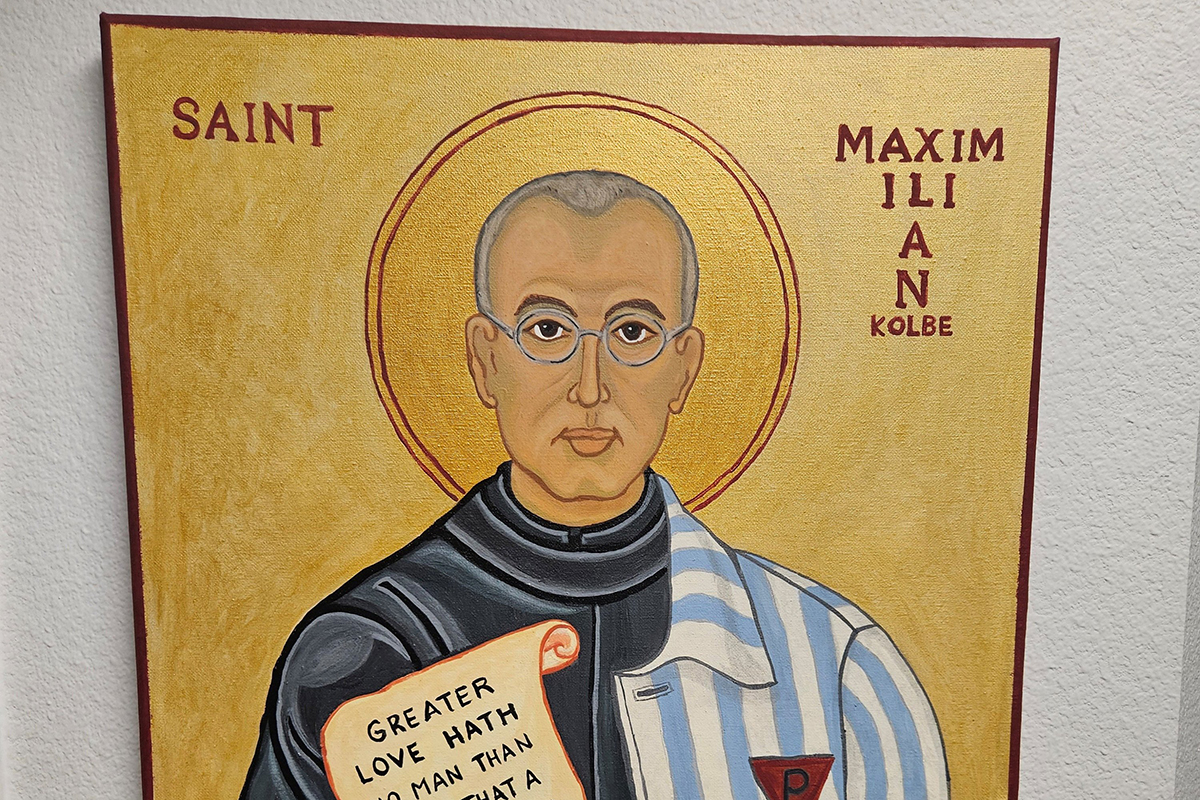
I was released from prison in 2015 and I lost touch with St. Kolbe in my prayer life for a couple of years when I returned to graduate school to complete my doctoral studies. In July 2018, I began working at the diocese leading the diocesan jail and prison ministry. The following month, August, one of my colleagues gifted me an icon of St. Maximilian Kolbe to inspire my work in the jails and the prisons.
The icon of Father Kolbe still hangs in the entranceway to my office; he is a reminder of the sacredness of our work and the sacrifice that he made so another could live. Father Kolbe is a modern saint that voluntarily gave up his own life for another — a Christ-like example of unconditional life. As I began to grow the ministry at the diocese, I returned to asking Father Kolbe to guide me and intercede to the Lord for the success of our ministry.
In Chapter 2 of “All Things New,” I write about St. Kolbe’s own story and then how his story and other saints provided guidance and inspiration for me during incarceration and later in the work I do on behalf of the incarcerated people of God in the diocese.
Camosy: What are some ways in which the ideas with which you are concerned show up in our own time?
Ehnow: Prison is not a place that anyone wants to be, but it is also a place with abundant opportunities for growth, particularly spiritual growth. My Catholic faith not only endured, but grew exponentially when I was in prison.
I read voraciously while “locked-up” and the reading led to much thinking about issues that concerned me, particularly justice. I broke the law, and I was held accountable for my own wrongdoing. The process that I went through “in the system”, in my opinion, was not focused on justice as much as it was focused on punishment and retribution.
In my own experience in “the system’ and in my post-incarceration research, I discovered that our system of justice is rarely aligned with our values as citizens and Christians. Jesus is justice perfected. God’s justice is not solely focused on punishment. Accountability and punishment are elements of justice, but those elements are supposed to be sanctions that lead to restoration.
God’s justice is focused on the restoration of relationships and a reparation of the harm done. God perfects justice through love, mercy and forgiveness. I think we should strive to move our own system of justice toward God’s model where mercy and forgiveness lead to an opportunity for true reconciliation and restoration.
Camosy: As with many issues, these ones seem so big and entrenched that it may be difficult to know where to begin to try to effect change. How might individuals who are moved by your story and advocacy here think about responding in their own lives?
Ehnow: “All Things New” is meant to change hearts. We all make mistakes and we all fall short of God’s ideal for us. Yet, God loves us despite our mistakes and sins. Too often, we condemn others and we do not seem to care if there is a path to forgiveness and restoration. As Catholics, we live in the world, but we are not of this world.
Justice for us, ideally, should be aligned with God’s justice, where accountability and punishment may be necessary, but mercy, forgiveness and restoration are the desired end states.
I think for all of us that think or are concerned about justice, that it starts with a “change of heart” and a reorientation towards God’s justice. Once we are aligned with an understanding of justice as God intends, then we can start the process of advocating for justice and educating others about justice.
Charles Camosy teaches moral theology and bioethics at The Catholic University of America in Washington.
