


(OSV News) — In his new encyclical on artificial intelligence, Pope Leo XIV took aim at the normalization of war, made more dangerous by a digital revolution that is “changing the nature of conflict” and blurring “the fine line between protection and aggression.”
The pope described the just war theory as “outdated” and — except for cases of “self-defense in the strictest sense” — said it has “all too often been used to justify any kind of war.” With AI expanding the capabilities of weapons systems, Pope Leo called for “the most rigorous ethical constraints” on the use of AI in warfare, as weaponry itself evolves with deadly efficiency.
Above all, Pope Leo urged a renewed commitment to St. Paul VI’s vision to build a “civilization of love.” He said “war is never inevitable” and said all can contribute to bringing about “the true peace born of justice,” nurtured in the theological virtue of hope.
The highly anticipated “Magnifica Humanitas,” signed by the pope on May 15 and released May 25, invoked the wisdom of the Church’s social teaching — which articulates the means of building a just society and living out holiness in modern life — as a framework for shaping AI amid rapid technological advances, a fractured global order, and accelerating threats to human life and dignity.
In the document, subtitled “On Safeguarding the Human Person in the Time of Artificial Intelligence,” Pope Leo situated the rapid development of AI within the current global geopolitical landscape.
AI has emerged as one key factor among many — such as developments in warfare, armaments, information access, markets, and social and global relations — driving the erosion of the postwar international order and the expansion of conflict, the pope said.
A ‘culture of power’ versus a ‘civilization of love’
In the encyclical’s fifth chapter, which discusses AI and war, Pope Leo begins by contrasting the “culture of power” with the “civilization of love,” the latter of which was coined by St. Paul VI in a 1970 Regina Caeli address during Pentecost.
The two terms respectively correspond with the document’s central biblical images: the construction of the Tower of Babel, symbolizing arrogance and pride, and the rebuilding of Jerusalem under Nehemiah after the Babylonian exile, which represents collaborative, God-centered efforts.
Alongside the culture of power — marked by “polarization and violence,” as well as the drive for supremacy — “a great part of humanity” also strives to build “the holy city of coexistence and peace,” said the pope.
Yet the culture of power is “taking hold,” with humanity’s common good “relegated to the background,” and “the concrete tragedy of peoples at war” is subordinated to the consideration of “strategic interests,” Pope Leo said.
The effects are intensified as “digital networks, the globalized economy and the development of AI create increasingly tighter bonds,” observed Pope Leo, noting that “decisions made in one place” are linked “in real time” to “the effects they produce elsewhere.”
The culture of power works to normalize war and expand military power, he said, while “fueling a false realism that insists that there is no alternative.”
Despite the international rules-based order agreed upon following World War II, the past 60 years have been marred by “conflicts of astonishing brutality” that have impacted civilians “on a massive scale,” Pope Leo said.
A ‘real paradigm shift’ to war revival
He identified “a real paradigm shift” that has led to a “troubling revival of war as an instrument of international politics,” all while the ethical principles that had constrained war “are being eroded.”
That revival has been compounded by “a disconcerting loss of historical memory.” As the first-hand accounts of survivors of the First and Second World Wars and the Holocaust, or Shoah — the systematic persecution and murder of six million Jews under the Nazi regime and its collaborators — “are disappearing,” Pope Leo said the lessons of war are being forgotten, obscured by “a “selective or distorted rewriting of the past.”
The pope pointed as well to the influence of digitally revamped, “fragmented information environments,” in which “algorithms that reward conflict” work to make war “culturally conditioned.”
“When historical memory fades and the ethical principles that protect civilians and the most vulnerable are weakened, it becomes easier to justify violence as necessary, inevitable or even ‘sanitized,'” he said. “It is in this context that humanity is slipping into a violent culture of power, where peace no longer appears as a responsibility to be taken on, but as a fragile interval between conflicts.”
Just war theory ‘outdated’
As a result, he said, “Today, more than ever, without prejudice to the right to self-defense in the strictest sense, it is important to reaffirm that the ‘just war’ theory, which has all too often been used to justify any kind of war, is now outdated.”
The Catechism of the Catholic Church stipulates that legitimate defense by military force is only morally permissible under strict conditions that are all present at one and the same time: the “lasting, grave and certain” damage from the aggressor, the exhaustion of all other means to end such damage, “serious prospects of success,” and the use of arms such that graver evils and disorders are not produced.
In an accompanying footnote to his statement on just war theory, Pope Leo quoted Pope Francis’ 2020 encyclical “Fratelli Tutti,” in which the late pope both noted that in recent decades “every single war has been ostensibly ‘justified'” and warned against falling into “an overly broad interpretation of this potential right. In this way, some would also wrongly justify even ‘preventive’ attacks or acts of war that can hardly avoid entailing ‘evils and disorders graver than the evil to be eliminated.'”
Noting modern war’s “disastrous consequences for civilian populations,” Pope Leo said, “Humanity possesses far more effective and capable tools for promoting human life and resolving conflicts, such as dialogue, diplomacy and forgiveness.”
A wider battlefield, a new arms race
Warfare itself has become more asymmetric and hybridized, said Pope Leo, with the battlefield expanding to encompass “economic, financial and cyberfronts.”
With the rise of “jihadist groups, private militias and criminal networks,” ideology and economic interests have become intertwined, making war a “way of life” for entire generations of the young, he said.
“Here, the objective is no longer a definitive victory, but the perpetuation of conflict as a source of power and income,” he said, noting the growth of the military-industrial complex has become “a key sector in the economy of various countries.”
A “new arms race” has been set in motion, with nuclear reduction agreements being dismantled and nuclear deterrence erroneously pursued as “indispensable” to security, he said.
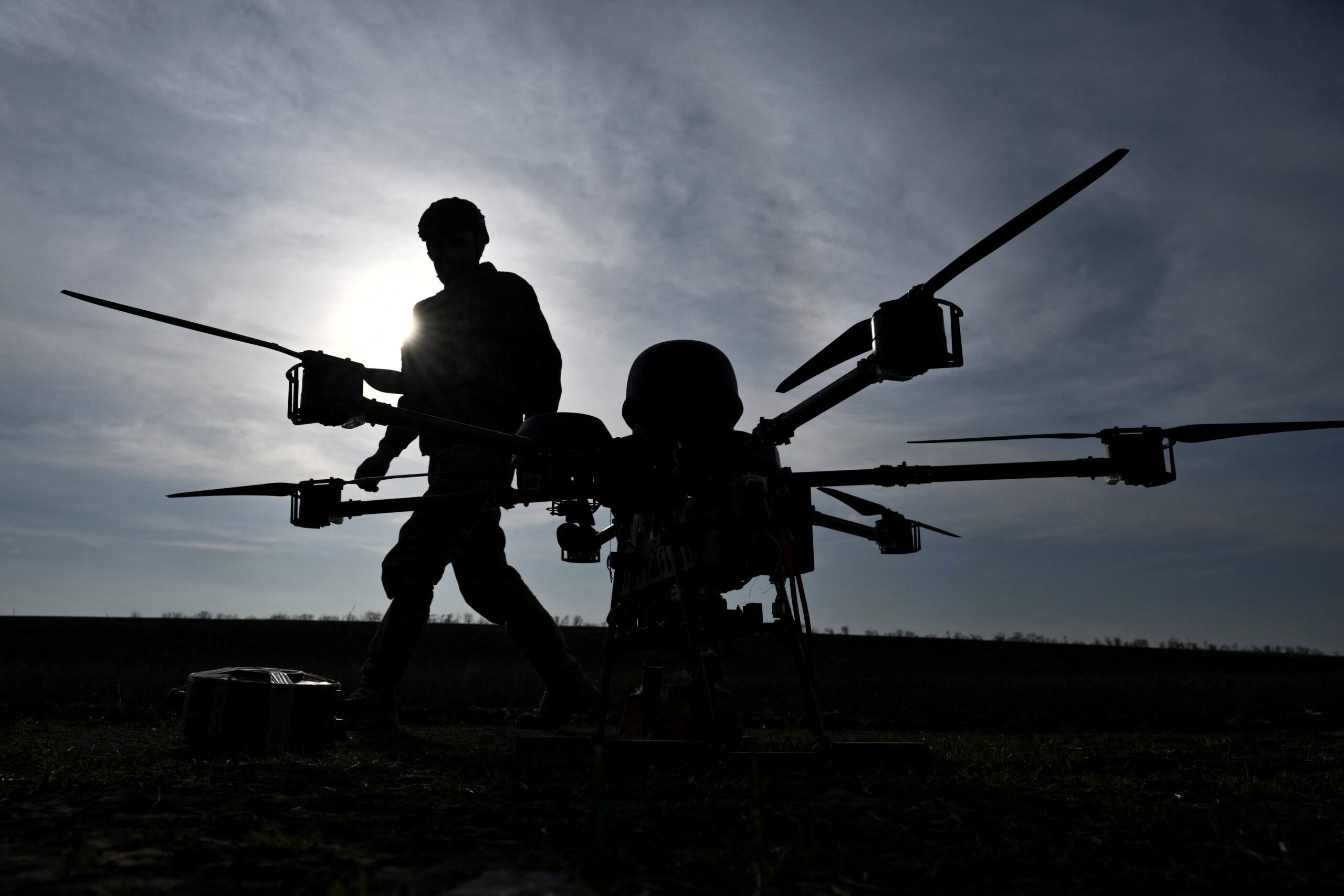
In an apparent reference to drones — which have been pivotal to the current wars in Iran, Ukraine, Sudan and Gaza — Pope Leo said “the development of ‘miniaturized’ weapons” in this new arms race has led to their use seeming “like a more viable option.”
AI and weapons
Pope Leo particularly noted autonomous weapons systems (a term often prefixed with “lethal”), which he said make war “more ‘feasible’ and less subject to human control.”
Currently, there is no internationally accepted legal definition of lethal autonomous weapons, which can range from semi-autonomous and supervised to fully autonomous, with no human control following launch.
With armed force as a last resort, Pope Leo said that “the development and use of AI in warfare must be subject to the most rigorous ethical constraints, to guarantee respect for human dignity and the sanctity of life and to avoid a race to develop such arms.”

“No algorithm can make war morally acceptable,” Pope Leo declared, underscoring his point that it is “not permissible to entrust lethal or otherwise irreversible decisions to artificial systems.”
While AI must reflect alignment with human moral values, Pope Leo dismissed the concept of “artificial moral agents” that would seek to replace a human being’s moral judgement, which involves “conscience, personal responsibility and the recognition of the other as a person.”
‘Concrete criteria’ required for the use of weapons in the AI age
Moreover, he said, three “concrete criteria for discernment” must be established for the use of weapons in an age of artificial intelligence: an “identifiable and verifiable” chain of responsibility that holds accountable “those who design, train, authorize and employ technology;” a moral timeframe for making “irreversible decisions” amid war where “speed and efficiency” are “never … the supreme motivating force;” and the identification and protection of civilians in conflict, rather than faceless strikes on non-combatants.
“Target selection and the use of force must not confuse combatants and non-combatants, nor ignore the impact on defenseless populations,” he said.
In addition, Pope Leo listed three “non-negotiable requirements” for weapons in the AI age. First, all systems in warfare must be able to retrace and reconstruct decision-making processes, “so that accountability and blame are not collapsed into ‘the machine.'” Second, the decision to use lethal force “must remain under effective, self-aware and responsible human control,” rather than “delegated to opaque or automated processes.” Third, a shared framework must be established to curtail the arms race and ensure protection for civilians and critical civilian infrastructures.
Greater danger, greater responsibility
Pope Leo urged “all key players” in AI — scientists, scholars, business leaders and politicians — to be “transparent and responsible,” keeping in mind “an acute awareness” of the full impact of their work in advancing technology, so as not to “deceive themselves into believing they are performing actions that are morally neutral and avoid questions about the ultimate ends that guide certain experiments.”
Such vigilance is especially crucial as “new wars … are perhaps even more dangerous than those of the past, since they tend to disregard all ethical limits.”
Pope Leo lamented that “decisions now seem to be driven almost exclusively by economic calculations, justified through media distortions, manufactured enthusiasm and ‘dreams’ that inevitably shatter, generating frustration and further violence.”
In nations wrought by “serious social tensions,” he said, “we cannot rule out the possibility that some leaders may consider armed conflict as an effective way of diverting attention from domestic problems and a cynical tool for managing difficulties.”
‘Let us disarm words’
Amid grave dangers of the moment, Pope Leo affirmed that Christians “do not merely gaze” upon the darkness “passively,” but “serve the good.” He said they “know the light and understand that the darkness has not overcome it and cannot defeat it,” a reference to John 1:5.
“Even in the darkest nights, the Lord raises up men and women who refuse to give up, who persevere in doing good, who protect the vulnerable and open pathways to reconciliation,” he said. “The memory of the saints, righteous people and the oft-forgotten peacemakers, show us that grace does not magically eliminate conflict, but instead it inspires active resistance to evil and an astonishing creativity in doing good.”
The “sum total of small and steadfast acts of fidelity,” he added, will build “the civilization of love.”
He pointed to his May 2025 call — which he repeated during the May 25 press conference announcing the encyclical’s release — to “disarm words” in order to “help disarm the world.”
Pope Leo also stressed the need to build justice-based peace that is not just “an absence of conflict at any cost.”
He urged “giving space to the perspectives and voices” of war’s victims to make people aware of the “abyss of evil inherent in war, and generally in all forms of violence.” He noted that “both history and memory” are essential to the prevention of war — along with dialogue, diplomacy, authentic multilateralism and prayer.
“Let us never tire of praying for peace,” he said, “and of committing ourselves to achieving it in our relationships and in society.”
– – –
Gina Christian is a multimedia reporter for OSV News. Follow her on X @GinaJesseReina.
